

Uzbekistan's export imbalance: textiles gained 28%, fruits and vegetables lost 11%
Uzbekistan's textile exports reached $2.4 billion in January–September 2026. This is 28.1% more than in the same period last year. At the same time, shipments of fruit and vegetable products abroad decreased by 10.9% to $1.3 billion. This was reported by the National Committee on Statistics. Textiles accounted for 9.3% of the country's total export volume. […]
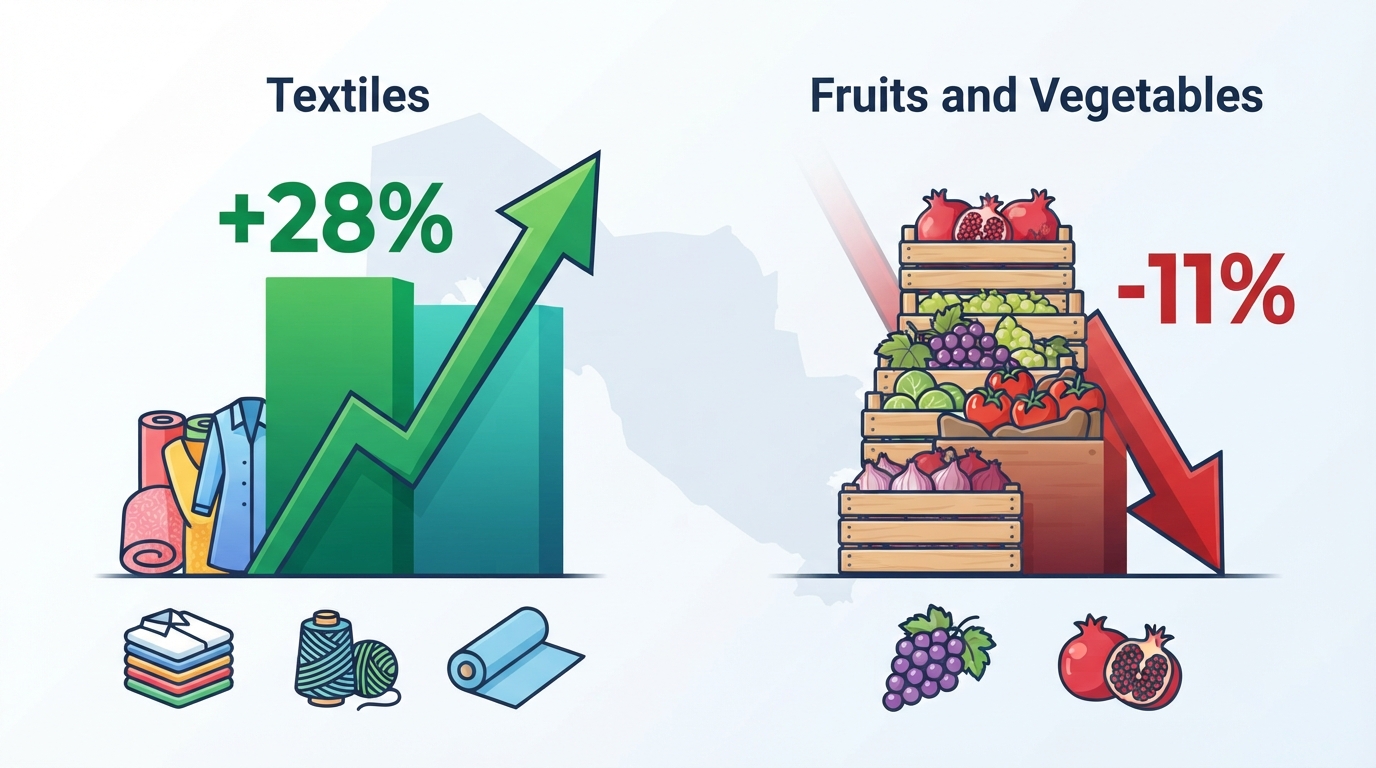
Uzbekistan's export imbalance: textiles grew by 28%, while fruits and vegetables dropped by 11%
Export of textile products from Uzbekistan in January–September 2026 amounted to $2.4 billion. This is 28.1% higher than the figure for the same period last year. Meanwhile, supplies of fruit and vegetable products abroad decreased by 10.9% to $1.3 billion. These data are provided by the National Committee on Statistics.
Textiles accounted for 9.3% of the country's total export volume. In the structure of textile supplies, the largest shares are occupied by finished products — 50.8% and yarn — 33%. These are followed by knitted fabric — 8%, fabrics — 5%, socks — 2%, and carpets — 1%.
Exports of textile yarn, fabrics, finished products, and similar goods increased by 25.9% and reached $1.48 billion. Supplies of clothing and accessories grew by 24.3% to $938.1 million.
Against this background, exports of fruits and vegetables show a decline. Over the nine months, 1.56 million tons of fruit and vegetable products worth $1.3 billion were sent abroad. Compared to January–September 2025, the physical volume of exports decreased by 3%, or 48.2 thousand tons, and its value decreased by 10.9%. This category accounted for 5% of Uzbekistan's total exports.
The largest reduction occurred in fruit exports. During the reporting period, their supplies amounted to 393 thousand tons worth $445.2 million. A year earlier, exports reached 413.7 thousand tons worth $489.2 million.
A different dynamic was observed for grapes: their physical volume slightly increased from 150.7 thousand to 151.6 thousand tons. However, supply revenue decreased from $145.6 million to $123 million.