

Uzbekistan to update school textbooks and expand dual education
On September 28, President of Uzbekistan Shavkat Mirziyoyev reviewed presentations on the reform of school and higher education. The meeting addressed the updating of textbooks, the development of dual education, and the operations of the branch of Liaoning Normal University in Uzbekistan. During the analysis of current textbooks, 1,257 errors were identified in 260 publications, and another 464 translation errors were found in 51 textbooks. Cases of inconsistency were also noted […]
Uzbekistan to update school textbooks and expand dual education
On September 28, President of Uzbekistan Shavkat Mirziyoyev reviewed presentations dedicated to the reform of school and higher education. The discussion focused on updating textbooks, developing dual education, and the activities of the branch of Liaoning Normal University in Uzbekistan.
An analysis of current textbooks revealed 1,257 errors in 260 publications, and another 464 translation errors in 51 textbooks. In addition, cases were noted where materials did not correspond to the age of the schoolchildren, as well as an excessive emphasis on rote memorization.
New educational materials are being created taking into account international experience. Textbooks for primary grades have been certified by the Finnish Education Alliance, while materials for mathematics, physics, chemistry, and biology for grades 5–7 are being developed based on Singaporean textbooks.
By 2027, it is planned to prepare 1,342 titles of textbooks and teaching materials.
The updated textbooks feature tasks aimed at developing critical and creative thinking, communication, teamwork, and the practical application of knowledge. The educational materials also include topics on career guidance, financial, digital, and environmental literacy.
A special emphasis is placed on teacher training. Professional development has already been completed by 110,000 primary school teachers. With the participation of Singaporean specialists, 121 master trainers and 739 mentor teachers have been trained, who in turn have trained another 90,000 educators.
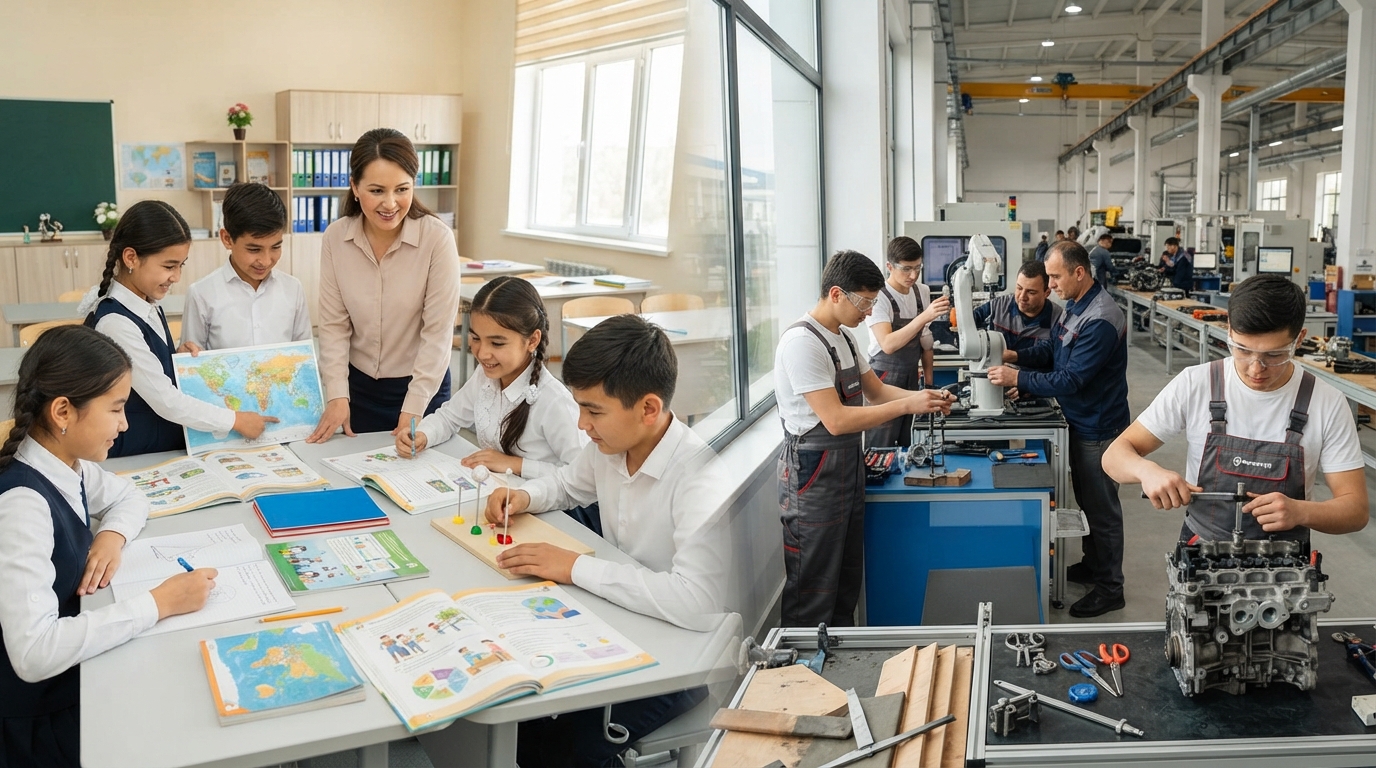
The meeting also discussed the expansion of dual education, which involves combining university studies with practical work at enterprises.
The goal has been set to cover at least 80% of third- and fourth-year students with this system — about 185,000 young people.
In the 2027/2028 academic year, it is planned to connect 75 universities and 3.5 thousand enterprises to the program. Practical training will be available to 12.5 thousand students.
Priority areas include engineering, manufacturing, construction, and agriculture.
As an example of the current system, the experience of the Andijan region was presented, where about 11,000 students undergo practical training at 2,000 enterprises.
It is proposed to provide enterprises participating in personnel training with a number of support measures, including subsidizing 50% of students' wages, customs and depreciation benefits, as well as preferences in public procurement.
The issue of the operation of the Liaoning Normal University branch in Khiva was considered separately.
The branch plans to open programs in international Chinese language education, international business, tourism management, and artificial intelligence. Instruction will be conducted in Uzbek, Chinese, and English.
The first student intake is scheduled for the 2026/2027 academic year. Graduates will be issued diplomas recognized in Uzbekistan and China.
The President instructed to ensure the quality of personnel training, link dual education with the real needs of regional enterprises, and carefully organize student admission to the branch of the Chinese university.