

All school textbooks in Uzbekistan will be updated to the new alphabet by 2031 — Deputy Minister
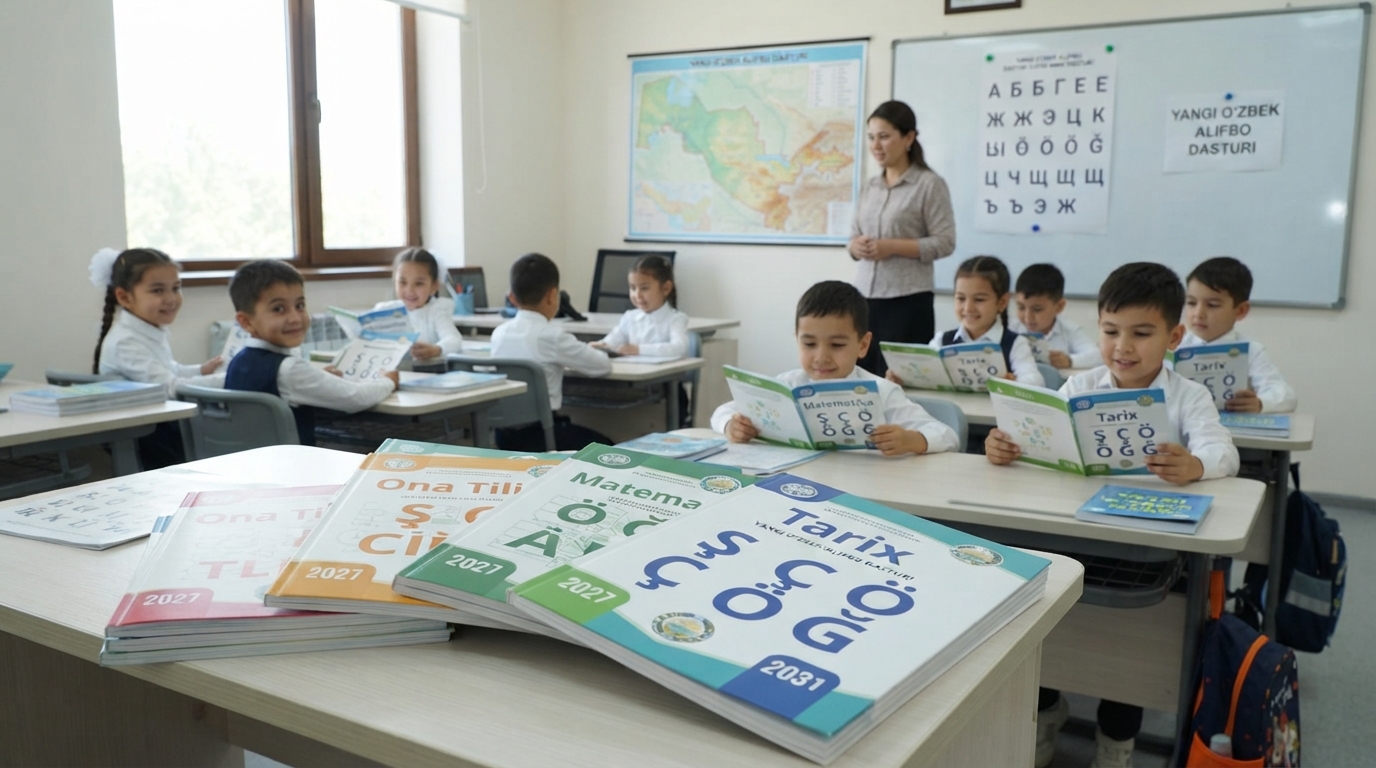
In Uzbekistan, it is planned to completely update textbooks to match the new Uzbek alphabet during the years 2027–2031. The first grades will transition to the new textbooks earlier than the others. The Deputy Head of the Ministry of Preschool and School Education reported that seminars for teachers are being prepared. According to him, the transition will not require additional funds.
All school textbooks in Uzbekistan will be updated to the new alphabet by 2031 — Deputy Minister
School textbooks in Uzbekistan are planned to be fully transitioned to the updated Uzbek alphabet between 2027 and 2031. This was announced on September 19 at a Senate session by the Deputy Minister of Preschool and School Education, Azizbek Turdiev, in response to questions from senators.
Senator Dilbar Suvonova asked whether deadlines had been set for revising textbooks, teaching aids, curricula, and literature in connection with the alphabet change, and whether additional funds had been allocated for this purpose.
The Deputy Minister stated that the Cabinet of Ministers must approve a program of measures to implement the law. Executive authorities and the Academy of Sciences have already submitted their proposals, including the Ministry of Preschool and School Education regarding the updating of textbooks and the training of teachers and students.
According to him, textbooks are already being updated according to an established schedule: for 1st grade — annually, for grades 2–4 — once every three years, and for grades 5–11 — once every five years.
"Starting from 2027, after the law comes into force, we will print first-grade textbooks using the new alphabet in any case," the Deputy Minister said.
He added that between 2027 and 2031, all school textbooks will be updated as part of the regular republication cycle.
"From 2027 to 2031, all our textbooks will be completely updated. [...] From this perspective, no additional funds will be required," the ministry representative stated.
The ministry is also preparing measures to adapt teachers and students. According to the Deputy Minister, training seminars are planned to be held in the preschool and school education system before the start of the new school year, from August 24 to 28.
"Teachers and students will be informed about these innovations and will be able to adapt to them," he noted.
The issue of which alphabet will be used for exams after the reform was also discussed separately at the meeting.
"After the law comes into force, exams will be conducted in the alphabet established by law. There will be no issues in this regard. We are ready for this," the Deputy Minister declared.
He noted that in primary school, instruction using the updated alphabet will begin with new textbooks, while materials for older grades are expected to be replaced gradually.
Earlier, the Senate approved changes to the Uzbek alphabet based on the Latin script. The new version will consist of 28 letters and one apostrophe, instead of the current 26 letters and three letter combinations. It is proposed to use Ş, Ç, Ö, and Ğ instead of Sh, Ch, Oʻ, and Gʻ, and to exclude Ng from the alphabet as a separate unit.