

School education in Uzbekistan: What has changed in 35 years?
**School Education in Uzbekistan: What Has Changed in 35 Years?**
It has been 35 years since Uzbekistan gained independence from the former Soviet Union. During this period, along with other sectors, a number of innovations have been implemented in the education system. Schools have been built, and new programs aimed at improving the content and quality of education have been introduced. Nevertheless, one question remains open: to what extent does the quality of education students receive meet the demands of real life? What is the difference between schools on the eve of independence and those of today?
### Differences in the Number of Schools and Students
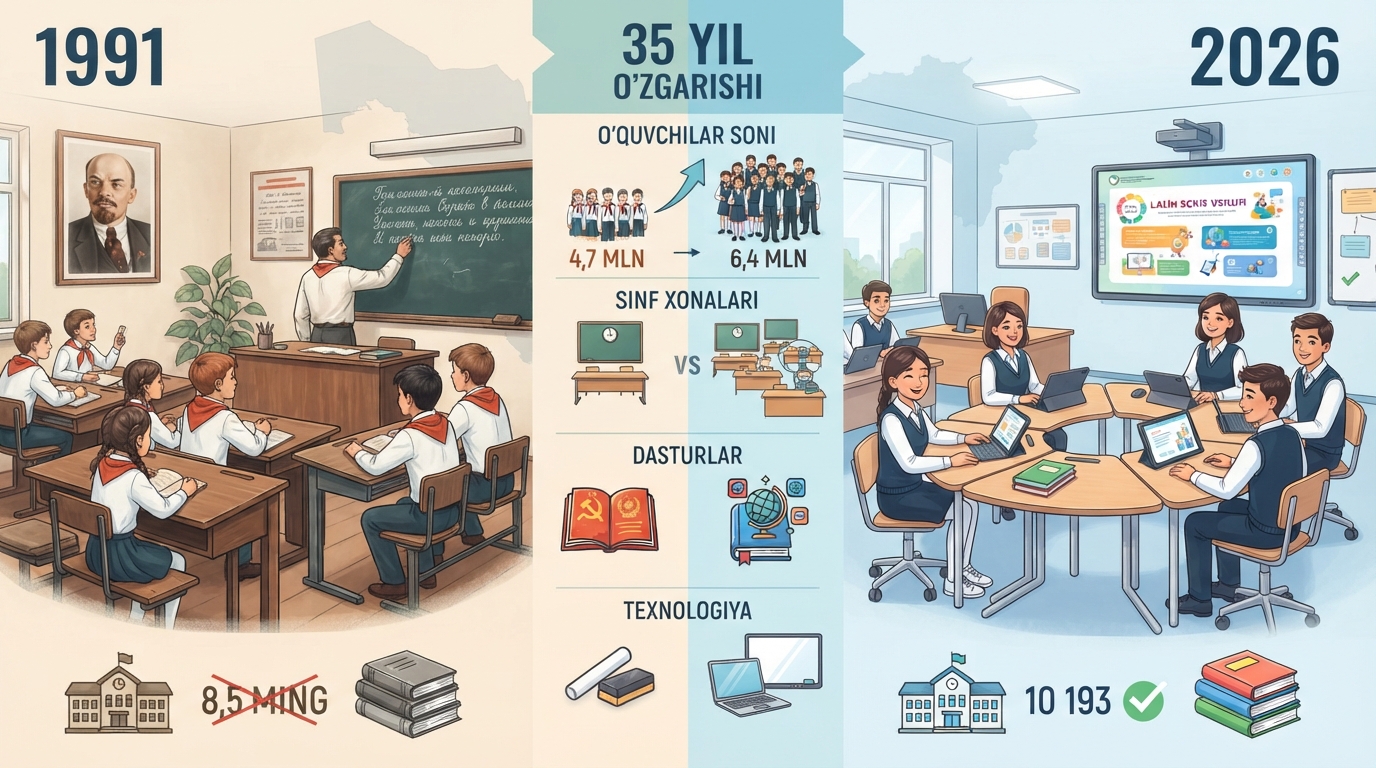
As the population of the republic has grown over the past 35 years, the number of schools and students has also increased. For instance, in 1990-1991, there were 8.5 thousand schools operating in Uzbekistan. A total of 4.7 million students studied in them.
By the beginning of 2026, the total number of schools in the country reached 10,193. This means that an average of 48 schools were built in each year of the past 35-year period. Currently, the number of school students stands at 6.4 million. While the number of students has increased by 1.7 million during the independence period, it has grown by an average of 48.5 thousand per year.
Against the backdrop of rapid population growth, it can be assumed that the construction of new schools is lagging behind the increase in the number of students. This is because in 1990-1991, 1.2 million students, or 26.1 percent of the total, studied in two or three shifts. Today, more than 60 percent of children receive education in two shifts. There are over five million student places in the country's schools. In other words, there is a shortage of places for more than one million students.
### The Impact of Politics on Education
The aspect of the Soviet-era education system in Uzbekistan that fundamentally differs from the current one is that the system previously operated on the basis of communist ideology. Political ideas were embedded into the curricula; in particular, Soviet ideology held a leading position in history, political science, and literature classes.
After independence, certain changes took place in state governance. Naturally, this process also affected education. New programs for the development of the system were developed, and textbooks were continuously updated.
### Changes in Educational Stages
In the decades preceding independence, school education lasted 7, 8, and 10 years. On July 2, 1992, the Law "On Education" was adopted. According to the document, general secondary education was established to consist of three stages: primary education (grades 1-4), basic education (grades 5-9), and secondary education (grades 10-11).
Based on the "National Program for Personnel Training" adopted in 1997, nine-year general secondary and three-year secondary specialized vocational education were introduced. According to the program, education was divided into the following types: preschool education; general secondary education; secondary specialized, vocational education; higher education; postgraduate education; personnel training and retraining; and extracurricular education.
The program noted that until 1997, the educational process in the country was designed for students with an average level of knowledge. It was also emphasized that even in 1997, curricula were not completely free from Soviet ideological remnants.
Starting from the 2017/18 academic year, the 11-year compulsory general secondary education system was restored. This initiative was reportedly widely supported by the public, parents, and 9th-grade graduates.
Starting from 2019, a new type of Presidential and specialized schools began to open in the republic. 3,120 specialized schools were opened. Thus, alongside ordinary general education schools, educational institutions based on nurturing relatively stronger and more talented youth separately also emerged. In turn, the activities of private schools also expanded.
Currently, more than 40 percent of schools are equipped not with traditional chalkboards as before, but with electronic smartboards. Many classrooms are equipped with computers, and digital education is also in the development stage.
### The Number of Textbooks Has Increased
In the early years of independence — 1991–1995 — 164 titles of school textbooks were published in Uzbekistan. In particular, 44 titles of completely new textbooks and 21 titles of alternative textbooks were created.
By 2023, based on advanced foreign experiences, new-generation textbook sets created in 775 titles for primary grades began to be printed in 72 million copies. In addition to textbooks, methodological manuals for teachers and multimedia applications were also created. For the first time in Uzbekistan's school education, the practice of adapting the best educational literature from abroad for schools was also established. For example, starting from the 2023/24 academic year, students in grades 1-11 began to be taught using English textbooks and methodologies. Within the framework of a project implemented in cooperation with the international organization USAID, a total of 46 titles of educational literature were adapted, translated, and piloted in Uzbekistan.
### Past and Present Ministers of Education
Over the past 35 years, the public education system has been headed by more than ten ministers. Among them, the person who remained in office the longest was Jura Yuldashev. Jura Yuldashev led the system from 1991 to 2000, which is nine years. Other ministers mostly worked in this position for three to five years, and some for just one year.
The minister of public education after Jura Yuldashev was Risoboy Jurayev (August 11, 2000 – May 7, 2004).
The third minister is considered to be Turopjon Jurayev, who led the system from May 7, 2004, to March 26, 2008. The remaining ministers and their years of administration are as follows:
Gayrat Shoumarov, April 28, 2008 – February 26, 2010;
Avazjon Marahimov, March 2, 2010 – June 30, 2011;
Temur Shirinov, July 4, 2011 – February 7, 2013;
Ulugbek Inoyatov, February 7, 2013 – June 20, 2018;
Sherzod Shermatov, June 20, 2018 – November 17, 2021;
Bakhtiyor Saidov, November 17, 2021 – December 30, 2022;
Hilola Umarova, December 30, 2022 – July 14, 2025.
Currently, the name of the ministry is the Ministry of Preschool and School Education, and the system has been headed by E'zoza Karimova since July 14, 2025.
### The Quality of Education Remains Urgent
Although a number of changes have been implemented in the system over the past 35 years, it is still too early to say that all children are being provided with quality education. This can be understood from the large share of children who attend tutors to repeatedly memorize the textbooks they were taught in order to enter higher education institutions, those who received low scores in the PISA exam, or those who could not even collect the minimum score to enter university. In other words, it is said that school education is not being mastered sufficiently.
Furthermore, there are not enough professional educators who provide quality education. For example, at a meeting in January 2022, the president stated that out of 504 thousand educators, 12 percent had secondary specialized education, and 38 percent had no qualification category at all.
In the first half of 2026, the average nominal monthly salary in Uzbekistan reached 7.1 million soums. However, the average salary of education sector representatives did not even reach 5 million soums. That is, the salary of most teachers is still lower than the average wage in the republic. Naturally, material interest also plays its role in the development of the sector and in shaping young people as mature specialists through education.
Uzbekistan aims to fundamentally increase the quality of education by 2030. In particular, the task has been set to include the country among the top 30 countries in the world in the PISA international assessment program. There are also major plans to improve infrastructure in the education system. For example, the "Uzbekistan – 2030" strategy aims to bring the provision of general secondary schools with electronic smartboards to 100 percent and to increase the share of educators with higher education to 99 percent by 2030.