

Independent Uzbekistan in a period of great change
The material is devoted to the important political, economic, and social changes that have taken place in Uzbekistan over the past 35 years of independence, in particular, the large-scale reforms of 2016–2026 and the process of building a New Uzbekistan.
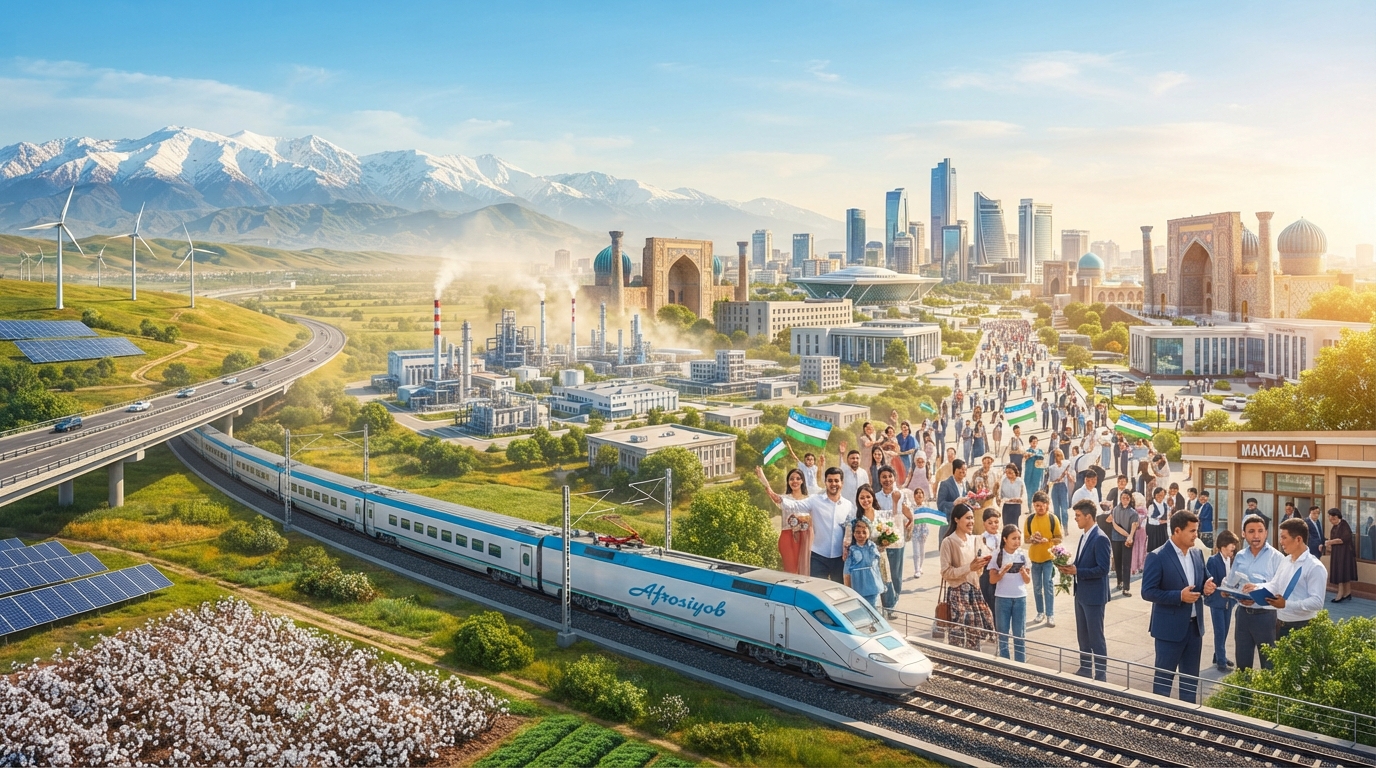
Independent Uzbekistan: A Time of Great Changes
During the 35th anniversary of Uzbekistan's independence, profound political, economic and social changes have taken place in the country. The society dreamed of by our ancestors was built, and Uzbekistan gained its place and voice on the world map as a sovereign, democratic and legal state.
From Independence to New Uzbekistan
In 1991-2016, a number of measures were taken to strengthen the independence of the state, create the foundations of national statehood and ensure stability. State symbols, the national currency (sum) and the Main Dictionary - the Constitution were adopted. A modern national army capable of ensuring the security of the country was created. Despite conflicts and internal threats in the region, peace and interethnic harmony were maintained.
The colonial economy left over from the Soviets was abolished and an independent economy was established. The planned economy based on administrative-command was abandoned, a transition to a market economy was made, and all forms of ownership, including private property, were created. The economic crisis was overcome, the economy stabilized, and grain and energy independence was ensured.
In 1992–2016, Uzbekistan rapidly developed industrial sectors, in particular, the fuel and energy, mechanical engineering, chemical, light and food industries. Work was carried out to renew and modernize mechanical engineering and metal processing, the chemical and petrochemical industries. New industries such as the automotive industry (GM Uzbekistan), the petrochemical industry (Shurtan and Ustyurt gas and chemical complexes) appeared.
Sectors aimed at processing agricultural raw materials (cotton and grain) at local enterprises and producing finished products were expanded. Small business and private entrepreneurship, including service provision and small-scale production, were supported by the state. A railway and tunnel through the Kamchik Pass, as well as the high-speed Afrosiab train, were put into operation.
Reform Strategy and a New Model of Development
Since 2016, a period of profound changes has begun in the history of the country, which laid the foundation for the creation of a New Uzbekistan. This period has been marked in the history of our country as a period of radical change, renewal and rapid modernization. Large-scale reforms launched under the leadership of President Shavkat Mirziyoyev have radically changed the political, social and economic face of the country.
During this period, the principle of “For the sake of human dignity” has become the main criterion of state policy. Unprecedented results have been achieved in developing the national economy, increasing people's well-being and strengthening Uzbekistan's influence in the international arena.
The new economic policy began to be implemented on the basis of well-thought-out, scientifically based and strategic goal-oriented programs. Under the initiative and leadership of President Shavkat Mirziyoyev, three major strategies were developed and consistently implemented: “Strategy of Actions on Five Priority Areas of Development of the Republic of Uzbekistan in 2017–2021”, “Development Strategy of New Uzbekistan for 2022–2026” and “Uzbekistan - 2030” strategy. They brought the country's development to a new level.
These programs logically complement each other and create a solid legal and strategic basis for building the foundation of New Uzbekistan and the Third Renaissance, modernizing public administration, liberalizing the economy and accelerating the development of the social sphere.
“Strategy of Actions on Five Priority Areas of Development of the Republic of Uzbekistan in 2017–2021” was the first major step, covering all spheres of life in the country. The State Program for 2017, “The Year of Dialogue with the People and Human Interests,” approved within its framework, radically reformed state and public administration under the principle “The people should serve our people, not state institutions.” In order to create a system of direct communication with the population, the Virtual Reception of the President of the Republic of Uzbekistan and People’s Receptions in places were established.
It was during this period that the problems that had accumulated in the economy over many years were resolved, in particular, the introduction of free convertibility of the national currency and the removal of barriers to foreign trade. These reforms opened the Uzbek market to foreign investors.
The “Development Strategy for 2022–2026” was its logical continuation, aiming to glorify human rights and dignity in the country, develop a free civil society, and improve the national economy based on innovations. It set as a priority the sharp increase in the volume of gross domestic product, a significant reduction in poverty and the creation of wider opportunities for entrepreneurship. The annual programs adopted within the framework of these strategies ensured that a large part of the state budget was directed to the social sphere, to improve education, healthcare and infrastructure.
The “Uzbekistan-2030” strategy, adopted as a continuation of previous strategies, is the main programmatic document that determines the directions of economic, social and political development of the country in the medium and long term, putting human interests first. Its updated version, approved by the Presidential Decree of February 16, 2026, serves to transfer reforms to a more precise, measurable and digitized system based on global economic and technological changes, real conditions and proposals from the general public.
The strategy aims to bring the education, healthcare and social protection systems to a completely new level in terms of quality; To ensure sustainable economic growth, it includes a significant increase in gross domestic product and per capita income; the introduction of water-saving technologies, ensuring environmental sustainability and the transition to a "green economy"; the creation of a public service apparatus, the fight against corruption and the independence of the judiciary; the continuation of an open, pragmatic and active foreign policy, and strengthening security.
In its updated version, the GDP volume was increased from the previously set $160 billion to $240 billion, and per capita income from $4,000 to $5,800 in the first version.
Economy and Entrepreneurship
In 2016-2026, Uzbekistan demonstrated high growth rates while maintaining macroeconomic stability. In particular, in 2025, the GDP volume grew by 7.7 percent and reached $147 billion.
As President Shavkat Mirziyoyev noted at the inauguration ceremony of new facilities on August 25 of this year to mark the 35th anniversary of the country's independence, "The last ten years have been forever sealed in the history of our country as a stage in building the foundation of a new Renaissance - the Third Renaissance."
During this period, the volume of the economy increased by more than 2.5 times. $160 billion in foreign investment was attracted to the sectors of the economy, 2,163 large industrial projects worth a total of $76 billion were launched, and almost 6 million people were provided with permanent jobs.
The economy is growing rapidly. New factories are being built every month. For example, on August 25, President Shavkat Mirziyoyev launched 163 new facilities in one day.
The volume of foreign direct investment attracted to the country's economy has also increased several times. As a result of the privileges created for foreign investors, the freedom of the foreign exchange market and the guarantee of property rights, Uzbekistan has become a center of investment attractiveness in Central Asia. In the industrial sphere, great steps have been taken towards transforming from a traditional raw material exporter into a country producing finished products with high added value. The textile, automotive, chemical, construction materials and electrical engineering sectors have become the engines of economic growth.
Foreign trade turnover has also expanded significantly. Uzbekistan has established trade relations with more than 160 countries of the world. The share of finished products in the export structure has increased, and products under the "Made in Uzbekistan" brand have taken a worthy place in world markets. The process of joining the World Trade Organization (WTO) has been accelerated, which opens up new horizons for national products to enter international markets.
During this period, a significant increase in real incomes of the population and a sharp reduction in the level of poverty have been ensured. In particular, in the period from 2016 to 2025, the real gross income of the population in Uzbekistan increased by almost 2 times, and the poverty rate decreased from 17 percent in 2021 to 5.8 percent by the end of 2025.
A technological revolution has been carried out in the industrial sector in the new Uzbekistan. In the chemical and gas-chemical industries, the expansion of the Shurtan gas-chemical complex, the construction of new metallurgical plants, and the transition to a fully domestic processing system for cotton raw materials in the textile sector were historic events. Uzbekistan, which previously exported cotton as a raw material at a low price, has today become a leading exporter of ready-made clothing and high-quality yarn. The introduction of the cluster system in this area has ushered in a new era in agriculture.
Forced labor, including child labor, has been completely eliminated in agriculture. This reform has raised Uzbekistan's international profile and led to the Cotton Campaign lifting its boycott of Uzbek cotton. The government has subsidized land use efficiency, drip irrigation, and water-saving technologies. These measures have made it possible to maintain and increase agricultural production even in the face of global climate change and water scarcity.
There have also been fundamental changes in the business sector. Based on President Shavkat Mirziyoyev's idea that "If the people are rich, the state will be rich and powerful," a wide path has been opened for the development of entrepreneurship. Unjustified inspections of their activities have been banned, and licensing and permitting procedures have been simplified. As a result of tax reforms, the value-added tax (VAT) rate has been reduced from 20 percent to 12 percent, which has left trillions of dollars at the disposal of business representatives.
The share of small business and private entrepreneurship in GDP exceeded 50 percent, and it became an extremely important sector that provides employment for the population. In each mahalla, preferential credit programs were launched to develop entrepreneurship, support women's and youth entrepreneurship. Thanks to these measures, hundreds of thousands of new jobs were created, and the state financially encouraged the entrepreneurial initiatives of the population. Through family entrepreneurship programs, thousands of families in remote villages gained a stable source of income.
During this period, the face of our country was radically changed. Large-scale construction and improvement works were carried out in the road transport, energy and utility sectors. Thousands of kilometers of internal roads were asphalted, and highways of international importance were reconstructed. Electrification work in the railway transport system was accelerated, and the service of high-speed "Afrosiyob" trains covered new regions, including Khiva and Bukhara.
In the energy sector, a leading position has been taken in Central Asia in the transition to renewable energy sources - solar and wind energy. In cooperation with Saudi Arabia's ACWA Power, the UAE's Masdar, and other large international companies, large solar and wind power plants have been launched in the Samarkand, Navoi, Jizzakh, Surkhandarya, and Bukhara regions. These green energy projects have become an important step in ensuring the country's environmental sustainability and eliminating electricity shortages.
Urbanization processes have also reached a new stage. Within the framework of the "Obod Qishloq" and "Obod Mahalla" programs, hundreds of remote areas have acquired a modern look, drinking water and natural gas networks have been laid. The pace of construction of affordable and comfortable multi-storey housing for the population in cities has increased dramatically. Mega-projects such as the New Tashkent City project have been launched, which demonstrate the country's economic power and architectural potential.
Human capital
In 2016-2026, social policy became the most central direction of state activity. The problem of poverty, which had been hidden for many years, was recognized and systematic work was launched to reduce it. A system of working by neighborhoods was introduced, and targeted support was provided to the stratum in need of social protection through the "Temir Daftar", "Ayollar Daftar" and "Yoshlar Daftar". They were later combined into a single electronic platform. The introduction of the positions of "governor assistants" and "youth leaders" in neighborhoods increased the effectiveness of solving problems on the spot.
A fundamental shift was made in the development of the education system. The level of coverage of preschool education increased from 27 percent in 2016 to 74 percent by 2026. Major reforms have also been carried out in the field of higher education: the number of higher education institutions has increased from 60 to more than 210, and the level of coverage has increased from 9 percent to more than 43 percent. Branches of prestigious international foreign universities have been opened in the country, and higher education institutions have been granted academic and financial independence. A network of Presidential schools, creative schools, and specialized schools has been created in the school education system, which has become an important factor in educating talented young people.
Great work has been done to reform the healthcare system, in particular, to raise primary health care to a qualitatively new level, digitize medicine, and bring specialized medical services closer to the regions. The ambulance system has been completely updated with modern vehicles and communication systems. The volume of free medical services for low-income families has been expanded, and state medical insurance mechanisms have begun to be gradually introduced.
Opening up to the world
A country that once lived by a policy of closure has since 2016 adopted the principles of openness, pragmatism, and good neighborliness in its foreign policy. The Central Asian region has been identified as a priority direction of the state's foreign policy. Friendly and mutually beneficial agreements have been reached with neighboring countries - Kazakhstan, Kyrgyzstan, Tajikistan, and Turkmenistan - on border issues, water and energy issues, and transport corridors that have been unresolved for many years. As a result, a completely new atmosphere of trust and cooperation has been formed in Central Asia.
Uzbekistan's activity in international structures such as the UN, the Shanghai Cooperation Organization, the Organization of Turkic States, and the Organization of Islamic Cooperation has also increased significantly. Global and regional initiatives put forward by the country, including the UN resolution on declaring the Aral Sea region a zone of environmental innovations and technologies, have been widely supported by the international community. Uzbekistan has been recognized as an active force in world politics, a guarantor of regional security and stability.
A new stage of development
In short, in 1992-2026, Uzbekistan became a truly independent, market-based state with a stable economic development. In particular, 2016-2026 was not only a period of achieving high macroeconomic indicators for Uzbekistan, but also a historical stage when the worldview of society changed, and the people's confidence in the state and the future strengthened. Consistent reforms, starting with the Strategy of Actions and continuing with the Development Strategy and the "Uzbekistan - 2030" strategy, ensure the country's sustainable development.
Today's New Uzbekistan is a powerful state with a rapidly developing economy, an increasing real standard of living for the population, support for entrepreneurship, high attention paid to education and science, and a voice in the international arena.
The victorious path that has been covered so far has proven that the country is moving in the right strategic direction, has created a solid foundation for building the foundations of New Uzbekistan and the Third Renaissance. Increasing the well-being of the population, ensuring a peaceful, dignified and prosperous life for citizens remains the priority direction of the ongoing reforms.
It should be emphasized that the results achieved have laid the foundation for further development and solving tasks that will determine the future of New Uzbekistan. This period will be written in golden letters as a very important and turning point in the history of the state, when all aspects of social life have been completely transformed and it has become a rapidly developing modern country!
Adil Olimjanov,
Center for Economic Research and Reforms