

Uzbekistan to redraw the industrial map of its regions
Uzbekistan intends to focus on the industrial specialization of its regions and the development of territories with the greatest potential. One of the key tasks will be to identify the three most promising districts and three driver industries for each region. This was discussed at a seminar in the Ministry of Economy and Finance. Participants discussed how to bring the development of regional industry and the work of industrial headquarters to a new level. […]
Uzbekistan intends to update the industrial map of its regions
Uzbekistan plans to focus on the industrial specialization of its regions and the development of territories with the greatest opportunities. One of the main tasks will be to identify three of the most promising districts and three driver industries for each region.
This was discussed at a seminar in the Ministry of Economy and Finance. Participants discussed how to bring the development of regional industry and the work of industrial headquarters to a new level.
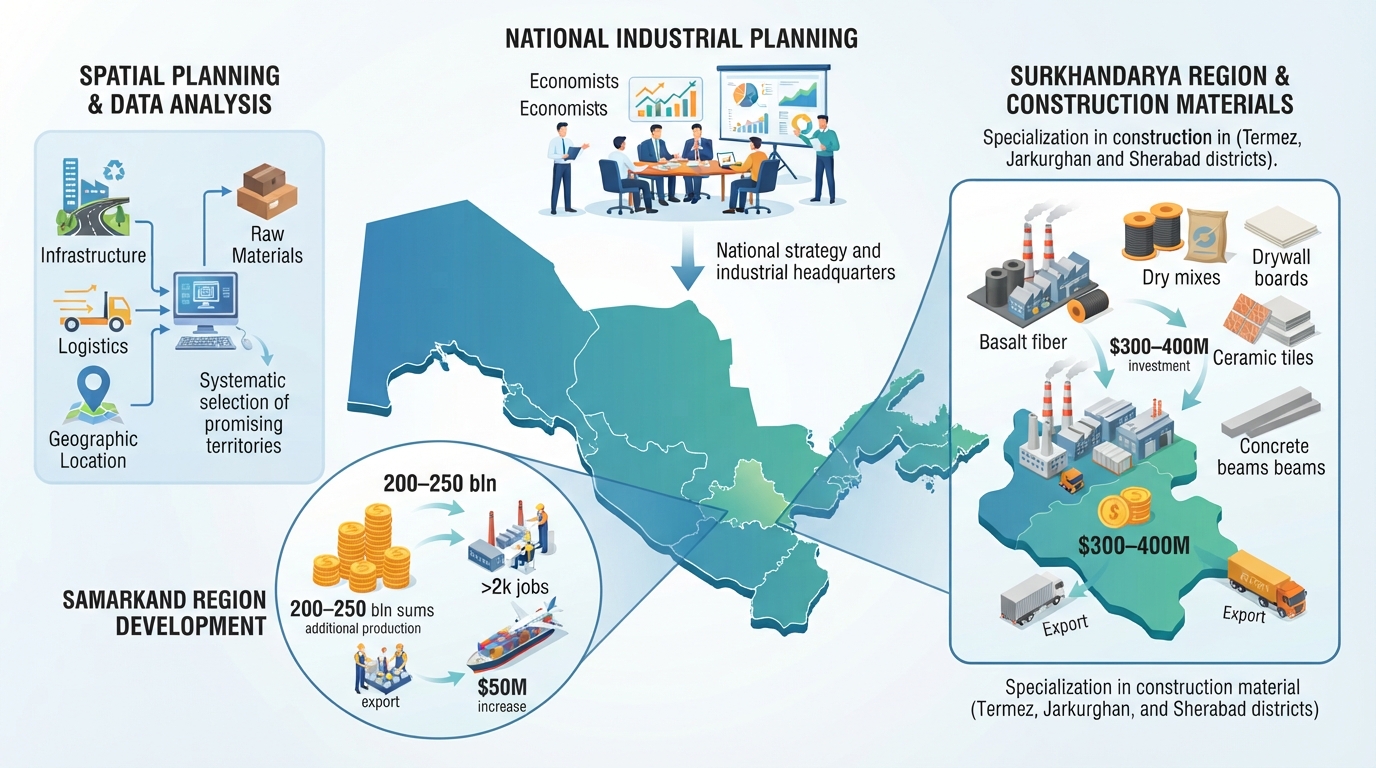
When selecting promising territories, they intend to consider not only the presence of existing enterprises, but also the region's specialization, raw material base, infrastructure, geographical location, and logistical capabilities. This approach should show more accurately which types of production are advisable to develop in specific districts.
Samarkand Region was cited as an example. Here, according to the seminar participants' estimates, the development of territories with high industrial potential can ensure an annual output of additional products worth 200–250 billion soums, create more than 2,000 jobs, and increase exports by $50 million.
Special attention was paid to Surkhandarya Region. It is proposed to specialize the Termez, Jarkurgan, and Sherabad districts in the production of building materials. In the future, they want to turn the region into a southern hub for the production and export of these products.
At the same time, this is not only about expanding already operating enterprises. As part of the industry's development, it is planned to attract $300–400 million in investments and increase the output of basalt products, dry building mixes, drywall, ceramics, and reinforced concrete products.
Another direction was the introduction of spatial and territorial planning practices in Uzbekistan. It is assumed that this will help to determine in advance where and which industrial facilities it is advisable to locate, taking into account infrastructure, raw materials, logistics, and the characteristics of a specific territory.
To prepare spatial strategies and regional plans, it is planned to involve international companies in the field of urban planning. Their services will be paid for using funds from the World Bank's "Medium Cities" project.
Thus, the industrial policy of the regions is intended to be built not only around attracting individual investors, but also around the systemic specialization of territories. The ministry believes that this will allow for more efficient use of the industrial potential of the districts, the development of driver industries, and targeted work with troubled enterprises.