

Where does Uzbekistan's food economy "brew"?
Based on the results of the first half of 2026, the main centers of the food industry in Uzbekistan were the city of Tashkent and the Tashkent and Samarkand regions. These three regions account for almost half of all food products produced by large enterprises in the country. According to the National Statistics Committee, from January to June 2026, large enterprises in Uzbekistan produced food products worth 75.2 trillion soums. Compared to the same period […]
Here's the rewritten text in Russian:
**Where is Uzbekistan's food industry concentrated?**
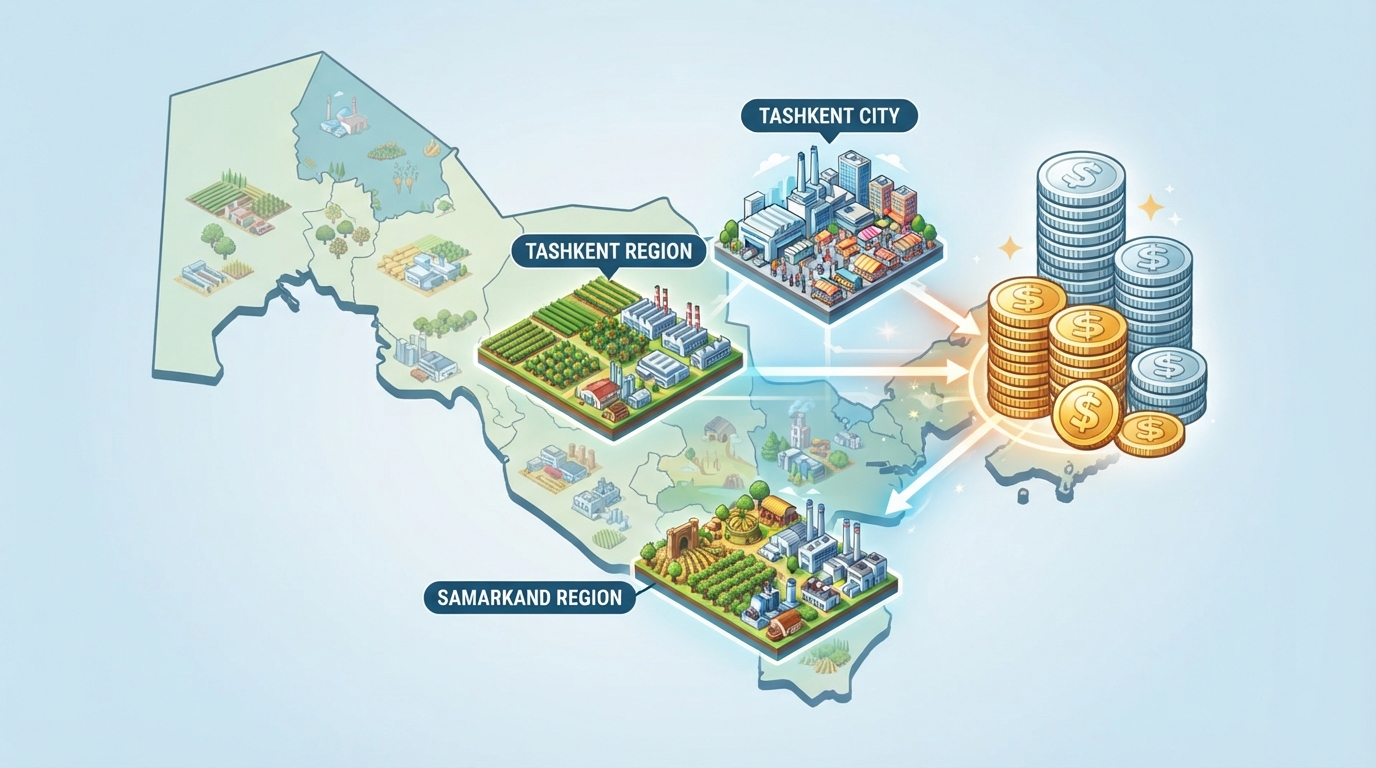
According to the results of the first half of 2026, the key centers of Uzbekistan's food industry were the city of Tashkent, as well as the Tashkent and Samarkand regions. These three regions together produce almost half of all food products manufactured by large enterprises in the country.
According to the National Statistics Committee, from January to June 2026, large enterprises in Uzbekistan produced food products worth a total of 75.2 trillion soums. This figure is 12% higher than the same period of the previous year.
The capital continues to hold a leading position in the industry. In the first six months, Tashkent produced food products worth 13.9 trillion soums. Tashkent Region ranks second with a production volume of 10.7 trillion soums, and Samarkand Region ranks third with a production volume of 10.1 trillion soums.
Together, these three regions produced food products worth 34.7 trillion soums, accounting for approximately 46% of the total output of large food processing enterprises in the country.
Thus, Uzbekistan's food industry exhibits a pronounced territorial concentration: almost every second soum earned from food production by large enterprises is accounted for by Tashkent, the Tashkent, and Samarkand regions.
This distribution of leaders indicates where a significant portion of the food industry's production capacity is currently concentrated. The capital city maintains its status as the largest center, while the neighboring Tashkent region and Samarkand also form a powerful industrial cluster.
Tashkent's leadership seems logical, as the capital is the largest market in the country and an important center for the processing, production, and sale of finished food products. At the same time, the nearly comparable figures for the Tashkent and Samarkand regions indicate that the food industry is gradually forming several large regional centers rather than being concentrated solely in the capital.