

Uzbekistan is turning into a talent hub for the Korean automotive industry
Uzbekistan and South Korea are gradually changing their model of automotive cooperation: from the supply of finished cars to technologies, production, and personnel training. A training program for car body painting specialists is being launched in Uzbekistan, the graduates of which will be able to apply for jobs in South Korea. Starting from 2026, KIA Auto is launching training workshops for body painting in Uzbekistan. As noted by the master's student […]
Uzbekistan is gradually becoming a human resources base for the Korean automotive industry
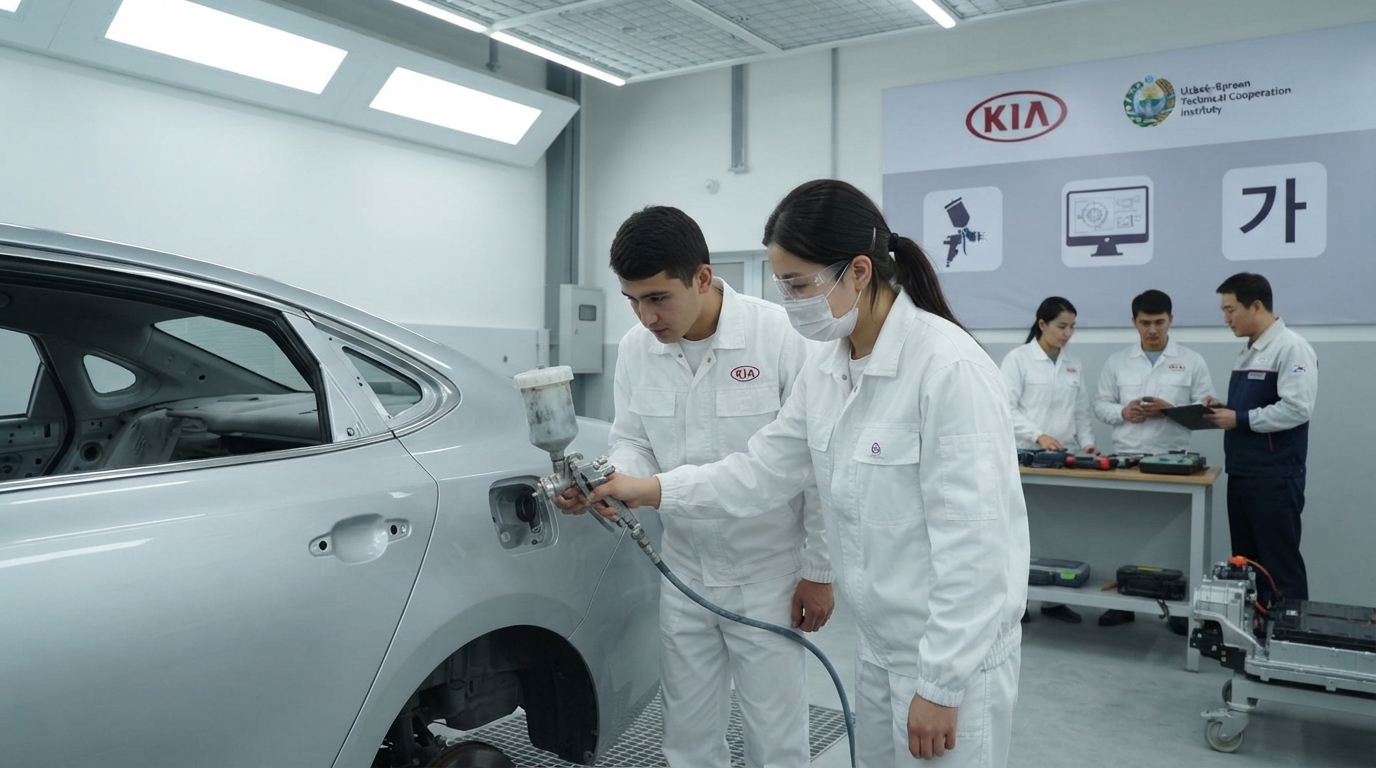
Uzbekistan and South Korea are gradually changing the format of their automotive cooperation: instead of supplying finished cars, the focus is shifting to technology, production, and specialist training. A training program for car body painters is launching in Uzbekistan, and its graduates will be eligible to apply for jobs in South Korea.
Starting in 2026, KIA Auto will launch body painting training workshops in Uzbekistan. As noted by Abduaziz Khidirov, a master's student at the Academy of Public Administration under the President, the republic will become the first foreign country where such a specialist training format will be implemented.
The program is designed for three months. During this time, future specialists will study car maintenance and body painting technologies, the basics of production culture, as well as the Korean language up to the TOPIK 1 level.
The key feature of the project is its practical focus on subsequent employment. Upon completion of the training, graduates will be able to apply for jobs at Korean enterprises under the E-7 skilled worker visa.
At the same time, the very opportunity to attract foreign workers directly to car body painting in South Korea only became available starting in 2025.
Thus, this is no longer just an educational initiative. Korean automakers are getting a chance to build a talent pool in advance, trained in accordance with the requirements of a specific industry and production culture.
The shift in the cooperation model is taking place against the backdrop of a noticeable reduction in car imports from South Korea to Uzbekistan, the analyst notes.
In 2024, Uzbekistan imported 74.7 thousand passenger cars worth $1.28 billion. More than 80% of the supplies came from China, while South Korea ranked second among the main suppliers.
However, already in January–February 2025, passenger car imports overall decreased almost fourfold to 4,439 cars, and their value fell more than fivefold to $75.9 million.
Supplies from South Korea also decreased: in the first two months of 2025, 1,191 passenger cars were imported from South Korea to Uzbekistan, which is approximately 3.5 times less than a year earlier.
Based on the results of the first half of 2025, 24.3 thousand passenger cars worth $422.1 million entered the country. South Korea accounted for 8.34% of these imports.
At the same time, the structure of the automotive market is also changing. The presence of electric vehicles is becoming increasingly noticeable. For instance, in June 2025, out of 5,968 imported passenger cars, 4,567 had an electric powertrain—more than 76% of the monthly imports.
Against this background, training specialists for the Korean automotive industry acquires a broader economic meaning.
For Korean companies, this format allows them to create a talent pool not by searching for ready-made specialists, but by training them directly in Uzbekistan.
For Uzbekistan, the benefit lies elsewhere: along with specialist training, professional competencies, production standards, and practical skills demanded by the modern automotive industry are entering the country.
In essence, a new bilateral chain is being formed: technology and training come to Uzbekistan, and trained specialists get the opportunity to integrate into the production chains of Korean companies.
For labor migration, this could also mean a gradual transition from predominantly low-skilled employment to professions requiring specialized training and certified skills.