

Uzbekistan approved the Customs-2030 strategy: what's changing?
Presidential Decree No. PF-174 introduces a large-scale reform of Uzbekistan's customs service, from simplifying export procedures to implementing AI and constructing new terminals.
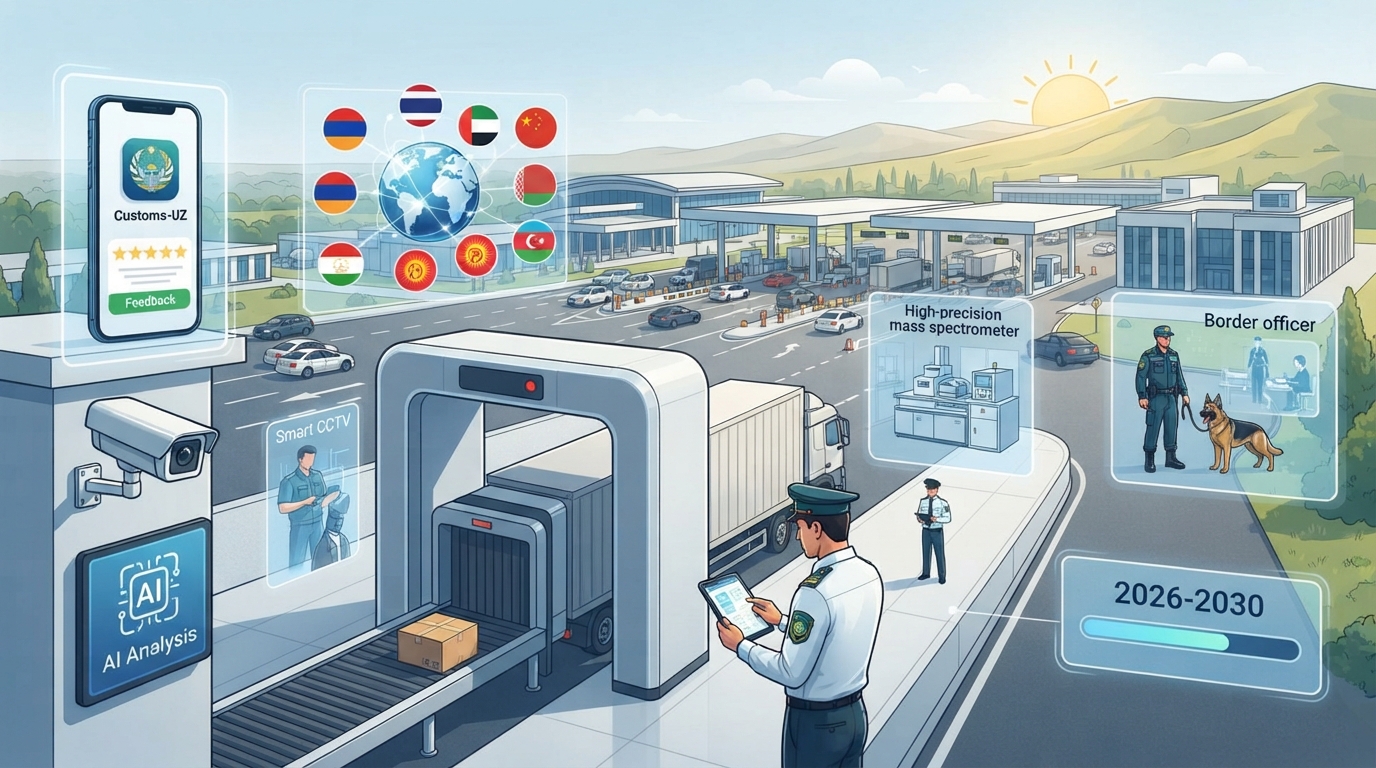
Uzbekistan has approved the "Customs 2030" strategy, aimed at modernizing the customs service and implementing advanced administrative practices. The corresponding decree (PF-174) "On measures to improve the activities of state customs service bodies and introduce modern approaches to customs administration" was signed by President Shavkat Mirziyoyev on August 27, 2026.
The "Customs of the New Uzbekistan - 2030" strategy, designed for the period from 2026 to 2030, covers a wide range of reforms, including improving the business environment, digitalization, human resources policy, and developing border infrastructure.
**Simplifications for Business**
Effective September 1, 2026, the following requirements for participants in foreign economic activity will be abolished:
* Advance payment to a foreign partner for imports without a foreign trade contract.
* Securing 50% of revenue for exports without a contract.
* Mandatory provision of payment guarantees (letter of credit, bank guarantee, insurance policy) when exporting goods in national currency.
Starting October 1, 2026, low-risk foreign trade participants with a valid VAT certificate will be able to offset VAT amounts when importing goods. Fees and charges for customs clearance, phytosanitary certificates, fumigation, and certificates of origin for exports will be reduced by 30%.
Starting January 1, 2027, a flat customs duty rate of 20% of the customs value of goods, but not less than $2 per kilogram, will be introduced. Participants in the "20,000 Entrepreneurs - 500,000 Qualified Specialists" program will be entitled to a 120-day payment plan for customs duties.
Until December 2027, individuals will be allowed to export duty-free cash currency equivalent to $10,000. By the same deadline, citizens of Uzbekistan will be allowed to temporarily import vehicles registered abroad for non-commercial purposes, provided they secure payment of customs duties. This will allow compatriots working in Kazakhstan and Russia to freely enter and exit the country in their personal vehicles.
Particular attention is being paid to resolving disputes over customs value: a specialized department is planned to be established at the customs clearance center and an online appeals mechanism for these matters will be launched.
**Digital Services and Feedback**
By January 2028, a unified mobile application is planned to be launched, integrating all customs services, including integration with the Unified Portal of Interactive Government Services. An interactive mobile application, "Customs Fine," is also being developed to inform individuals about imposed fines and facilitate their payment.
By 2030, the number of electronic services provided through the "Yagona Darcha" (Single Window) information system will increase from 41 to 49. A "Feedback" module will be introduced to collect feedback from entrepreneurs, which will be used to rank customs offices, posts, and individual employees.
**Digitalization and Artificial Intelligence**
A Digital Technology Center will be established within the State Customs Committee, based on the existing Information and Communications Technology Department. The department has been tasked with implementing artificial intelligence to determine commodity codes according to the foreign trade nomenclature, analyze X-rays and documents, and utilize voice assistants.
Planned solutions include an AI-based customs value control model, a system for automatically determining the type of vehicle based on its dimensions, and a Smart CCTV intelligent video surveillance system with facial recognition, automatic license plate reading, and suspicious activity detection. By 2030, the share of customs clearance without human intervention is planned to reach 60%.
**Customs Administration Reform**
The strategy envisages reducing the average customs clearance time for imports to 2 hours and for exports to 30 minutes. The share of customs revenue in GDP is planned to reach at least 4.4%.
The state institution "Bozhkhona-Service" will be transformed into a limited liability company with the attraction of foreign investment. The Cabinet of Ministers has been instructed to determine its operating procedures within two months, including the implementation of the unified digital information ecosystem "Safe Customs."
**Combating Illegal Trafficking and the Canine Service**
High-precision mass spectrometry technologies are planned to be introduced at the Central Customs Laboratory for the rapid detection of unidentified chemicals, new psychoactive substances (NPS), synthetic drugs, and fentanyl analogues.
To develop canine services, the National Canine Center plans to train and improve the skills of 220 canine handlers for customs and other law enforcement agencies. The creation of an "Express Carrier" institute is also planned to ensure the prompt and high-quality delivery of international courier shipments.
**International Cooperation**
The document provides for the preparation of customs cooperation agreements with Armenia, Thailand, and Indonesia, as well as the development of statistical data exchange with the United Arab Emirates.
Uzbekistan intends to participate in the Digital Customs and Logistics Alliance (CATS) project within the framework of the Central Asia Regional Economic Cooperation (CAREC) program of the Asian Development Bank.
In conjunction with the World Customs Organization, it is planned to develop a new version of the commodity nomenclature for foreign economic activity of Uzbekistan for 2027, as well as expand the number of foreign countries with which the practice of mutual recognition of authorized economic operators has been implemented. Corresponding agreements have already been signed with China, Russia, Belarus, and Azerbaijan.
A separate area of focus is negotiations with Kyrgyzstan on the operation of the Rishtan, Vodiil, Okkiya, and Chashma border customs posts based on the one-stop border post principle. Technical agreements on information exchange with Belarus, Russia, and Tajikistan on rail freight transportation are also planned.
**Infrastructure Development**
The khokimiyats of the Andijan, Surkhandarya, and Tashkent regions have been instructed to allocate land within three months for the construction of customs terminals and parking areas near major border posts.
Between 2026 and 2030, border posts are planned to be gradually equipped with electronic scales, license plate recognition cameras, body scanners, and GPS seals, as well as the reconstruction of a number of border posts and administrative buildings.
Specific projects include the construction of a new border crossing point, Khalkobod-Karabai Konisbayev, on the border with Kazakhstan in the Yangiyul district, at a cost of $220 million, scheduled for completion in 2027. The project also includes the creation of conditions for state oversight bodies at the Sirdaryo railway border crossing.
**HR Policy and Anti-Corruption**
Customs authorities will gradually implement the ISO 37001:2025 international standard for anti-corruption management systems, as well as an "Integrity Monitoring" system to analyze the lifestyle of employees in positions with a high corruption risk. International internships for graduates of universities ranked in the top 300 of the QS World University Rankings, as well as training courses with foreign specialists, are also planned.
Customs employees will also receive an expanded social package, including service housing and mortgage subsidies.
**Strategy Financing**
The total capital investment required to implement the strategy in 2026–2030 is estimated at 1.7 trillion soums.
The bulk of the funds—over 1.5 trillion soums—is provided by the extra-budgetary funds of the State Customs Committee, with the remainder coming from the state budget and the Digital Technology Center.