

Some customs requirements will be abolished, export-related fees will be reduced by 30 percent
Uzbekistan has abolished some prepayment requirements for imports and exports, as well as the obligation to submit permits and certificates at customs for a number of products, effective September 1. Some customs duties on exports will be reduced by 30 percent.
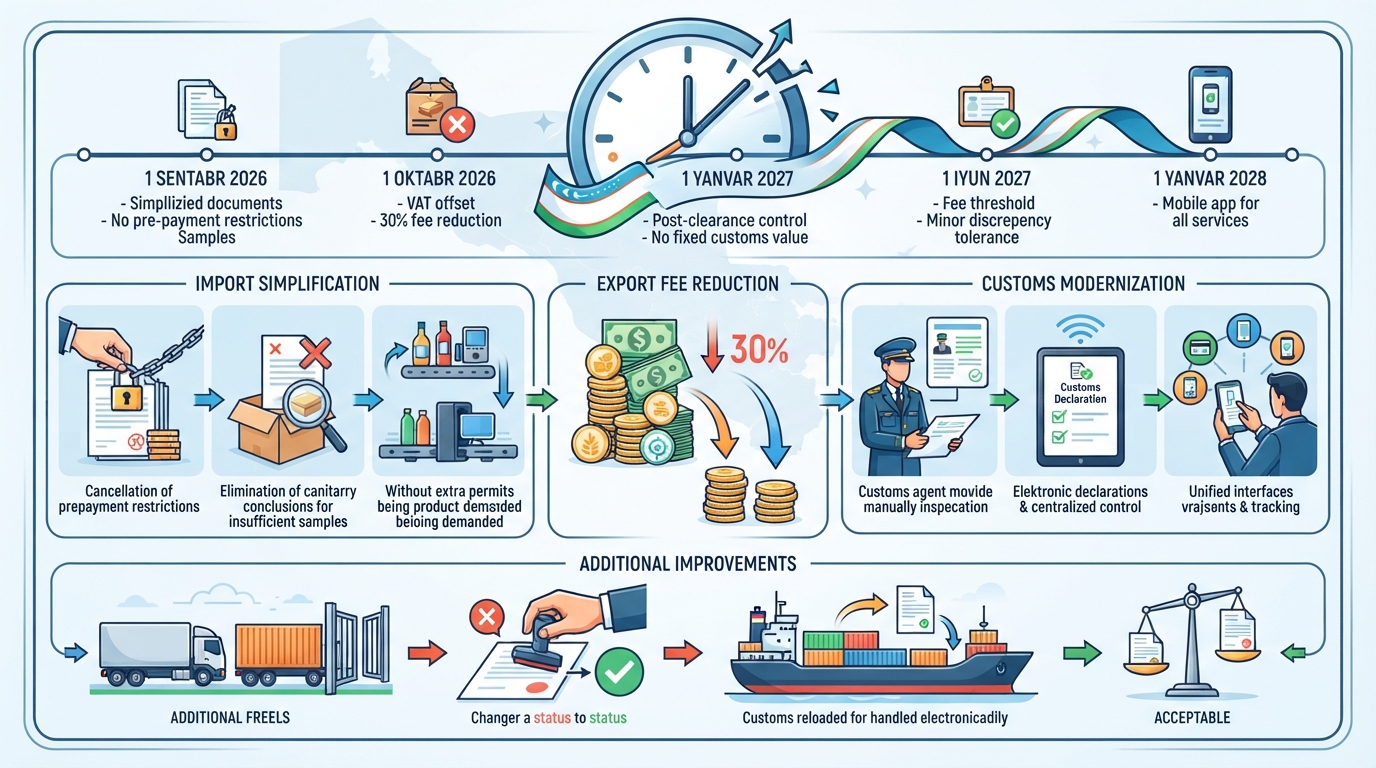
Some customs requirements will be abolished, export-related fees will be reduced by 30%
In Uzbekistan, new procedures will be introduced to increase the convenience of customs procedures for entrepreneurs and simplify customs administration. This is stipulated in the Decree of the President of Uzbekistan dated August 27, 2026 “On measures to improve the activities of the State Customs Service and introduce modern approaches to customs administration”.
Starting from September 1, 2026:
* The restriction on making an advance payment to a foreign partner when importing on the basis of an invoice without concluding a foreign trade agreement will be abolished.
* The requirement to provide an advance payment of 50% of the proceeds when exporting on the basis of an invoice without a contract will also be abolished.
* The requirement to provide an advance payment or provide guaranteed forms of payment, such as a letter of credit, bank guarantee or insurance policy, when exporting goods in national currency will also be abolished.
* In cases where there are insufficient samples for testing food products, the requirement to issue a sanitary and epidemiological conclusion will be canceled. For this, the authorized body will submit a letter stating that the quantity of products is insufficient for testing.
* When importing biological assets and new chemicals, food additives, polymers, perfumery and cosmetic products, the requirement to provide a permit, a certificate of state registration of medicines and medical devices during customs clearance will be canceled. In this case, the availability of relevant permits and certificates will be monitored during the mandatory conformity assessment and the process of issuing a sanitary and epidemiological conclusion.
From October 1, 2026:
* Tax authorities will create the opportunity to offset the amounts of value added tax paid for imported goods to participants in foreign economic activity with a low risk level and an active VAT certificate.
* Due to the digitization and improvement of export control processes, the amount of fees and charges for customs clearance, phytosanitary certification, fumigation, and certificates of origin of goods will be reduced by 30 percent.
From January 1, 2027:
* The customs value of goods imported by participants in foreign economic activity with a low risk level will be controlled after they are released for free circulation.
* For the purpose of customs value control, it is prohibited to establish a fixed customs value for goods. Also, the practice of making preliminary decisions on customs value will be introduced.
* The practice of using price data from official dealers and distributors in customs value control will also be established.
From June 1, 2027:
* If the single customs duty on goods imported by individuals for non-commercial purposes is less than the customs duties payable, these duties will not be collected.
* If during customs control minor discrepancies are detected between the certificate of origin of the goods and the documents submitted, which do not affect the nature of the goods, this will not be a basis for rejecting the certificate.
Until January 1, 2028:
* A mobile application will be introduced that will allow entrepreneurs to make all services and payments provided by customs authorities in one place.
Additional changes:
* An ecological certificate for export will be issued upon the exporter's voluntary application.
* The processes of submitting, reviewing and sending a response to an application for the refund of overpaid or collected customs duties will be centralized and transferred to electronic form.
* A number of processes will be simplified by directly re-issuing the customs cargo declaration.
* If the legislative requirements for re-export are met and the control of the goods at the border customs post is completed, previously paid customs duties and taxes will be refunded.
* If a properly executed certificate of origin is presented within one year after the goods are placed under a customs regime providing for the payment of customs duties, the most favored nation or free trade regime is restored.
* If during customs control after the goods are released for free circulation it is found that the certificate of origin was incorrectly issued, the right to restore tariff preferences is granted if the correct certificate is presented within three years from the date of customs clearance. With the exception of cases provided for by international norms.
* A procedure for submitting transit declarations before the vehicles arrive at the border customs post is introduced.
* A new simplified procedure for submitting the initial customs cargo declaration is introduced. According to it, the initial declaration is accepted by the authorized bodies as an application for obtaining certificates and permits for goods.
* Certificates and permits for goods with a low risk level are issued in advance on the basis of the initial declaration. The practice of re-reflecting these documents in the final declaration is abolished.
* Goods allowed to be imported on the basis of a preliminary declaration are released in an accelerated manner upon arrival at the border customs post, depending on their level of risk. The stages and mechanism for applying this procedure are determined by the Customs Committee.
* Financial penalties for overdue receivables for export transactions are not applied to authorized economic operators.