

UzAuto Motors No Longer Dictates the Rules? How the Uzbek Auto Market is Changing
For several decades, the Uzbek car market was dominated by a seller's dictatorship. Customs duties, complex certification procedures, and non-tariff barriers consumed almost half the cost of a car. Meanwhile, domestic choice was severely limited, while demand continued to grow.
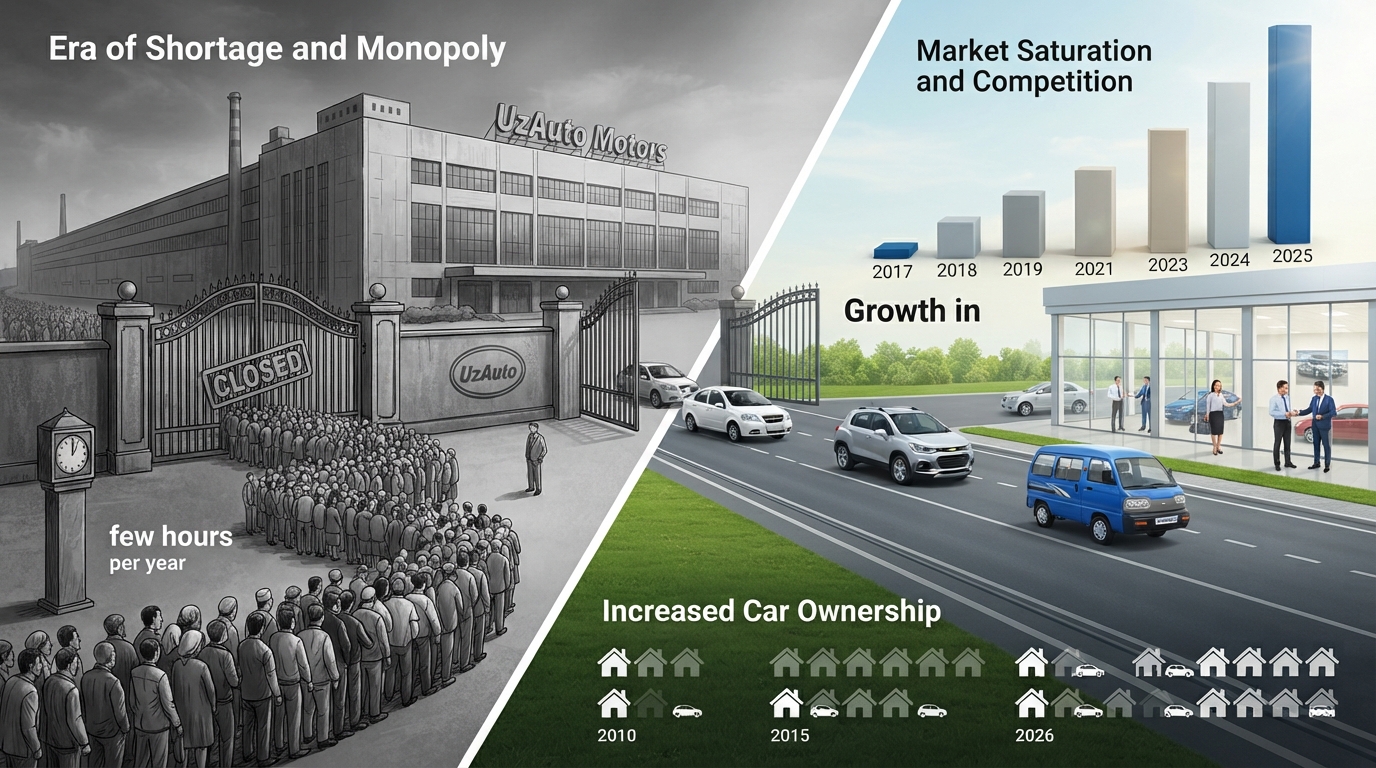
Is UzAuto Motors Losing Its Monopoly? The Transformation of Uzbekistan's Automotive Market
For decades, Uzbekistan's auto market was dominated by sellers. High customs duties, complex certification procedures, and non-tariff barriers nearly doubled the cost of cars. Meanwhile, the choice of models on the domestic market was extremely limited, yet demand continued to grow.
Until recently, closed dealerships, opaque contracting schemes, artificial hype, and endless queues were commonplace. Opportunities to purchase a desired car only arose twice a year and lasted only a few hours. All of this was perceived as an integral part of everyday life.
However, this is changing.
Let's consider the sales policy of UzAuto Motors, a key player and de facto monopoly on the domestic market. Initially, the automaker offered installment plans for the Tracker and Onix models with a down payment. Later, this option was also extended to the Damas.
But the real turning point occurred when installment plans became available for the most sought-after car in the country – the Cobalt. The buyer pays 50% of the price upfront, with the remainder payable over eleven months, with no overpayments.
Furthermore, the company has introduced direct discounts: the price of the Cobalt has been reduced by 15 million soums, and the Captiva by 45 million soums.
Why did an auto giant with a nearly thirty-year history suddenly make such concessions? Was the company just trying to be generous? Of course not. Deep economic factors are behind these unprecedented steps.
**Factor One:**
Market supply is growing at a tremendous rate. Judge for yourself: in 2017, only 135,000 cars were produced in the country. And in 2025, that number will reach almost 458,000! In just eight years, production volumes have increased almost 3.5-fold. With the exception of the pandemic year of 2021, the domestic auto industry has been developing almost non-stop.
This has impacted the daily lives of citizens. Look at how the car ownership rate has grown. In 2010, only one in five families owned a car. By 2015, that number had risen to nearly one in two. And by 2026, statistics show 61 cars per 100 households.
In other words, today, a significant majority of families in the country own their own vehicle. These figures indicate that the market is rapidly becoming saturated. The shortage is a thing of the past, and now a truly fierce battle for every buyer is beginning in Uzbekistan.