

Why are cars starting to get cheaper in Uzbekistan?
In three years, the price of used cars in Uzbekistan has fallen by almost 30 percent. An analysis of tens of thousands of ads shows that it's not just about the age of the cars. The price of car scarcity has changed.
**Why are car prices falling in Uzbekistan?**
A decrease in car prices is observed in Uzbekistan. An analysis of more than 61 thousand car sales ads over four years revealed that prices have decreased in all 90 comparable groups, the average decrease was about 33.5%. This is due not only to the age of the cars, but also to the general cheapening of the market.
**Decline in the price index**
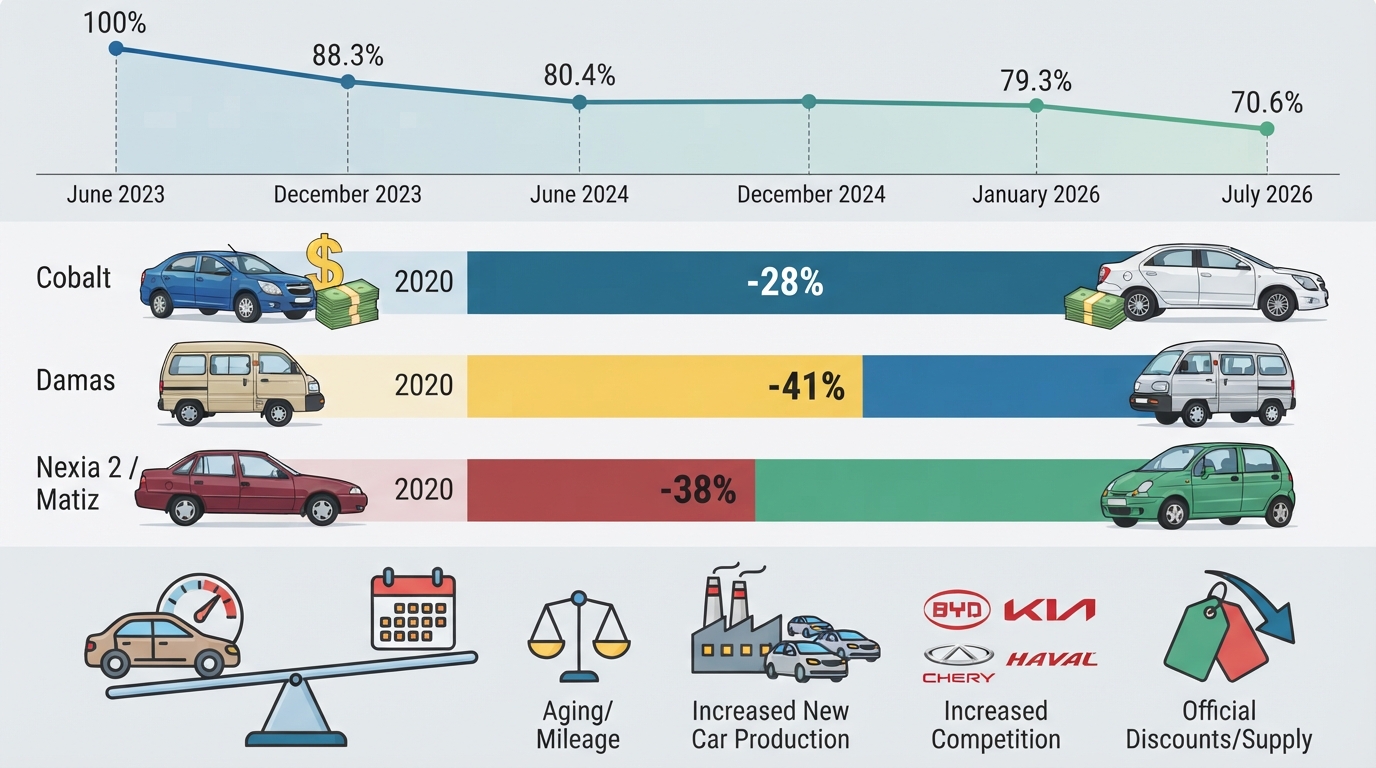
Since the market structure is constantly changing, researchers have compiled a price index. This index allows you to compare the prices of cars of the same model and age in different months. If the indicator in June 2023 is taken as 100, then by July 2026 the index had dropped to 70.6.
The decrease was not uniform:
* In December 2023, the index was at the level of 88.3.
* By June 2024, it fell to 80.4.
* Throughout 2025, the market remained at almost the same level.
* In the first half of 2026, the price decline continued, from 79.3 in January to 70.6 by July.
This change cannot be explained solely by the dollar exchange rate, since by the end of 2025, the soum had strengthened against the dollar by about 6.9%, and annual inflation had decreased to 7.3%. So, the car as an asset has really become cheaper.
**Price declines by model**
Price declines were observed across almost all model lines:
* While 2020 Cobalts were on sale for $13,000 in 2023, by 2026 their average price was around $9,350, which represents a 28% decrease.
* The decline was even stronger for some older and cheaper cars: the 2020 Damas fell by 41%, the 2013 Nexia 2 and the 2012 Matiz by 38%.
**Reasons for price declines: age and market changes**
It is natural for a car to become cheaper as it ages. However, research shows that about half of the price decline can be explained by the car's age, and the rest is not related to the car's age, but to changes in the market price level.
For example, a three-year-old (2020 model) Cobalt in 2023 cost about $13,000. It is now six years old and has an average price of $9,350. Today, the average price of a three-year-old (2023 model) Cobalt is about $10,800. So the difference between the price of a three-year-old and a six-year-old Cobalt is about 13%, but the 2020 Cobalt lost about 28% of its value during the study period. This means that half of the price decrease is due to the age of the car, and the other half is due to changes in the market.
**The disappearance of market scarcity**
A few years ago, buying a new car was often not only about its official price. You had to get a contract, wait for the car, or buy it for an additional fee. This situation also affected the secondary market, keeping the price of used cars high. Even if the car is old, the shortage will cover a significant part of its depreciation.
The data shows that this mechanism is disappearing. The sale of almost new cars has ceased to occupy its former place in the secondary market.
**Growth and competition in the new car market**
In the first quarter of 2026, 91,088 new cars were sold in Uzbekistan, which is 20.9% more than in the same period last year. UzAuto Motors' market share fell from 82.6% to 79.3%, while BYD Uzbekistan Factory occupied 8.6% of the market. The increase in the number of new manufacturers (BYD, Kia, Chery, Haval, etc.) is changing the market position of the used car dealer. A car in the secondary market now competes not only with other used cars, but also with new cars.
**Manufacturer discounts**
The new discount program announced by UzAuto Motors (up to 15 million soums for Cobalt MCM, up to 45 million soums for Captiva, and 15 million soums for Damas) is also affecting the secondary market. The price of a new car acts as an upper limit for the price of a used car. If a new car becomes cheaper, the seller of a three-year-old car will also be forced to reduce the price. Thus, the manufacturer's discount will gradually be transferred to the entire secondary market.
**The importance of mileage and year of manufacture**
Research shows that the year of manufacture of a car explains the price more than the mileage. For example, the average price of a 2020 Cobalt with up to 50,000 kilometers in 2026 is about $10,200, while cars with 200,000–400,000 kilometers will cost $8,700. Even if the car has traveled several hundred thousand kilometers, the difference in price will be about 15%, which is much less than expected.
**Future Trends**
The pressure on the used car market remains. The new car market is growing, the number of manufacturers is increasing, and UzAuto Motors is taking advantage of discounts and preferential financing programs.
Currently, in Uzbekistan, a three-year-old Cobalt retains about 81% of the price of a new car, a Damas retains 80%, and a Tracker 2 retains 79%. For comparison, in the first quarter of 2026, the average three-year-old car in the United States sold for about 66% of the original suggested retail price. However, markets differ in factors such as taxes, import restrictions, income, fleet composition, access to credit, and repair costs.
Previously, the secondary market was supported by a shortage of new cars, queues, and limited choice. Now this mechanism is weakening. New cars are becoming more numerous, and so are manufacturers. The buyer has more opportunities to finance the purchase of a car. New cars compete through discounts. New cars are becoming less and less common in auctions. The secondary market is also gradually paying the car owner not for scarcity, but for the model, year of manufacture, condition, and subsequent use.
**Research methodology**
The study included more than 61,000 car sales announcements for the period from May 2022 to July 2026. About 42 thousand ads were used to analyze prices, and the results were compared with data from Avtoelon and OLX. Ads with installment payments, loans, exchanges, and unusual prices were excluded from the sample. Most of the data reflects the price requested by the seller, not the actual transaction price. The study shows the general dynamics of the secondary car market, but does not take into account the technical condition of each car, mileage, reliability, and other features of specific transactions.