

The 6-month-long Cobalt is now on sale: how has the car market changed?
The introduction of discounts and even interest-free payments for the Cobalt has become the most striking and symbolic example of how much the automotive market has changed. Kun.uz lists five main factors explaining the decline in car prices in the domestic market.
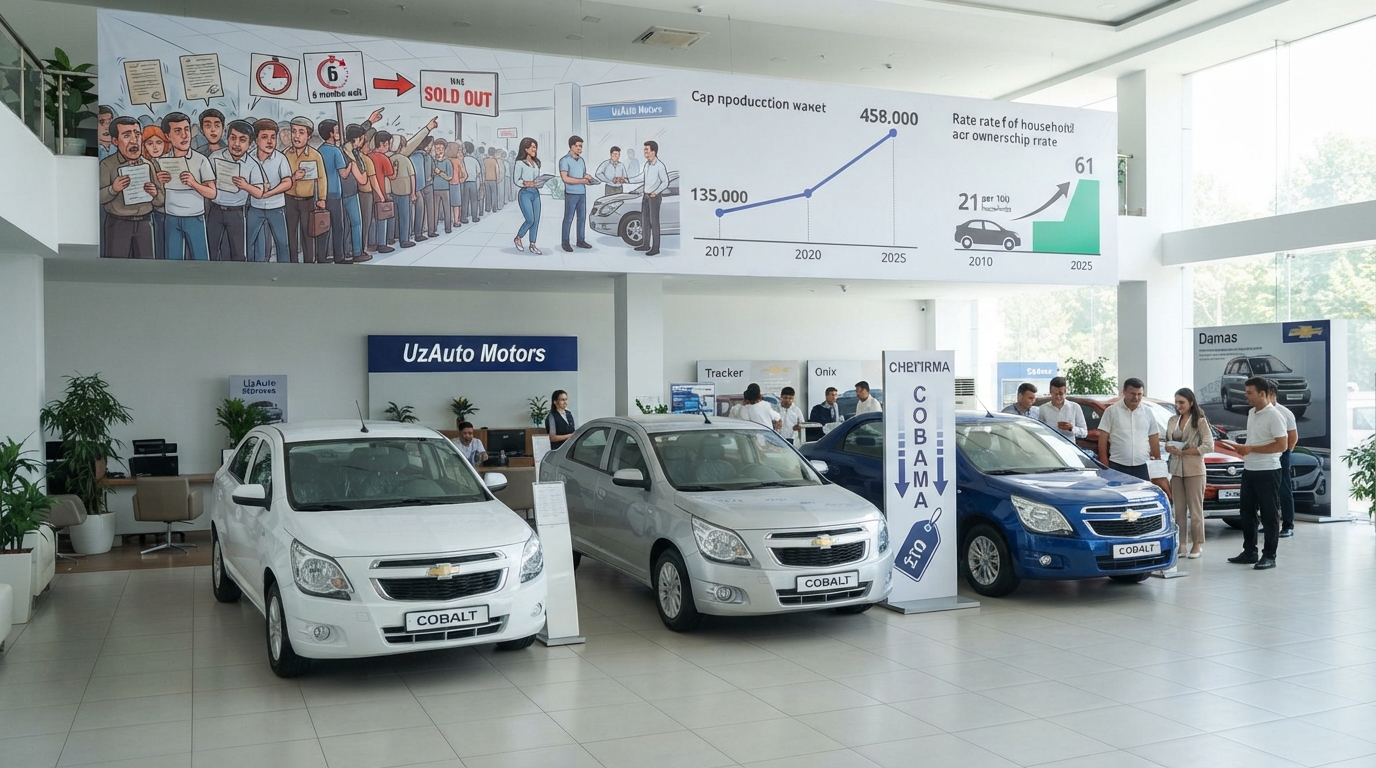
Cobalt, which forced to wait 6 months, is now on sale: how are the changes in the car market?
For many years, the "seller's dictatorship" reigned in the Uzbek car market. In the conditions of customs duties, certification and other non-tariff barriers, which make up almost half of the cost of a car, as well as limited domestic competition, demand has been growing steadily. Until recently, behind-the-scenes games, chaos and queues for contracts that open twice a year for only 4-5 hours were considered normal and not surprising to many. However, the situation is changing.
For example, let's look at the sales policy of UzAuto Motors, a major player in the domestic market. Initially, models such as Tracker and Onix were offered to buyers at their original price with a down payment. Later, this opportunity was also introduced for Damas.
The real turning point was the emergence of the opportunity to purchase the company's most popular car, the Cobalt, at its original price for up to 11 months with a 50% down payment.
A few days ago, a discount of up to 45 million soums was announced for the Captiva, and up to 15 million soums for the Cobalt. Such changes are not due to the sudden awakening of generosity towards UzAuto Motors, which is approaching 30 years old, but due to a number of fundamental factors.
Why are cars getting cheaper?
The volume of supply on the market is increasing year by year. For example, if in 2017 the country produced 135 thousand cars, then in 2025 this figure amounted to about 458 thousand, and in 8 years there was a 3.4-fold increase. With the exception of 2021, production has been increasing significantly every year.
This, in turn, directly affected the level of motorization of the population.
In 2010, the number of passenger cars per 100 households was 21, but in 2015 it increased to 41, in 2020 to 49, and in 2025 to 61.
The above figures indicate that the market is entering a phase of relative saturation and a real struggle has begun between manufacturers for each buyer.