

Two Years in Uzbekistan: Reflections on Change, People, and Opportunities. Column by Akiko Fujii
Uzbekistan's greatest opportunity lies in its people—and in the ability of everyone to contribute to the country's ongoing transformation and reap its benefits. Akiko Fujii, UNDP Resident Representative, shares her reflections on two years in the country in a new column.
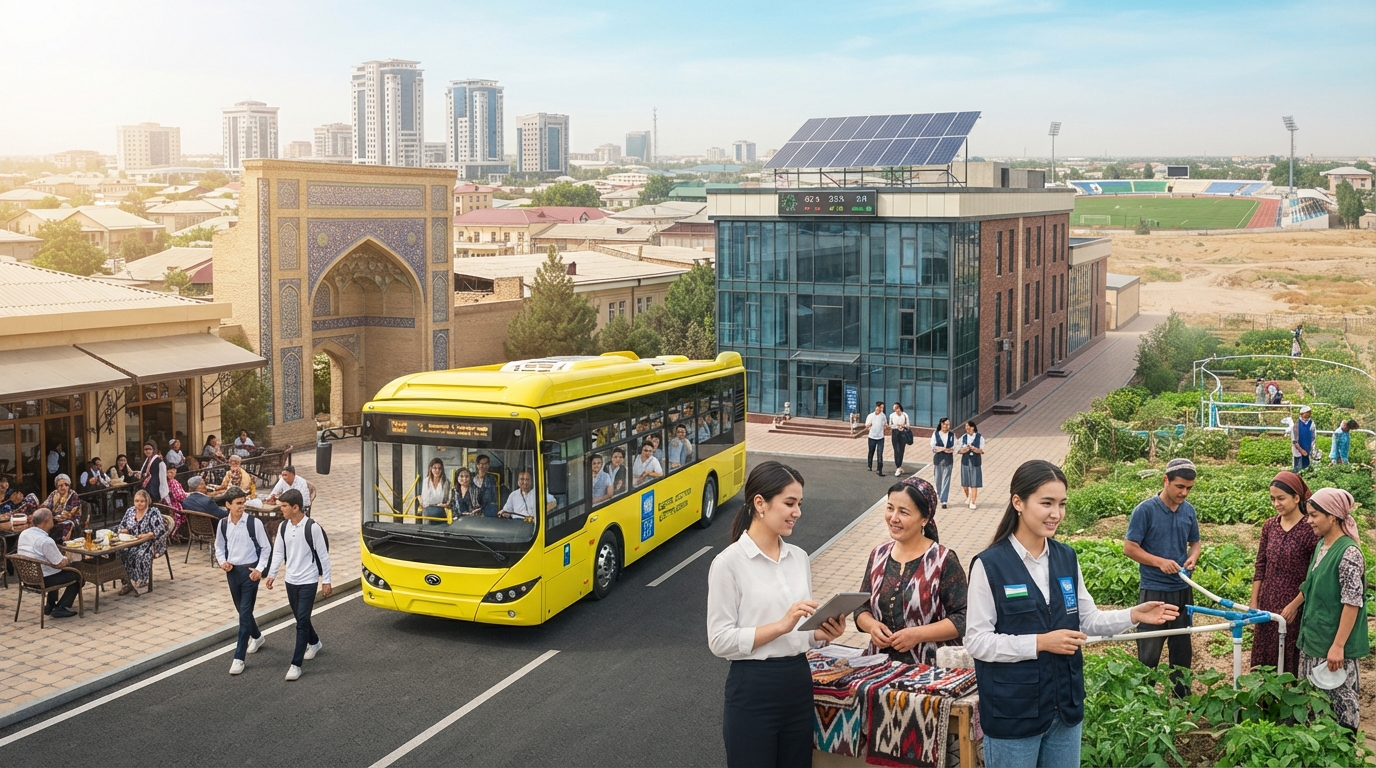
Two Years in Uzbekistan: Reflections on Change, People, and Opportunities. Column by Akiko Fujii
By Akiko Fujii, UNDP Resident Representative in Uzbekistan
One of the first words I learned when I arrived in Uzbekistan two years ago, in July, was "chilla," the name for the hottest 40 days of the year. Like everyone else in the country, I was delighted when chilla officially ended this year. At UNDP Uzbekistan, we celebrated the occasion in the most seasonal way possible: with melons. They're always delicious here, but this time their sweetness was especially memorable. Perhaps because the melon came at the end of an unusually hot July—a month that Uzhydromet described as significantly hotter than usual. The temperature in Tashkent reached 44.3 degrees Celsius, almost approaching the all-time high.
And this brings me to my first thought: climate change.
It affects us all, but its impacts are far from being felt equally everywhere. In Uzbekistan, where the climate is arid and desert landscapes occupy a significant portion of the country, more than 25% of land is already degraded, and almost 45% is at risk of desertification. Here, climate change is not an abstract concept, but a part of everyday life. This is especially important given that 80% of the country's water resources come from abroad. The recent adoption of the Water Code and water resources reforms are a step in the right direction. However, increasing resilience to climate change will require efforts at all levels – from regional cooperation, which is key for the future, to the careful use of water in each individual community.
I am pleased that UNDP is actively supporting the country's efforts in this area, especially in vulnerable regions like the Aral Sea region.
We have begun implementing an integrated portfolio approach based on the understanding that environmental health, decent employment, and effective local governance are closely interrelated and, together, contribute to improving people's lives. During my visits to the regions, I met many women and men who are pioneering new water-saving approaches and creating jobs in fish farming and agriculture. Now is the time to scale up these solutions.
The decisions being made today take on even greater significance when we consider who will bear the consequences—Uzbekistan's young and growing population.
When I first arrived in this country, I was struck by the energy of young people.
Over the years, this sense of youth power has only intensified. This year, Uzbekistan took an important step in collecting data by conducting a census.
The emerging demographic picture reveals both the scale of opportunity and the responsibility that comes with it: the country's population has exceeded 39 million, and children under 5 now represent the largest age group.
Uzbekistan's first-ever participation in the FIFA World Cup also impressed me as another vivid manifestation of this youthful energy. But the potential of this young population goes far beyond numbers. A demographic dividend doesn't just happen. Developing human capital requires unlocking talent and, more importantly, creating the conditions for it to stay and flourish in the country.
This includes the quality of education, skills development and training, healthcare, access to infrastructure, public services, and justice. This is what will determine whether Uzbekistan's demographic potential can become the foundation for its future prosperity.
At the same time, not only is the population changing—people's lifestyles are also changing.
For the first time, the majority of Uzbekistan's population—54.5%—lives in cities.
Urbanization is occurring alongside another profound transformation—the increasing digitalization of everyday life. I see young people gaining unprecedented access to modern digital information and content created using artificial intelligence, gaining new experiences of urban mobility and independence, and gaining a wider range of economic opportunities.
These changes open up enormous opportunities. At the same time, every transformation poses new questions. How can we preserve the strong tradition of mutual care and community, so vividly embodied in the mahalla, in a context where lifestyles are becoming increasingly urban and digital? And how can we ensure that expanding digital opportunities empower people without exposing them to new forms of risk?
The risks of online violence and digital financial crime, especially for vulnerable groups, show why technological progress must be accompanied by education, awareness-raising, and effective prevention systems.
I am pleased that we are effectively collaborating with partners to jointly address these challenges.
For me, this is one of the most interesting dimensions of the transformation taking place in Uzbekistan: economic and technological change are changing the way people live, work, and care for each other. This is particularly evident in the expansion of opportunities for women.
Over the past two years, I have witnessed significant political commitment to ensuring equal opportunities for women and men in all spheres of public life. In the past few years, the number of women entrepreneurs has increased sevenfold.
However, creating opportunities is only part of the task. How fully women can benefit from these services also depends on what happens at home.
On average, women spend 46.92 hours per week on unpaid childcare, which impacts their professional growth and economic participation.
And here I return again to Uzbekistan's young population. The opportunity to reap the demographic dividend is limited, and its success depends not only on preparing young people for the future labor market but also on high-quality care for children and the elderly. This important work must be distributed fairly and supported by active public and private support systems. Only a fair, high-quality, and sustainable care system will enable women and men to realize their full economic potential. Thus, investing in a comprehensive care system is investing in human capital, women's economic participation, and, ultimately, in the future prosperity of Uzbekistan.
Climate resilience, a young population, rapidly changing cities, digital transformation, women's economic participation, and the care system may at first glance seem like completely different topics. But after two years in Uzbekistan, I increasingly see them as parts of a single story—the story of a country that is rapidly changing and is making decisions that will shape the opportunities available to the next generation.
Two years may not be enough to fully understand a country, but it is certainly enough time to be inspired by its energy and ambition.
During my visits to our project sites throughout Uzbekistan, I met farmers experimenting with water-saving technologies, women developing their own businesses, young people seizing new opportunities, and communities uniting to improve their lives. These encounters convinced me that Uzbekistan's greatest opportunity lies in its people—and in the ability of everyone to contribute to the transformation taking place in the country and reap its benefits.
I sincerely congratulate Uzbekistan on its 35th anniversary of independence, and it is a great honor for me to share this special moment with the people of Uzbekistan. I am truly delighted to be working with UNDP in Uzbekistan at a time when the country is facing unique development opportunities.