

Uzbekistan has identified targets for achieving the SDGs.
Uzbekistan noted poverty reduction, increased AI readiness, and energy development, outlining objectives for achieving the Sustainable Development Goals.
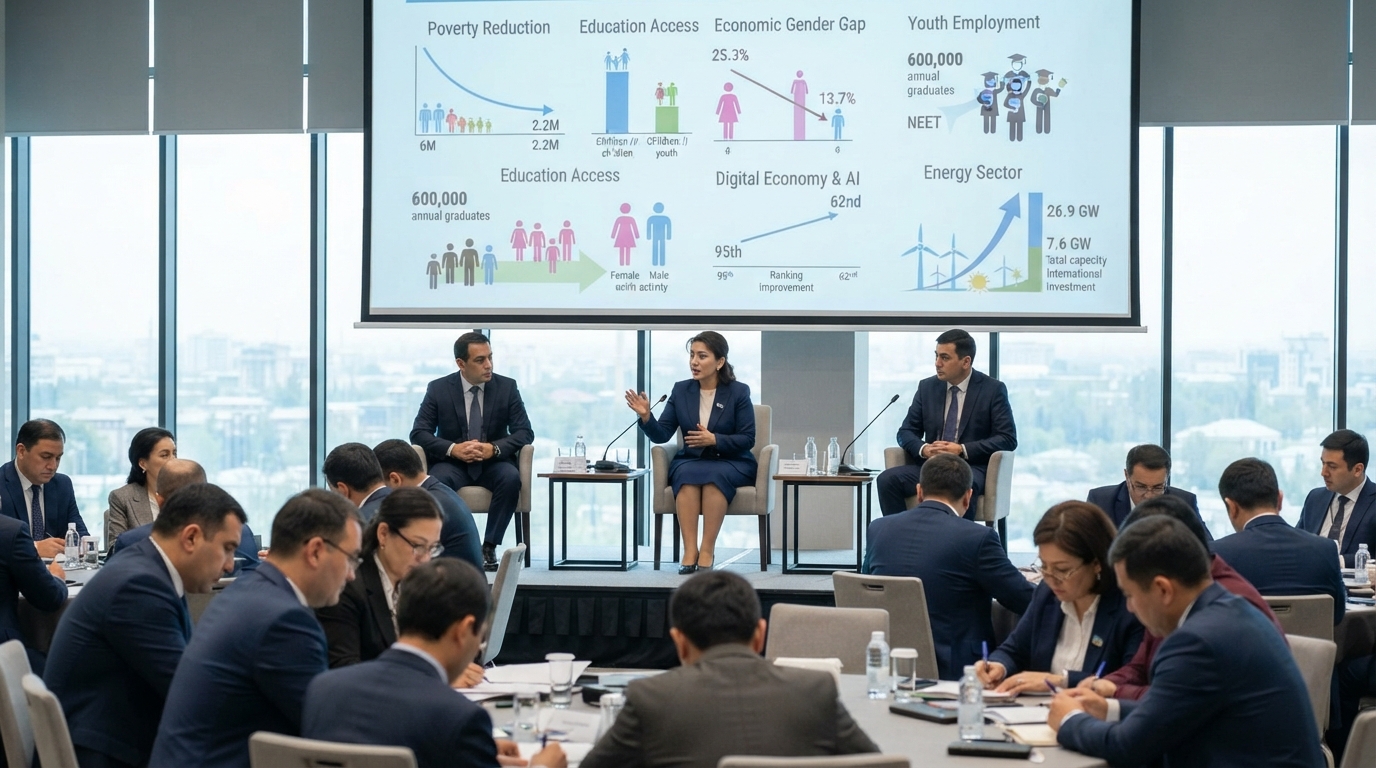
Uzbekistan has identified its priorities and objectives for achieving the Sustainable Development Goals (SDGs). These issues were discussed at a seminar organized by the Institute for Macroeconomic and Regional Studies (IMRS) under the Cabinet of Ministers of the Republic of Uzbekistan. During the event, the country's achievements on key SDG indicators were reviewed and areas requiring further efforts were identified, according to IMRS.
One significant achievement was the significant reduction in poverty. According to the data presented, this figure stood at 17% in 2021 and fell to 5.8% by 2025. Over the same period, the number of citizens living below the poverty line decreased from 6 million to 2.2 million. Factors contributing to this progress included targeted social policies, job creation, support for entrepreneurship, human capital development, and the implementation of the "mahalla" principle.
Progress was also recorded in increasing preschool and higher education enrollment, as well as in ensuring gender equality. However, women's economic activity remains lower than that of men: 43-45% for women versus approximately 70% for men. According to the International Labor Organization, the wage gap between women and men reaches 25-35%.
The seminar focused on youth employment. Approximately 600,000 young people enter the labor market annually. The youth unemployment rate in 2024 was projected to be 8%. Meanwhile, the proportion of young people neither studying nor working nor undergoing vocational training decreased from 25.3% in 2005 to 13.7% in 2025.
One persistent problem is the lack of practical experience among young professionals. An analysis of resumes on the Mehnat.uz platform revealed that 69.1% of young people lack work experience. In a survey conducted by the Institute of Regional Studies (IMRI), 27.2% of respondents cited finding a job as the most pressing issue, while 25% cited learning foreign languages.
Uzbekistan also demonstrated improvement in the digital economy and artificial intelligence. The country rose from 95th place in the AI readiness ranking in 2020 to 62nd place in 2025. The seminar participants identified expanding computing power and technological infrastructure as the next challenge.
In the energy sector, the country's installed power capacity nearly doubled between 2016 and 2025, reaching 26.9 GW. Of this, solar and wind generation accounted for 7.6 GW, or 28.2%. In recent years, approximately $23 billion in foreign investment has been attracted to the development of the energy sector.
At the same time, the seminar noted the problem of international statistics lagging behind current developments. Specifically, Uzbekistan's indicator for the share of renewable energy in final energy consumption in the Sustainable Development Report 2026 is calculated based on 2022 data. Thus, changes in the energy sector since this period, including the commissioning of new capacity, are not yet fully reflected in individual international SDG indicators.
The event participants emphasized that further progress toward the Sustainable Development Goals requires intensified scientific research, improved quality and relevance of statistical data, evidence-based decision-making, and regular assessment of the effectiveness of measures being implemented.