

Two years in Uzbekistan: reflections on changes, people and opportunities. Column by Akiko Fujii
Uzbekistan's greatest opportunity is its people, the ability of every individual to contribute to the changes in the country and enjoy their results. UNDP Resident Representative Akiko Fujii shares her thoughts on the results of her two years in the country in a new column.
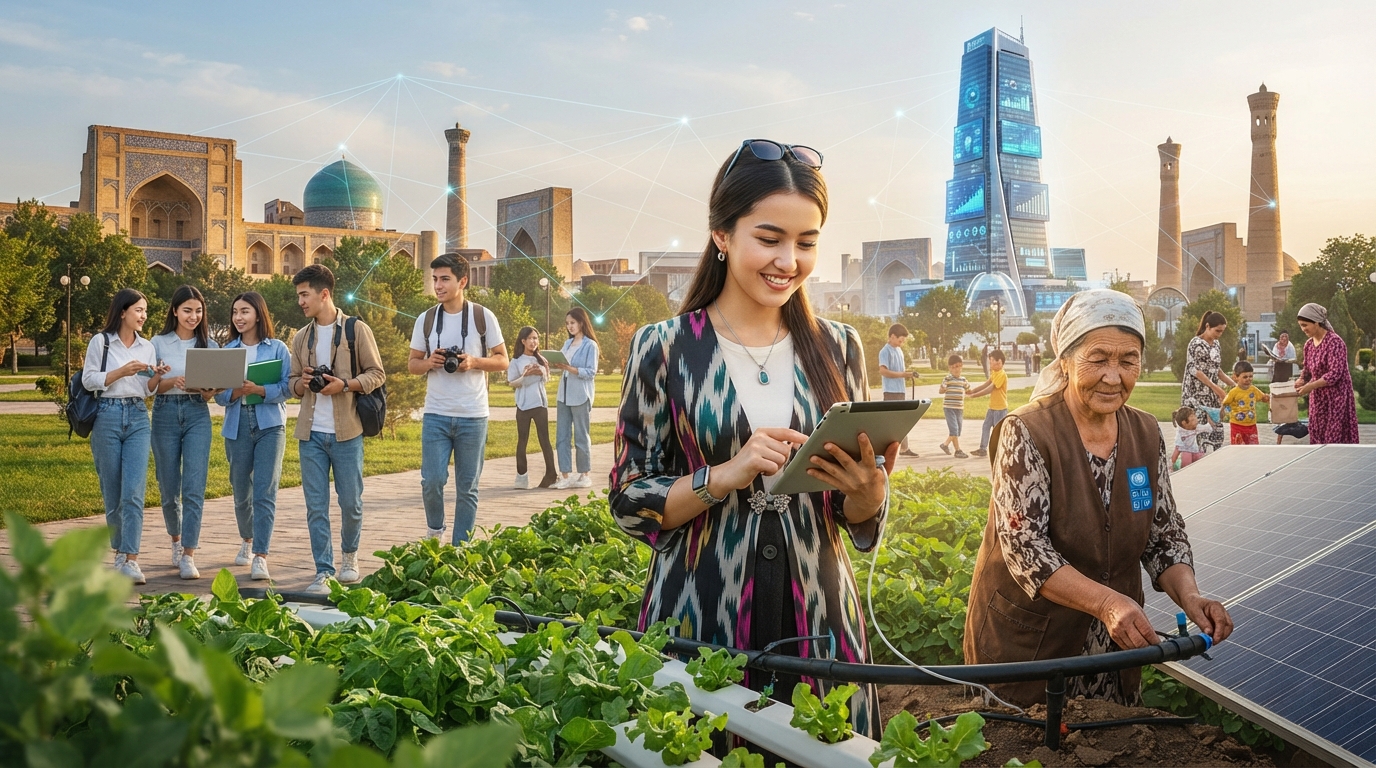
**Two years in Uzbekistan: Reflections on change, people and opportunities. Column by Akiko Fujii**
**By Akiko Fujii, UNDP Resident Representative in Uzbekistan**
When I arrived in Uzbekistan two years ago in July, one of the first words I learned was "chilla." It refers to the 40 hottest days of the summer. Like everyone else in the country, I was overjoyed that this year's chilla had officially ended. At UNDP Uzbekistan, we celebrated the occasion in a seasonal way: with melons. Melons are always delicious, but this time their sweetness was especially memorable. Perhaps it was because the melons ripened at the end of July. According to Uzgidromet, this month was much hotter than usual, with temperatures in Tashkent reaching +44.3 degrees, almost equaling a historical record.
Which brings me to my first point: climate change.
Climate change continues to affect us all over the world, but the impact is not uniform everywhere. In Uzbekistan, an arid country with a vast desert landscape, more than 25 percent of its land is already degraded, and nearly 45 percent is at risk of desertification. Climate change is not an abstract concept here, but a part of everyday life. This is especially important because 80 percent of the country’s water resources come from outside the country. The recent adoption of the Water Code and water-focused reforms are steps in the right direction, but building climate resilience requires efforts at every level: from regional cooperation, which is essential for the future, to water conservation efforts in every neighborhood.
I am pleased that UNDP is actively contributing to the country’s efforts, especially in vulnerable areas such as the Aral Sea region. We have begun to implement an integrated portfolio approach, recognizing that the state of nature, decent jobs and effective local governance are closely linked to improving people’s lives on the ground. During my visits to the regions, I met many women and men who are trying out new ways to save water and creating jobs in fisheries and agriculture. Now is the time to scale up these initiatives.
The decisions being made today take on even greater significance when we consider who will inherit their consequences: Uzbekistan’s incredibly young and growing population.
When I first arrived in this country, I was struck by the energy of the youth. This impression of the power of youth has only grown stronger over the years. Uzbekistan took a significant step forward this year in collecting data through a population census. The emerging demographic landscape shows both the opportunities and the responsibilities ahead: the population has exceeded 39 million, and children under five now make up the largest group of the population.
Uzbekistan’s first-ever participation in the FIFA World Cup was another example of the power of youth for me. But the potential of a young population is not limited to numbers alone. The demographic dividend does not happen by itself. It is important to develop human capital, that is, to develop talent and, more importantly, to retain it in the country.
This includes the quality of education, skills development and vocational training, healthcare, access to infrastructure, public services and justice. It is these factors that will determine whether Uzbekistan’s demographic potential translates into future prosperity.
At the same time, it is not just the population that is changing – people’s lifestyles are also changing. For the first time in Uzbekistan, the majority of the population, 54.5 percent, lives in cities.
Urbanization is another profound change, accompanied by the increasing digitalization of everyday life. I see young people gaining unprecedented access to information generated by modern digital and artificial intelligence, new opportunities for mobility and independence in cities, and economic opportunities expanding.
These developments open up enormous opportunities. At the same time, any change also raises new questions. How can the strong traditions of mutual care and community that are evident in the neighborhood continue to thrive as lifestyles become increasingly urbanized and digitalized? And how can we ensure that the expansion of digital connectivity does not expose people to new forms of harm while increasing their opportunities?
The increasing threat of online violence and digital financial crimes, especially for vulnerable groups, shows that technological advances must go hand in hand with education, awareness, and effective prevention systems. I am pleased that we are working effectively with our partners to help address these challenges.
For me, this is one of the most exciting aspects of Uzbekistan’s transformation: economic and technological changes are reshaping the way people live, work, and care for each other. This change is particularly evident in the changing opportunities available to women.
Over the past two years, I have witnessed a strong political will to ensure equal opportunities for women and men in all areas of society. The number of female entrepreneurs has also increased sevenfold in the past few years. But creating opportunities is only part of the story.
Whether women can fully take advantage of these opportunities also depends on what happens at home. Women spend an average of 46.92 hours a week on unpaid childcare. This affects their professional development and economic participation.
This brings me back to Uzbekistan’s young population. The demographic dividend is time-limited and depends not only on preparing young people for the future labor market, but also on providing quality care for children and the elderly. This important work must be done in an equitable manner, based on active support systems from the public and private sectors. Only through a fair, quality, and sustainable care system can women and men be economically empowered. Therefore, an investment in a comprehensive care system is an investment in human capital, women’s economic participation, and ultimately the future prosperity of Uzbekistan.
Issues such as climate resilience, a young population, rapidly changing cities, digital transformation, women’s economic participation, and care may seem very different from each other. But after two years in Uzbekistan, I increasingly see them as different parts of the same story: a country that is rapidly changing and where the decisions we make today are shaping the opportunities available to future generations.
Two years may not be enough to fully understand a country, but it is long enough to be inspired by its enthusiasm and aspirations.
During my travels across Uzbekistan, where our projects are implemented, I met farmers testing water-saving technologies, women building businesses, young people seizing new opportunities, and communities coming together to improve their lives.
These meetings convinced me that Uzbekistan’s greatest potential lies in its people and that it is important to ensure that everyone can contribute to and benefit from the country’s transformation.
I would like to sincerely congratulate Uzbekistan on its 35th anniversary of independence and am honored to be able to celebrate this important moment with the people of Uzbekistan. I am delighted to be serving UNDP in Uzbekistan at a time of unique development opportunities for the country.