

Two police officers in Chirchiq received 6 years in prison for attempting to cover up a crime
In Chirchiq, two prevention inspectors were sentenced. One of them offered a beaten citizen to "hush up" the case in exchange for money. The officer received $2,700 from the attackers, transferred $1,000 of it to the victim, and split the remaining amount with his colleague. The court sentenced the two inspectors to 6 years of imprisonment.
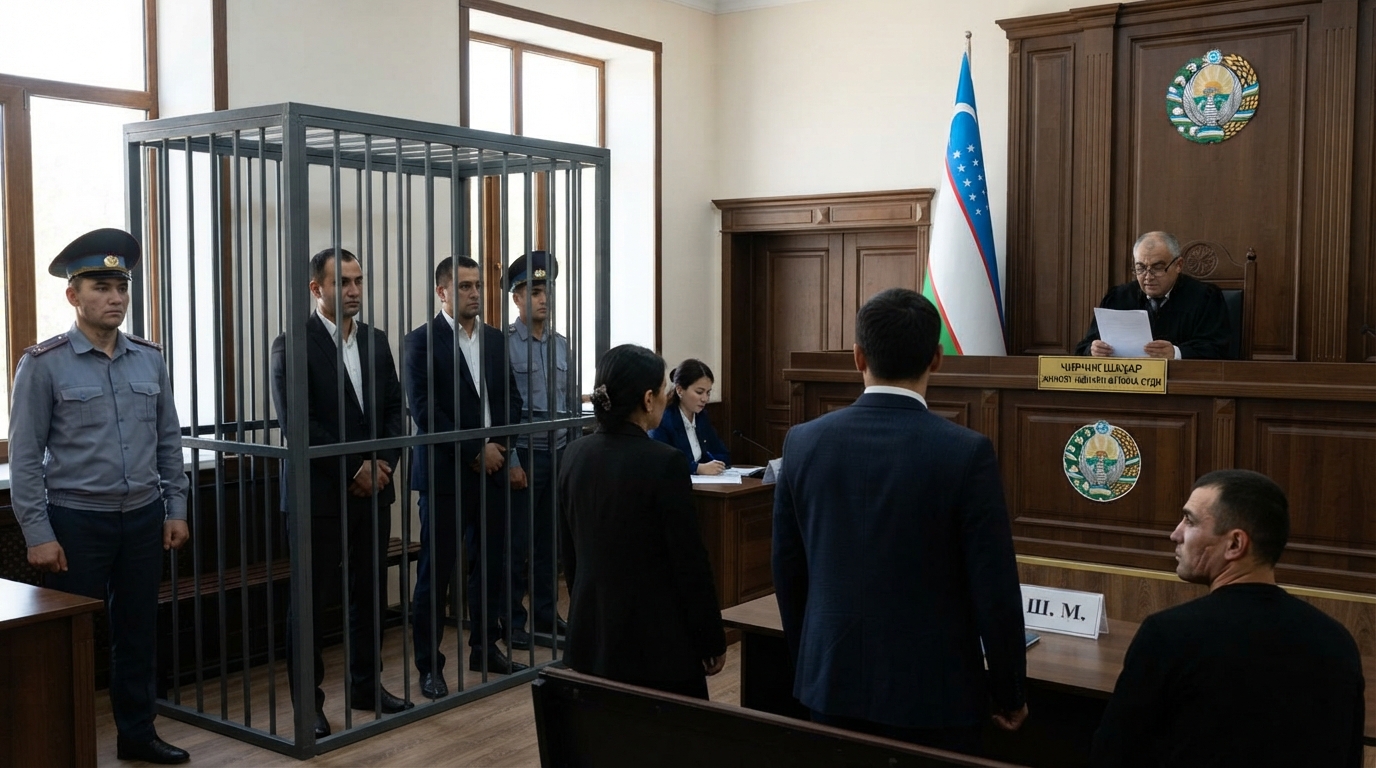
Two Internal Affairs Officers in Chirchik Sentenced to 6 Years in Prison for Attempting to Cover Up a Crime
On October 7, the Chirchik City Criminal Court in the Tashkent region announced a verdict against two internal affairs officers who attempted to cover up a crime. The State Security Service (SSS) reported the detention of the officers back in April.
According to the verdict, at around 19:00 on February 17, citizen Sh. M. came with an acquaintance to one of the cafes in Chirchik. While they were in the main hall, he noticed his acquaintance D. at a neighboring table, who was there with about six companions.
At that time, an intoxicated woman repeatedly engaged in disputes and conflicts with other patrons of the cafe. She also quarreled with the female administrator and pushed her. Sh. M. broke them up.
After this, the woman told him not to interfere and left. A short while later, she approached D.'s table, took a photo of those sitting there with her phone, and stated that "my son Umid and Islam Bukharsky will come now," after which she left the cafe.
According to Sh. M.'s testimony in court, about 20 minutes later, when he went outside the cafe to smoke, a young man named Umid approached him. Without asking Sh. M. for any explanations, he pinned him against the stairs and threatened to throw him down.
Sh. M.'s acquaintance separated them. Sh. M. then returned to the cafe. His acquaintance approached him, asked whom he had offended, and informed him that "Islam Bukharsky" was waiting for him outside.
Sh. M. went outside. "Islam Bukharsky," about 10 young men, and patrol officers were there. "Islam Bukharsky" told him to go back inside the cafe. However, one of the young men from the group grabbed Sh. M. by the arm and turned him toward himself, after which Umid punched him in the jaw with his fist. Sh. M. fell to the ground, then got up, entered the cafe, and washed off the blood.
When he went outside again, "Islam Bukharsky," his companions, and the patrol officers had already left.
Sh. M. was going to leave the cafe and hailed a taxi, but an unmarked white Gentra car pulled up nearby. A man who got out of the car introduced himself as Islam and stated that Umid was his friend, after which he left Sh. M. his phone number.
As Sh. M. recounted, while they were talking, four or five more people from the previous group approached. They attempted to force him into a cream-colored Epica car parked in the cafe's parking lot. Sh. M. tried to run away. Those in the car pursued him for about a kilometer.
When Sh. M. stopped out of exhaustion, the people who got out of the car approached him. According to his testimony, Kurbonali, nicknamed "Gera," punched him with his fist, and the rest kicked him. Sh. M. lost consciousness.
Upon waking up, he found himself lying on the lap of an unfamiliar woman. It turned out that she had called an ambulance. Sh. M. was taken to the central hospital of Chirchik, where he received first aid. Doctors reported that he had a laceration in the jaw area and offered to apply stitches, but he refused.
The next day, around 11:00, Sh. M. came to the internal affairs department to file a complaint. On the same day at approximately 15:30, crime prevention inspector D. Rakhimbaev summoned him to his office. "Islam Bukharsky" was also there. The internal affairs officer suggested they talk and left the office.
According to Sh. M., "Islam Bukharsky" asked him not to file a complaint. He explained that the young men had made a mistake, and the incident could be settled and the damage reimbursed. He asked how much money he needed. Sh. M. replied that he wanted legal action to be taken and that those who beat him should at least be arrested for five days. He also said that he had three children and that he could have died as a result of the beating.
After this conversation, the inspector told Sh. M. that there was no corpus delicti in his case and that it was impossible to initiate a criminal case under any article. He also suggested accepting money as compensation for the harm caused. According to Sh. M.'s testimony, after the internal affairs officer's words, he decided that achieving legal accountability for the perpetrators was impossible and agreed to take the money.
On the same day, one of the participants in the beating borrowed money from an acquaintance and handed over $2,700 to D. R. However, this amount did not reach the victim.
On the night of February 19, at approximately 1:00, the inspector summoned Sh. M. again. Near the building, he saw the inspector, "Islam Bukharsky," and about eight other young men. Then Rakhimbaev and another uniformed inspector, N. Atabekov, entered the office.
According to Sh. M., Rakhimbaev handed him $2,000 and told him to give $100 to Atabekov. The victim complied with the request. After Atabekov left, Rakhimbaev demanded $900 back from him. Sh. M. was left with an amount of $1,000.
Sh. M. recounted that Rakhimbaev then demanded another $100 from him, stating that the money needed to be passed to higher-ups and that many people were aware of this. Sh. M. refused, explaining that he needed the money for medical treatment. Rakhimbaev then said he would call the next day and that Sh. M. must write a counter-statement.
On February 19, the victim wrote a statement regarding compensation for damages and stating he had no claims against anyone. Nine days later, on February 28, initiation of a criminal case regarding the beating was denied. However, on March 5, an investigation was opened by the Investigation Department under the Ministry of Internal Affairs of Uzbekistan.
During the investigation, relatives of the individuals involved in the beating demanded the return of the previously transferred $2,700. According to the victim, the investigator informed him of this demand. Without revealing that most of the money remained with the internal affairs officers, the man stated that he had spent the funds on his own needs.
On April 20, Sh. M. filed an application with the Tashkent Regional Department of the State Security Service requesting that legal action be taken against Chirchik City Internal Affairs Officers Rakhimbaev and Atabekov.
During an operational event, the crime prevention inspector was detained while transferring $300 to Sh. M.
In court, both internal affairs officers did not plead guilty. Atabekov stated that he knew nothing about the monetary transactions. According to him, he saw Sh. M. for the first time regarding his statement in his colleague's office, where the latter reported that the parties to the conflict had reached an agreement and the victim had no claims.
Atabekov claimed that he suggested the parties discuss the situation on their own, but gave no instructions to anyone to drop the case or accept money.
The court concluded that the guilt of the defendants was confirmed by witness testimony, wiretapped phone conversations, and other evidence.
By the verdict of the criminal court, Rakhimbaev and Atabekov were found guilty of committing crimes provided for under: paragraphs "v" and "g" of Part 2 of Article 210 of the Criminal Code (taking a bribe through extortion, by prior conspiracy by a group of officials); paragraphs "a" and "b" of Part 2 of Article 230−1 of the Criminal Code (falsification (forgery) of evidence, committed by prior conspiracy by a group of persons, resulting in detention, custody, criminal prosecution, or exemption from criminal liability, conviction, or acquittal of a person); Part 2 of Article 241−1 of the Criminal Code (intentional concealment of a crime from registration).
By partial addition of the imposed sentences, the court sentenced both to 6 years of imprisonment. In addition, they are prohibited from working in the internal affairs system for three years.
It was ruled that Atabekov's term of serving the sentence be calculated from June 22, and Rakhimbaev's from April 24.
The parties may file an appeal or protest against the court's decision.