

Trans-Caspian Transport Corridor to link Europe and Asia
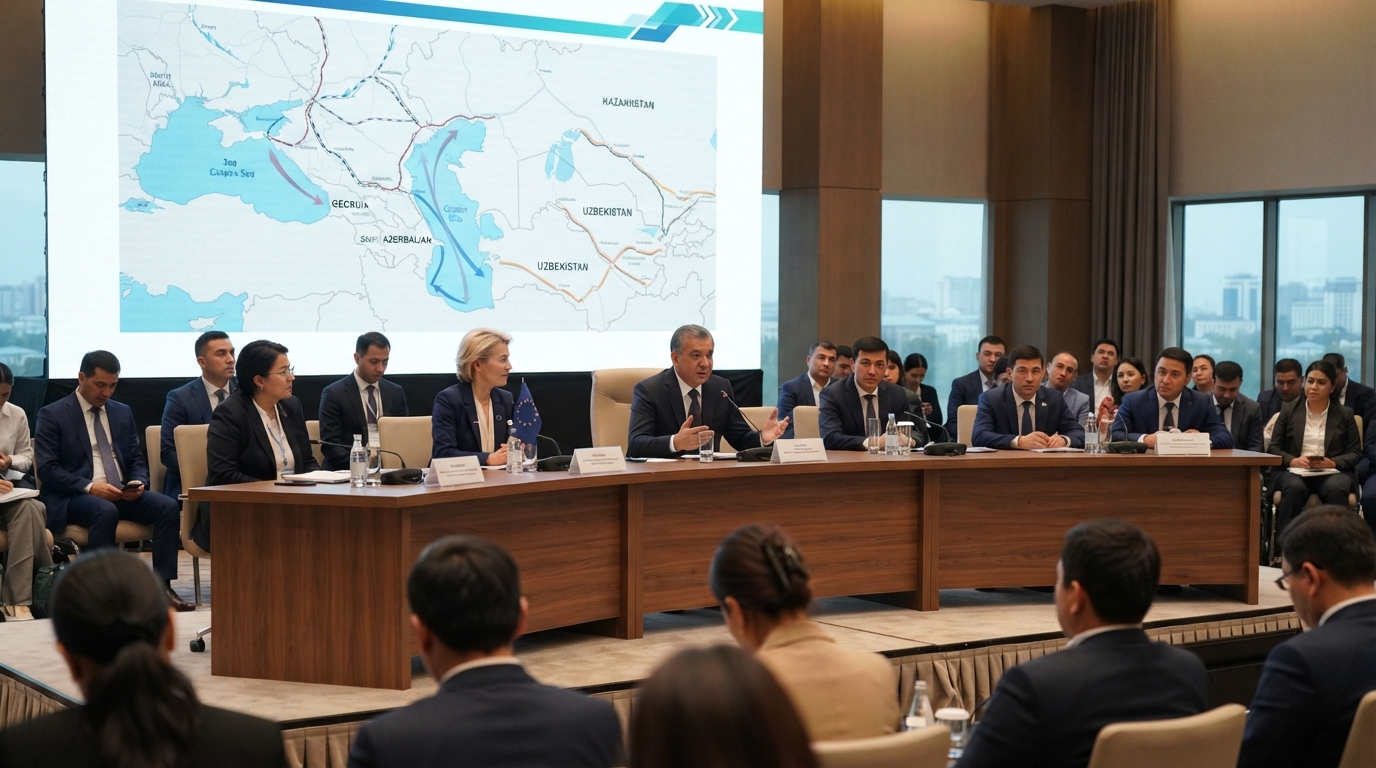
The second National Conference on the Trans-Caspian Transport Corridor (TCTC) took place in Tashkent, bringing together representatives of the Government of Uzbekistan, the European Commission, national and international partners to discuss infrastructure priorities, project preparation, and practical measures to improve the efficiency of the Corridor. The event is part of the European Union-funded TCTC Coordination Platform, which brings together five Central Asian countries, the EU, international financial institutions, and international partners […]
The Trans-Caspian Transport Corridor will connect Europe and Asia
The second National Conference on the Trans-Caspian Transport Corridor (TCTC) was held in Tashkent, bringing together representatives of the Government of Uzbekistan, the European Commission, as well as national and international partners. Participants discussed infrastructure priorities, project preparation, and practical steps to increase the efficiency of the Corridor.
This event is held within the framework of the European Union-funded TCTC Coordination Platform, which brings together five Central Asian countries, the EU, international financial institutions, and international partners. The platform was established to coordinate investments and reforms aimed at transforming the Corridor into a sustainable, secure, and fast transport link between Europe and Asia.
"International transit corridors are very important for Uzbekistan. Our country is one of only two in the world whose neighboring states also do not have direct access to the open sea. Today, our economy is developing rapidly, and it is extremely important for us to have international transit corridors and to be integrated into them. Transport costs currently account for an extremely large share of the cost of production, so one of the most promoted initiatives is the resolution of transport and logistics issues. Together with the European Union, as well as on our own, we are implementing a number of major projects. All of them are aimed at protecting the interests of our country," noted the Minister of Transport of the Republic of Uzbekistan, Ilkhom Makhkamov.
In recent years, cooperation between Uzbekistan and the EU in this direction has moved from developing plans to their practical implementation. This is facilitated by the formation of a concrete project portfolio, enhanced coordination between countries, and the attraction of financing.
Holding the National Conference has practical significance. One of the key tasks of the current forum was to identify the bottlenecks of Uzbekistan's transport system and discuss ways to improve them. Separately, the support that the EU and international financial institutions can provide in mobilizing investments, financing projects, and providing technical assistance was considered. Priorities include the modernization of railway and road infrastructure, the development of logistics centers, and the creation of a unified digital transport system in Uzbekistan and the region as a whole.
"First of all, it is necessary to consider the corridor as a single system. We are talking not only about Uzbekistan, Kazakhstan, or individual countries of Central Asia, but also about the states of the South Caucasus. It is important to ensure the most efficient functioning of all procedures along the entire Corridor. In particular, it is necessary to digitize documentation as much as possible and harmonize customs procedures to the maximum extent. This will yield very concrete results: cargo will move faster, without unnecessary delays, and every step to reduce transit time will increase the attractiveness of the Corridor for investors and its direct users. Another important task is to ensure the predictability of the TCTC's operation. Transport and logistics companies need to understand how long the transportation will take and exactly how the movement of goods will be organized. The more predictable the timeframes and financial conditions of operation are, the more attractive the Corridor will become. Finally, there remains a significant volume of infrastructure projects that need to be implemented. We look forward to further close cooperation with our partners in Uzbekistan, the government, and financial institutions to advance these projects, including directly in Uzbekistan," noted Peteris Ustubs, Director for Asia, Central Asia and the Pacific at the European Commission.
The conference was attended by representatives of government agencies, international financial institutions, development partners, as well as the private sector in the field of transport and logistics.
The event was co-chaired by the Ministry of Transport of the Republic of Uzbekistan and the European Commission's Directorate-General for International Partnerships.