

Trade between Central Asian countries in 2021–2025
The article is about the development of trade relations between Central Asian countries in 2021–2025, the structure and dynamics of intra-regional trade, the role of the countries in mutual trade, and the strengthening of economic interdependence. It also analyzes the opportunities for further expanding regional trade and developing production cooperation.
Trade between Central Asian countries in 2021–2025
The mutual economic interdependence of the region's countries has strengthened
In 2021–2025, intra-regional trade in Central Asia developed under conditions where, on the one hand, the region's countries expanded their foreign trade relations with the rest of the world, and on the other hand, the post-crisis recovery in 2020 from the pandemic period, changes in logistics routes, and the growing importance of neighboring markets as sources of raw materials, food, industrial goods, and transit-trade flows took place.
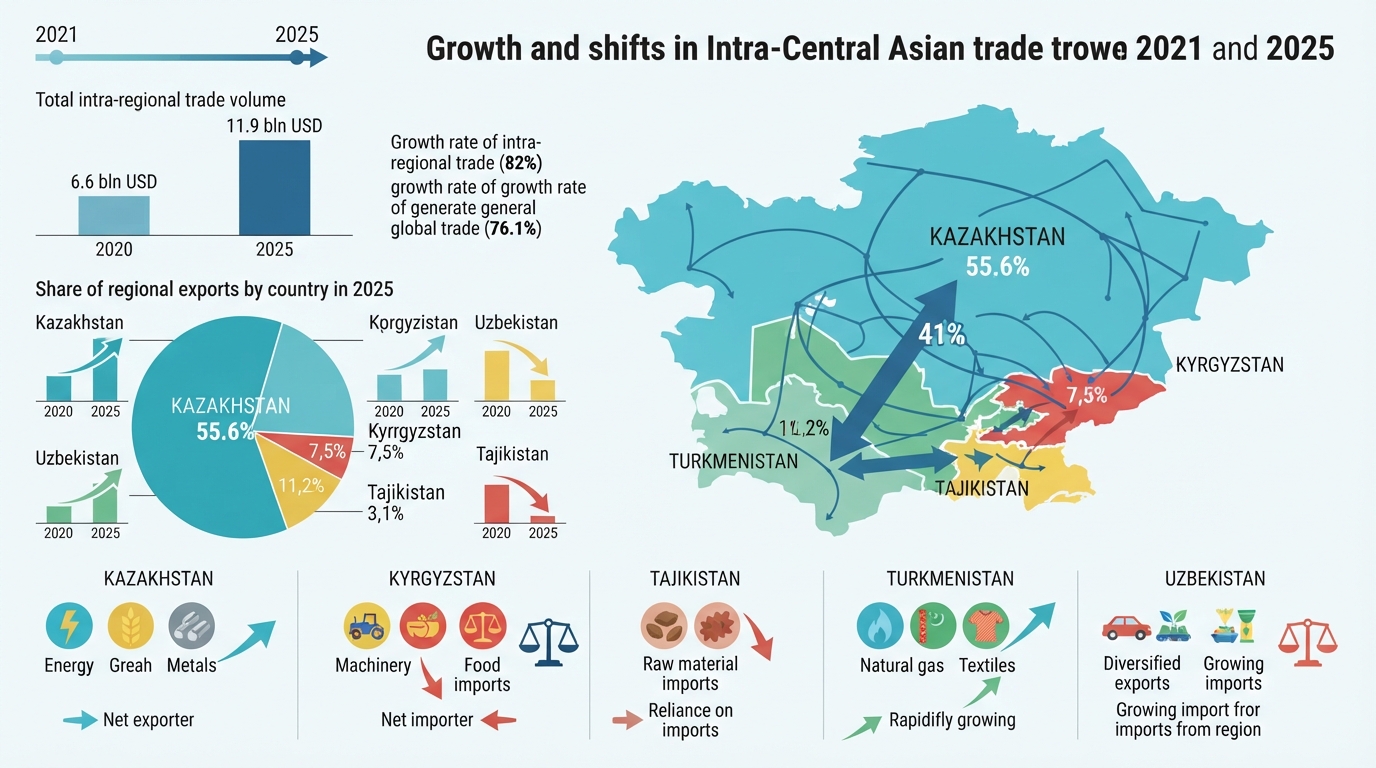
In 2021–2025, Central Asia's internal trade rose by 82 percent, increasing from $6.6 billion in 2020 to $11.9 billion in 2025
(in this analysis, the sum of the export volumes of Central Asian countries to other countries in the region was taken as the indicator of intra-regional trade, which allows avoiding double counting, as the exact same flow is not simultaneously counted as an export of one country and an import of another).
For comparison, the total trade turnover of the region's countries with the world increased by 76.1 percent — from $143 billion to $253 billion.
Thus, in 2020–2025, intra-regional trade grew faster than the region's total trade turnover with the world. Nevertheless, its share in the region's overall foreign economic system remains limited: in 2021–2025, the ratio of intra-regional trade volume to Central Asia's total trade turnover with the entire world remained at the level of 5 percent (the ratio of mutual trade turnover of Central Asian countries to Central Asia's trade turnover with the world also remained virtually unchanged during this period and was around 8-10 percent).
This shows that although regional trade is growing rapidly, foreign markets outside Central Asia maintain their priority. Central Asia has not yet formed a large internal trade contour on a scale equal to the region's foreign trade with China, Russia, the EU, Turkey, and other partners.
Dynamics of the structure of intra-regional trade in Central Asia in 2021–2025
In 2020–2025, the structure of Central Asia's internal trade remained concentrated. In 2025, Kazakhstan accounted for 55.6 percent of the total exports of Central Asian countries to other states in the region. This is even higher than the figure in 2020, when Kazakhstan's share was 53.3 percent. In terms of value, the volume increased 1.9 times — from $3.5 billion to $6.6 billion. Thus, Kazakhstan not only maintained but further strengthened its role as the largest supplier of goods to the regional market.
Meanwhile, Uzbekistan's share decreased from 28.5 percent in 2020 to 22.6 percent in 2025. This does not mean that its exports to the region contracted in absolute terms: the volume of deliveries increased by 44 percent — from $1.9 billion to $2.7 billion. However, exports from Kazakhstan and Turkmenistan grew relatively faster, which is why Uzbekistan's relative share in Central Asian internal trade declined.
Turkmenistan's share increased significantly — from 7.3 percent to 11.2 percent. The country showed the highest growth rates in exports to Central Asian states — a 2.8-fold increase, reaching $1.3 billion in 2025 from $475 million in 2020. This reflects that Turkmenistan's export direction is increasingly focused on neighboring markets, primarily Uzbekistan, with exports to our country increasing 2.6 times.
Kyrgyzstan's share remained virtually unchanged: 7.2 percent in 2020 and 7.5 percent in 2025. Kyrgyzstan's exports to Central Asian countries increased nearly 1.9 times — from $471 million to $896 million. Moderate dynamics were observed in Tajikistan — the growth amounted to 51.7 percent, reaching $372 million from $245 million. Tajikistan's share in interregional trade decreased from 3.7 percent to 3.1 percent.
At the level of bilateral directions, the Kazakhstan–Uzbekistan connection remains the main trade core of the region. In 2025, Kazakhstan exported $3.5 billion worth of goods to Uzbekistan, while Uzbekistan exported $1.3 billion worth of goods to Kazakhstan. In general, these two mutual directions accounted for nearly $4.9 billion, or about 41 percent of the total internal trade in Central Asia. This confirms that the Kazakhstan-Uzbekistan trade axis remains central to the entire region.
The second largest direction is Kazakhstan's export to Kyrgyzstan. In 2025, it amounted to $1.7 billion, growing nearly 2.9 times compared to 2020. This direction became one of the main sources of growth in intra-regional trade. Significant growth was also observed in Kazakhstan's exports to Tajikistan (up to $1.1 billion) and Turkmenistan's exports to Uzbekistan (up to $1.1 billion).
Overall, in 2020–2025, the structure of Central Asian internal trade shifted toward strengthening the roles of Kazakhstan and Turkmenistan as suppliers of goods to the regional market, while a relative decrease in the shares of Uzbekistan and Tajikistan was observed. However, institutionally and geo-economically, Uzbekistan remains the central link of regional trade, as it is an important sales market for almost all neighboring countries and, at the same time, a major exporter to the region.
In 2020–2026, the dominance of trade relations around Kazakhstan and Uzbekistan was noted. At the same time, Uzbekistan's ties with Kyrgyzstan, Tajikistan, and Turkmenistan strengthened, indicating Uzbekistan's growing role as a regional trade hub. Furthermore, trade relations ceased to be one-sided: the role of Kyrgyzstan in Kazakhstan's trade, Uzbekistan in Tajikistan's trade, Kazakhstan in Turkmenistan's trade, and Turkmenistan and Tajikistan in Uzbekistan's trade increased.
The role of regional trade for Central Asian countries
Regional trade plays a dual role for Central Asian countries. On the one hand, it remains a relatively small part of the region's total trade turnover with the entire world. On the other hand, for individual countries, it is of systemic importance as a sales market, a source of imports, a channel for industrial and agro-industrial cooperation, as well as a mechanism for offsetting external shocks. This is particularly evident for countries with relatively small economies and high dependence on neighboring markets.
For Kazakhstan, the importance of regional trade increased moderately. The share of Central Asian countries in Kazakhstan's total trade turnover rose from 5.4 percent in 2020 to 6.1 percent in 2025. The volume of Kazakhstan's trade turnover with the region grew nearly 1.9 times in absolute value, i.e., by $4.1 billion — from $4.7 billion to $8.8 billion. At the same time, Kazakhstan maintains a clear positive trade balance with the region: in 2025, Kazakhstan's exports to Central Asian states amounted to $6.6 billion, while imports from the region stood at $2.2 billion. This reflects Kazakhstan's role as a major supplier of food, raw materials, energy carriers, metals, and industrial products to neighboring countries.
The structure of Kazakhstan's exports to the region remained oriented toward Uzbekistan, but the role of Kyrgyzstan strengthened. In 2025, Uzbekistan accounted for 53.2 percent of Kazakhstan's exports to Central Asia, Kyrgyzstan for 25.1 percent, Tajikistan for 17 percent, and Turkmenistan for 4.8 percent. Compared to 2020, faster deliveries were made particularly to Turkmenistan and Kyrgyzstan, but Uzbekistan maintained its status as the main regional market for Kazakh goods.
For Kyrgyzstan, regional trade remains one of the most important components of its foreign trade system. In 2020, Central Asia accounted for 21.1 percent of Kyrgyzstan's total trade turnover, and in 2025, it was 18.8 percent. Despite the decrease in share, the absolute volume of trade with the region increased nearly 2.5 times — from $1.2 billion to $3.0 billion. The main feature of Kyrgyzstan is its growing dependence on imports from the region: the volume of imports from Central Asian countries increased from $729 million in 2020 to $2.1 billion in 2025, while the export volume grew from $471 million to $896 million. As a result, in 2025, Kyrgyzstan's regional trade balance was negative, recorded at $1.2 billion.
The structure of Kyrgyzstan's exports to the region remained almost bicentric. In 2025, Kazakhstan accounted for 50.6 percent of Kyrgyz exports to the region, and Uzbekistan accounted for 45.3 percent. At the same time, the volume of deliveries to Uzbekistan grew faster than to Kazakhstan: Kyrgyzstan's exports to Uzbekistan increased approximately 2.7 times compared to the 2020 level, while exports to Kazakhstan increased 1.6 times. This indicates the gradual strengthening of Uzbekistan's role as a trade market for Kyrgyzstan.
For Tajikistan, regional trade traditionally holds great importance, but its relative role declined in 2020–2025. The share of Central Asia in Tajikistan's total trade turnover contracted from 28.3 percent to 18.4 percent. This was due to the fact that the country's total trade turnover with world countries grew 2.4 times, while trade with the region increased by 54.2 percent. Nevertheless, Central Asia remains the main direction of Tajikistan's foreign trade: in 2025, the volume of trade with the region approached $2 billion. At the same time, the trade structure is characterized by a large deficit: Tajikistan's exports to Central Asian states amounted to $372 million, while imports stood at $1.6 billion, forming a negative balance of nearly $1.2 billion.
In 2025, Uzbekistan accounted for 74.1 percent of Tajikistan's exports to Central Asian states, and Kazakhstan accounted for 22.9 percent. The volume of deliveries to Kyrgyzstan and Turkmenistan was minimal. This means that Tajikistan's regional exports remain significantly dependent on a single direction — the Uzbek market.
For Turkmenistan, the importance of regional trade increased even further. According to calculations based on available data, the share of Central Asian countries in Turkmenistan's total trade turnover rose from 4.6 percent in 2020 to 11.2 percent in 2025. This means that the regional market has become much more important for the country. Turkmenistan's trade turnover with Central Asia increased nearly 2.8 times — from $628 million to $1.8 billion. At the same time, the volumes of exports and imports grew almost at the same pace, but the export base remained much higher: in 2025, Turkmenistan's exports to the region amounted to nearly $1.3 billion, imports stood at $435 million, and the positive balance was about $0.9 billion.
Turkmenistan's main regional partner remains Uzbekistan — in 2025, our country accounted for 78.2 percent of Turkmenistan's exports to Central Asia.
Although its share in total trade turnover decreased, regional trade is of strategic importance for Uzbekistan. In 2020, Central Asian countries accounted for 13.9 percent of Uzbekistan's foreign trade turnover, and in 2025, they accounted for 11.7 percent. The decrease in share was not due to a contraction of regional ties, but rather to the faster growth of Uzbekistan's trade with the rest of the world. In absolute value, the volume of Uzbekistan's trade turnover with Central Asian states increased 1.7 times — from $4.6 billion to $7.7 billion. At the same time, Uzbekistan's imports from the region grew faster than its exports: regional exports increased by 44 percent, reaching $2.7 billion from $1.9 billion, while imports increased by 86 percent — from $2.7 billion to $5 billion. As a result, in 2025, Uzbekistan's regional negative balance amounted to nearly $2.3 billion.
At the same time, compared to other countries in the region, the structure of Uzbekistan's exports to Central Asia is more diversified across countries. In 2025, Kazakhstan took 49.3 percent of Uzbekistan's exports to Central Asia, Kyrgyzstan — 26.8 percent, Tajikistan — 19.9 percent, and Turkmenistan — 4 percent. At the same time, compared to 2020, the most significant growth was recorded in the direction of Tajikistan, where Uzbekistan's exports increased by approximately 85 percent, as well as in the direction of Kazakhstan by 73 percent.
Thus, the role of intra-regional trade varies across countries. Kazakhstan and Turkmenistan act mainly as net exporters to the region, while Kyrgyzstan, Tajikistan, and Uzbekistan have a negative balance in trade with Central Asian states. For Kazakhstan, the region is a non-priority but important direction. For Kyrgyzstan and Tajikistan, it remains one of the main sources of import and trade dependence. For Turkmenistan, the importance of the region has increased sharply. For Uzbekistan, Central Asia, despite the relative decrease in its share in total trade turnover, is one of the most important directions of economic cooperation.
Conclusion
In 2021–2025, intra-regional trade in Central Asia expanded steadily, which testifies to the strengthening economic interdependence of Central Asian countries and the growing practical importance of neighboring markets for exports, imports, logistics, and production cooperation.
At the same time, the growth of regional trade has not yet fundamentally changed its share in Central Asia's total foreign trade. The weight of intra-regional trade remained virtually unchanged. This means that Central Asian countries are simultaneously deepening regional ties and actively expanding trade with external partners.
Kazakhstan and Uzbekistan remain the main core of regional trade. They account for more than two-thirds of the total intra-regional trade turnover of Central Asian countries. Kazakhstan is the largest supplier to the region, maintaining a significant positive balance. Uzbekistan is the second largest participant in regional trade by scale, but has a negative balance due to the rapid growth of imports from neighboring countries. This reflects both Uzbekistan's expanding domestic demand and its growing interdependence with regional suppliers.
The most significant relative changes were observed in Turkmenistan and Kyrgyzstan. Turkmenistan sharply increased the importance of the regional market. Tajikistan maintained a high level of dependence on the regional market, but its relative role declined.
In terms of structure, intra-regional trade remains concentrated to some extent, but is gradually diversifying. The trade between Kazakhstan and Uzbekistan remains the main direction. At the same time, Kazakhstan's ties with Kyrgyzstan, Uzbekistan's ties with Turkmenistan and Tajikistan, as well as Kyrgyzstan's ties with Uzbekistan strengthened. This shows that regional trade is gradually moving beyond two or three traditional axes, forming a denser network of mutual deliveries.
The main conclusion is that Central Asia became more interconnected in trade relations in 2021–2025, but the potential of intra-regional trade is not yet fully utilized. For further growth, it is important to reduce non-tariff barriers, simplify border procedures, develop transport and logistics infrastructure, expand industrial cooperation, harmonize technical requirements, and support joint production and sales chains. If current trends persist, regional trade could become one of the key factors in increasing the resilience of Central Asian economies and transitioning from a trade model based mainly on raw materials and imports to deeper production integration.