

Structural transformation of the Central Asian economy in 2021–2025
The presented material examines the dynamics and structural changes of GDP by the production approach. The material was prepared on the basis of the World Bank's world development indicators.
**Structural Transformation of Central Asian Economies in 2021–2025**
In 2021–2025, the states of Central Asia took measures aimed at expanding productive capacity and strengthening the resilience of their economies. This manifested in post-pandemic recovery, maintaining stable growth, and structural transformation of the economies of the region's countries.
The combined GDP of the five Central Asian countries during this period almost doubled in nominal dollar terms — from $285 billion in 2020 to $543 billion in 2025. The main contribution to the growth was provided by Kazakhstan — $135 billion and Uzbekistan — $77 billion, which together account for 82% of the regional growth.
In the country structure of regional GDP, Kazakhstan accounts for the main share, but its share decreased from 60% to 56%. The share of Uzbekistan increased from 24.6% to 27.1%, Kyrgyzstan — from 2.9% to 4.2%, Tajikistan — from 2.9% to 3.3%. The share of Turkmenistan decreased from 9.6% to 9.2%.
Kazakhstan remains the largest economy in the region. Over 5 years, the country increased its GDP from $171 billion to $306 billion, and the average annual real growth was 4.8% — this is the lowest figure among the countries of the region, which is why its share in the total volume of the regional economy also decreased.
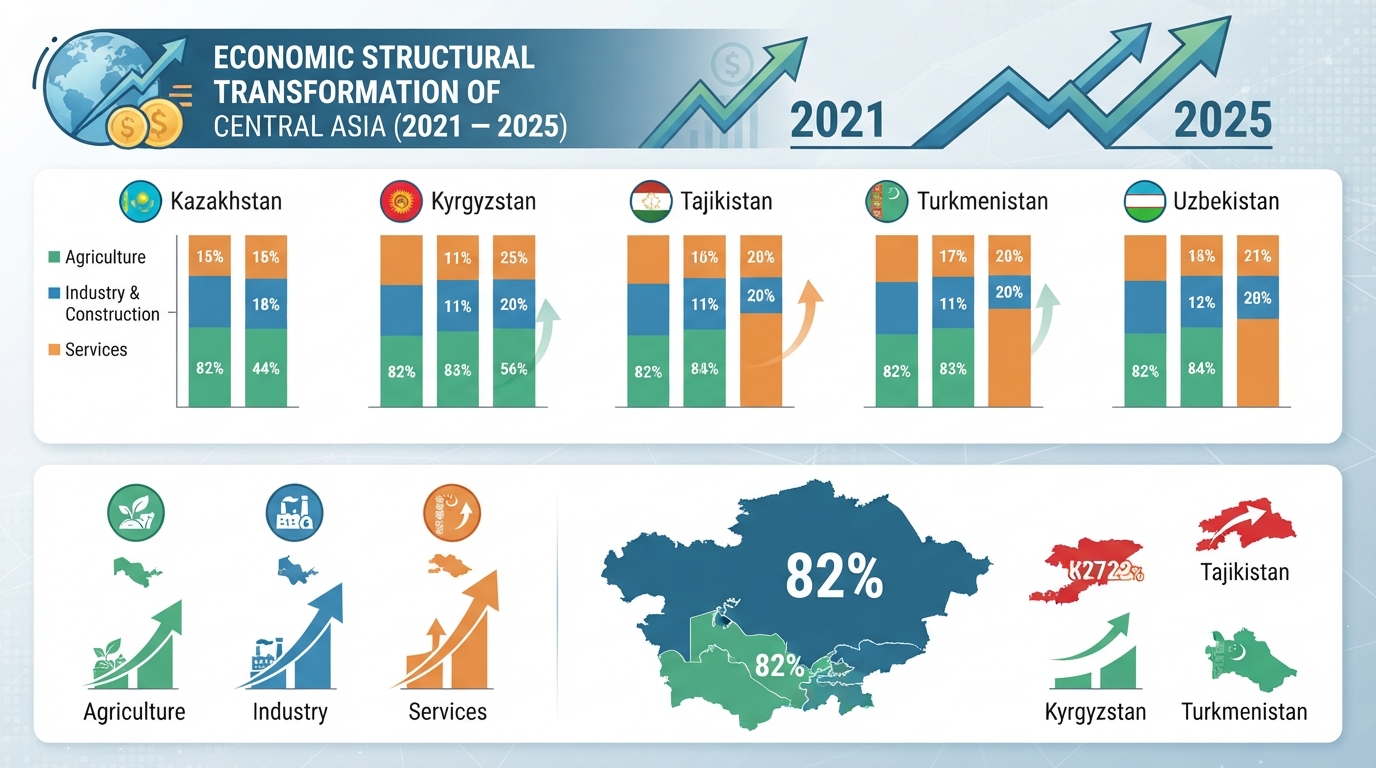
In the structure of Kazakhstan's GDP, the share of agriculture decreased — from 5.4% to 3.7% (−1.6 p.p.), as well as industry and construction — from 33.1% to 32.3% (−0.8 p.p.). At the same time, the share of services grew — from 56.1% to 57.7% (+1.6 p.p.). The average annual real growth of value added in agriculture was 3.5%, industry and construction — 5.5%, services — 4.4%.
Kyrgyzstan's GDP grew from $8.3 billion to $22.6 billion with an average annual growth of 9.2% — this is the highest rate among the countries of the region. The acceleration became sustainable after 2021: real GDP growth was about 9% annually in 2022–2023 and exceeded 11% in 2024–2025.
In the structure of Kyrgyzstan's economy, the share of agriculture decreased from 12.2% to 8.0% (−4.2 p.p.), industry and construction remained almost unchanged — from 26.9% to 26.5% (−0.4 p.p.), and services grew slightly from 50.7% to 51.2% (+0.5 p.p.). The average annual real growth of value added in agriculture was 2.3%, industry and construction — 10.5%, services — 8.5%.
Tajikistan's economy increased from $8.1 billion to $17.7 billion with average annual rates of 8.5%. In the structure of GDP, the share of agriculture remained almost unchanged — growth from 22.7% to 22.9% (+0.2 p.p.), the share of industry and construction decreased from 33.8% to 32.2% (−1.6 p.p.), and services grew from 35.3% to 38.0% (+2.7 p.p.). The average annual real growth of value added in agriculture was 1.2%, in industry and construction — 10%, in services — 9.7% (average annual growth rates by economic sectors for 2021-2024).
Turkmenistan's GDP in 2021-2025 increased from $27.4 billion to $49.8 billion with an average annual real growth of 6.3%. The share of agriculture in the economy grew from 11.6% to 12.4% (+0.8 p.p.), mainly at the expense of industry and construction, whose weight decreased from 36.9% to 36% (−0.9 p.p.). The share of services increased from 48.6% to 48.9% (+0.2 p.p.). The average annual real growth of value added in agriculture was 5.7%, industry and construction — 5.1%, services — 11.3%.
Uzbekistan increased the size of its economy from $70.1 billion to $147 billion with an average annual growth of 7%. During the period under review, a pronounced structural transformation was observed: the share of agriculture decreased from 21.6% to 16.6% (−5.0 p.p.) with average annual growth rates of this sector at 3.9%. The weight of industry and construction decreased from 33.4% to 32.5% (−0.8 p.p.) with an average annual growth of 7.2%. At the same time, the share of services grew from 38.7% to 46.5% (+7.7 p.p.), providing the highest growth rates — an average of 8.7% per year.
In general, in 2021-2025, common trends for all countries in the region were GDP growth, faster growth of value added in industry and construction compared to agriculture, dominance of the service sector in the economy, and an increase in its share in the structure of GDP.
In the sectoral structure of regional GDP in 2021-2025, the share of services grew from 50.4% to 53% (+2.6 p.p.), while the share of agriculture decreased from 10.7% to 8.8%, and industry (including construction) — from 33.4% to 32.5%.
The reduction in the regional share of agriculture occurred primarily due to changes in the structure of the region's large economies — Uzbekistan and Kazakhstan, as well as a noticeable decline in this sector in Kyrgyzstan. At the same time, the volume of agricultural value added grew in all five countries. Consequently, the decrease in the share of agriculture was associated precisely with slower growth rates compared to other sectors of the economy. In particular, in all countries, the real value added of industry and construction grew faster than agriculture.
A comparison of the intermediate years shows that sustainable and reversible changes can be distinguished. In Uzbekistan, the growth of the share of the service sector and the decline in the weight of the agricultural sector can be traced almost annually; in Kyrgyzstan, the share of the agricultural sector decreased most consistently. In Kazakhstan and Turkmenistan, the service sector first reduced its share, and then expanded again, and in 2025 already exceeded the level of 2020. In Tajikistan, services gradually increased their share after 2021, but agriculture maintained its former weight and importance in the economy.
In general, it can be stated that there was no single model of structural transformation for all five countries of the region. Kazakhstan started this period already with a high share of services, which then moderately increased; Uzbekistan significantly expanded the service sector in its economy at the expense of the agricultural sector; Kyrgyzstan sharply reduced the share of agriculture with positive dynamics of real growth in industry; Tajikistan's economy maintained a large agricultural sector; and Turkmenistan observed a stable ratio of the shares of all major sectors of the economy.
Summing up, it should be noted once again that during these five years, the economies of all countries in the region grew steadily. At the same time, the relative role of Uzbekistan and Kyrgyzstan increased in the regional structure, although Kazakhstan still generates more than half of the combined GDP. At the sectoral level, the most sustainable overall result is expressed in the growth of the share of services in the countries of the region, which indicates the continuation of the development vector aimed at making the economies of Central Asia more complex and transitioning to models of a more diversified and complex structure.