

Mutual trade of Central Asian countries for 7 months of 2026.
Based on the results of January–July 2026, mutual trade among the Central Asian states maintained high dynamics. Its volume increased by 25.4% and reached 8.1 billion USD.
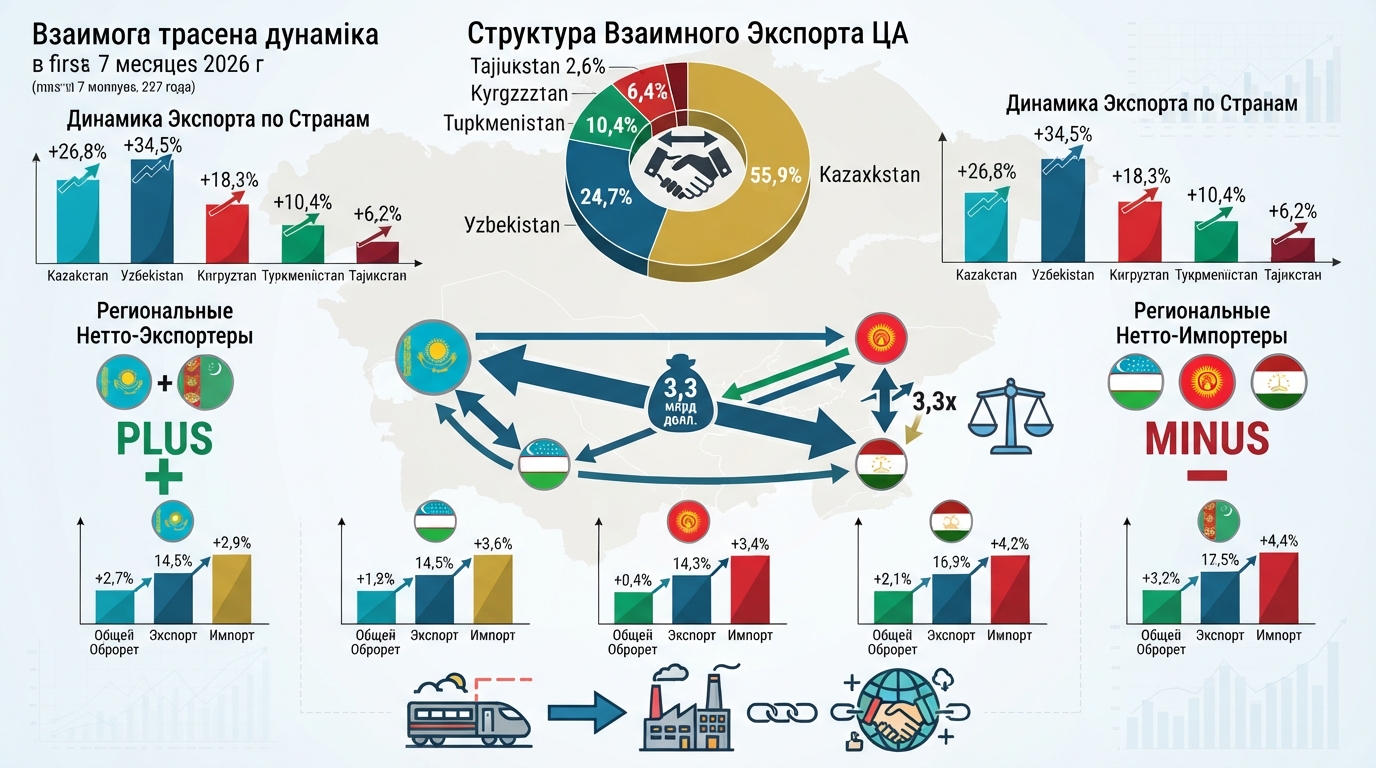
Mutual Trade of Central Asian Countries for 7 Months of 2026
The sum of export deliveries from each country to other Central Asian states is used as an indicator of intraregional trade. This method avoids double counting, as the same transaction is recorded as an export of one country and an import of another. For Turkmenistan, mirror data from the national statistics of Central Asian countries were used.
All Central Asian countries increased their deliveries to the states of the region. The main volumes and dynamics are accounted for by Kazakhstan and Uzbekistan. Kazakhstan's exports to the countries of the region grew by 26.8% to $4.5 billion, while Uzbekistan's grew by 34.5% to $2 billion. Deliveries from Kyrgyzstan increased by 18.3% to $523 million, Turkmenistan's by 10.4% to $844 million, and Tajikistan's by 6.2% to $209 million.
In the structure of mutual exports, Kazakhstan accounts for the largest share — 55.9% of the total volume. The share of Uzbekistan was 24.7%, Turkmenistan — 10.4%, Kyrgyzstan — 6.4%, and Tajikistan — 2.6%. Thus, Kazakhstan and Uzbekistan together provided 80.6% of intraregional deliveries. In addition, they accounted for about 90% of the growth in Central Asia's mutual exports.
The largest trade direction remains the exchange between Kazakhstan and Uzbekistan. The volume of bilateral trade in the first seven months of 2026 reached $3.3 billion. Trade between Kazakhstan and Kyrgyzstan, as well as Tajikistan, and Uzbekistan's ties with Kyrgyzstan, Tajikistan, and Turkmenistan are also of significant importance. The trend toward increasing trade between Kyrgyzstan and Tajikistan also continues. At the same time, direct exchange between Kyrgyzstan, Tajikistan, and Turkmenistan remains relatively small.
By the nature of their participation in mutual trade, Central Asian countries are divided into two groups. Kazakhstan and Turkmenistan act predominantly as regional net exporters. Uzbekistan, Kyrgyzstan, and Tajikistan remain net importers.
Country Trade Trends with the Region
In January–July 2026, Kazakhstan's trade turnover with Central Asian countries reached $5.9 billion, growing by 25%. Exports increased by 26.8% to $4.5 billion, while imports rose by 19.2% to $1.4 billion. Exports exceeded imports by more than three times, and the trade surplus with the region amounted to about $3.2 billion.
Central Asia accounted for 6.7% of Kazakhstan's total foreign trade, including 8.9% of exports and 3.7% of imports. For the country, the region retains a significantly higher value as a sales market than as a source of supply.
Uzbekistan remains Kazakhstan's main partner, accounting for 55% of the country's trade with the region. The share of Kyrgyzstan was 25%, Tajikistan — 14%, and Turkmenistan — 5%.
All directions showed growth: trade with Uzbekistan increased by 30%, with Tajikistan — by 25%, with Kyrgyzstan — by 20%, and with Turkmenistan — by 6.1%. Thus, Kazakhstan is actively increasing its trade volume with the countries of the region this year.
Uzbekistan's trade with Central Asian countries grew by 28% and reached $5.4 billion. Exports increased by 35% to $2 billion, while imports rose by 25% to $3.4 billion. The trade deficit amounted to about $1.4 billion. The import deficit was concentrated in trade with Kazakhstan and Turkmenistan, while Uzbekistan maintained a surplus with Kyrgyzstan and Tajikistan.
The region provided 10.9% of Uzbekistan's foreign trade, 10.1% of exports, and 11.4% of imports. Similar shares in foreign trade flows indicate a relatively balanced role of Central Asia as both a sales market and a source of supply.
Kazakhstan accounted for 61% of Uzbekistan's trade with the region, Kyrgyzstan — 14%, Turkmenistan — 15%, and Tajikistan — 11%. At the same time, smaller directions grew the fastest: trade turnover with Kyrgyzstan increased by 54%, and with Tajikistan — by 45%. Trade with Kazakhstan grew by 24%, and with Turkmenistan — by 16%. This indicates a gradual expansion of the geography of Uzbekistan's regional exchange.
Kyrgyzstan's trade turnover with Central Asian countries reached $2 billion, increasing by 12.3%. Imports amounted to $1.5 billion, growing by 10.3%, while exports were $523 million, with an 18.3% growth. Despite the faster growth of exports, the trade deficit remained significant at $942 million.
Central Asian countries accounted for 19.9% of Kyrgyzstan's foreign trade turnover, 17.6% of imports, and 31.4% of exports. The countries of the region are of great importance for Kyrgyzstan, especially as sales markets for its products.
Kyrgyzstan's regional trade is concentrated mainly in two directions. Kazakhstan formed 61% of the trade turnover with Central Asian countries, and Uzbekistan — 36%. The share of Tajikistan was 2.1%, and Turkmenistan — 1.4%. Trade with Uzbekistan grew by 40.3%, and with Tajikistan — 3.3 times. Meanwhile, trade turnover with Kazakhstan decreased by 0.6%, and with Turkmenistan — by 25.8%.
Tajikistan increased its trade turnover with Central Asian countries by 30% to $1.4 billion. Imports grew by 35% to $1.2 billion, while exports rose by 6.2% to $209 million. As a result, the trade deficit with the region reached $977 million.
Central Asia accounted for 17.6% of Tajikistan's total foreign trade, 19.2% of imports, and 11.7% of exports. For the country, the region is of higher importance as a source of goods than as a sales market.
Kazakhstan remains the dominant partner, accounting for 64% of Tajikistan's trade with the countries of the region. The share of Uzbekistan was 30%, Turkmenistan — 3.4%, and Kyrgyzstan — 2.7%.
Over the 7 months, trade turnover grew with all countries of the region, in particular with Kazakhstan — by 32.7%, and with Uzbekistan — by 13%. The highest growth rates were shown by trade with Kyrgyzstan and Turkmenistan, though their volumes remain small.
According to mirror data, Turkmenistan's exports to Central Asian countries amounted to $844 million, an increase of 10%. The country accounted for 10% of the region's mutual exports. The main destinations remain Uzbekistan and Kazakhstan, while deliveries to Kyrgyzstan and Tajikistan maintain a limited scale.
Overall, the results of January–July 2026 confirm the preservation of positive dynamics in intraregional trade. Particularly notable was the strengthening of Uzbekistan's trade with Kyrgyzstan and Tajikistan, as well as the further revival of Kyrgyz-Tajik exchange.
At the same time, direct flows between Kyrgyzstan, Tajikistan, and Turkmenistan remain small, and large trade imbalances and high concentration of country directions persist.
In this context, the transition from predominantly bilateral exchange to multilateral production ties is of particular importance. This requires further removal of non-tariff barriers, development of border infrastructure, convergence of technical requirements, expansion of non-resource exports, and the formation of cross-border value chains.