

Mutual Trade among Central Asian Countries in the First Half of 2026
In the first half of 2026, mutual trade among Central Asian countries maintained strong momentum, increasing by 25.3% to $6.7 billion.
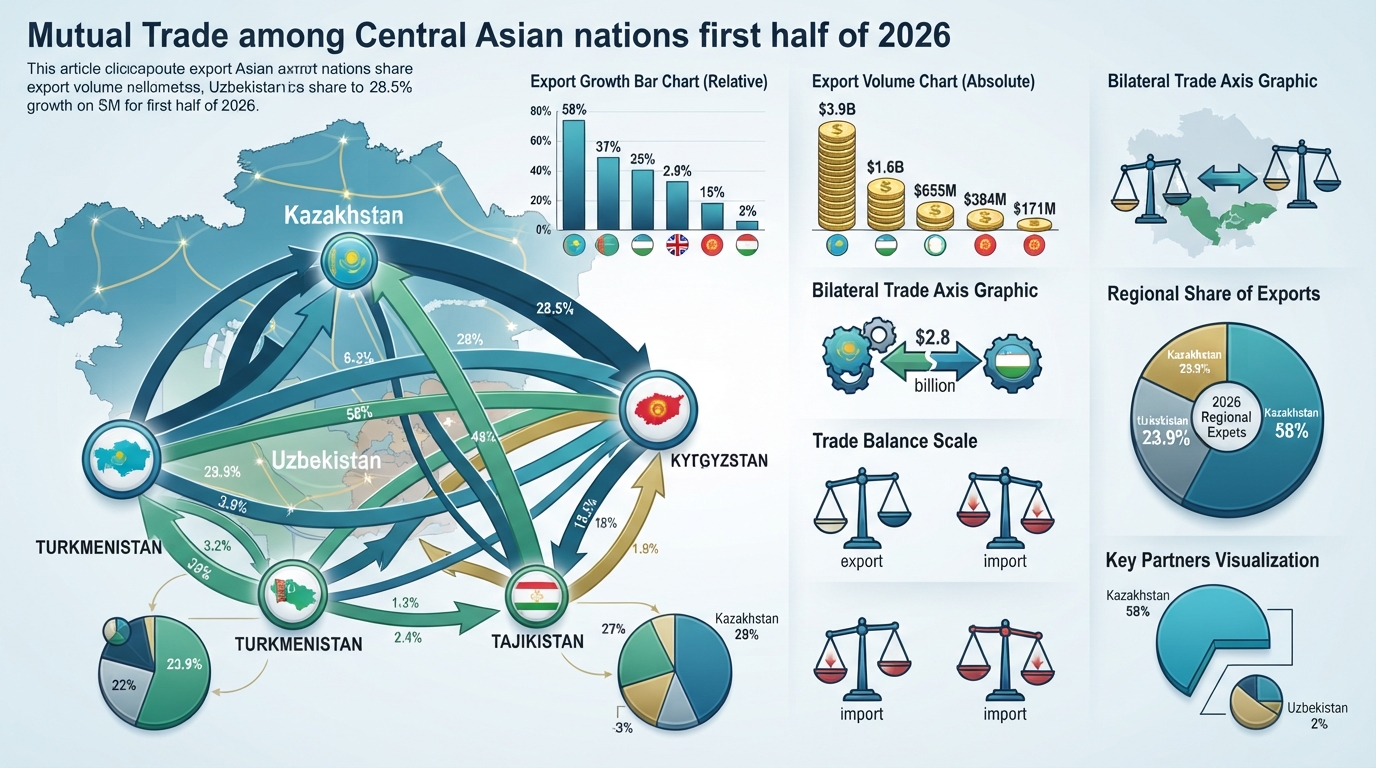
Mutual Trade Among Central Asian Nations in the First Half of 2026
All Central Asian nations contributed to the overall growth in mutual trade during the first half of 2026.
Kazakhstan led the region in intra-regional export growth, with a 28.5% increase, reaching $3.9 billion, which represents 58% of the total mutual exports. Uzbekistan's exports saw a 27.2% rise to $1.6 billion (23.9% of the total). Turkmenistan followed with a 19.2% increase, reaching $655 million (9.8%), and Tajikistan's exports grew by 15.8% to $171 million (2.6%). Kyrgyzstan's export growth significantly lagged the regional trend, increasing by only 4.5% to $384 million (5.7%).
The most substantial absolute increases in exports originated from Kazakhstan (an additional $862 million, accounting for 64% of the total increase) and Uzbekistan (an additional $341 million, or 25% of the increase). These two countries form the region's largest trade axis, with their bilateral trade turnover reaching $2.8 billion, according to data from both sides.
Other notable trade connections include Kazakhstan's trade with Kyrgyzstan and Tajikistan, as well as Uzbekistan's trade with Kyrgyzstan, Tajikistan, and Turkmenistan. In contrast, trade among Kyrgyzstan, Tajikistan, and Turkmenistan remains relatively constrained, indicating a lack of diversification in direct trade links among the region's smaller economies.
A significant trend this year has been the continued substantial increase in mutual trade between Kyrgyzstan and Tajikistan, coinciding with improved bilateral relations, as evidenced by both countries' statistics.
Overall, the participation of countries in mutual trade remains uneven. Kazakhstan stands as the region's largest net exporter, with its exports to other Central Asian countries exceeding its imports by more than threefold. Turkmenistan also primarily functions as a supplier. Uzbekistan, Kyrgyzstan, and Tajikistan, however, experience trade deficits within the region.
Intra-regional trade is calculated by summing each country's exports to other Central Asian states, thereby avoiding double-counting (where a single transaction is recorded as both an export by one country and an import by another). For Turkmenistan, mirror data from the national statistics of other Central Asian countries were utilized.
**Country Trends in Trade with the Region**
**January–June 2026:**
**Kazakhstan's** trade turnover with Central Asian countries reached $5.1 billion, marking a 28.1% increase. Exports grew by 28.5% to $3.9 billion, while imports increased by 26.5% to $1.2 billion. This resulted in a 29% expansion of the trade surplus, reaching $2.7 billion.
Central Asia accounted for 7.1% of Kazakhstan's total foreign trade, comprising 9.6% of its exports and 3.9% of its imports. This indicates that the region is more crucial to Kazakhstan as an export market than as a source of imports.
Uzbekistan remains Kazakhstan's primary regional trading partner, representing 55% of Kazakhstan's trade with Central Asia. Kyrgyzstan accounted for 25%, Tajikistan for 14.5%, and Turkmenistan for 5.4%.
**Uzbekistan's** trade with Central Asian countries experienced the fastest growth, increasing by 29.6% to $4.4 billion. Exports rose by 27.2% to $1.6 billion, while imports increased by 31.1% to $2.8 billion. The trade deficit widened by 36.5% to $1.3 billion. Uzbekistan's import deficit is predominantly concentrated in trade with Kazakhstan and Turkmenistan, whereas trade with Kyrgyzstan and Tajikistan generated a surplus.
Central Asia constituted 10.8% of Uzbekistan's foreign trade, with 10.1% of its exports and 11.3% of its imports. Similar shares in exports and imports suggest a relatively balanced role for Central Asia in the country's foreign trade landscape.
Kazakhstan accounted for 62.7% of Uzbekistan's trade with the region, Kyrgyzstan for 14.1%, Turkmenistan for 13.5%, and Tajikistan for 9.8%. Notably, the latter three directions recorded faster growth, indicating a gradual diversification of Uzbekistan's regional trade links.
**Kyrgyzstan** remains the country whose national exports are most reliant on Central Asian markets. Trade turnover with the region reached $1.5 billion, an increase of 3.2%. Imports amounted to $1.2 billion (+2.8%), while exports reached $384 million (+4.5%). The trade deficit remained largely unchanged from the previous year at $774 million.
Central Asia accounted for 19.5% of Kyrgyzstan's total foreign trade, including 16.9% of imports and 35.9% of exports. This represents the highest share of the region in exports among Central Asian countries. Despite relatively modest growth, this highlights the region's role as a vital and stabilizing market for Kyrgyz goods amidst an overall decline in the country's exports.
Kyrgyzstan's regional trade is primarily concentrated in two directions: Kazakhstan, which accounts for 60% of its trade with the region, and Uzbekistan, with 36%. Tajikistan accounted for 2.1% in the first half of the year, and Turkmenistan for 1.7%.
**Tajikistan** increased its trade turnover with Central Asian countries by 29% to $1.2 billion. Imports amounted to $984 million, while exports reached $171 million. The trade deficit widened by 35% to $813 million.
The region accounted for 16.9% of Tajikistan's foreign trade, including 18.8% of imports and 10.8% of exports, confirming that neighboring countries serve more as a source of goods than as an export market.
Kazakhstan remains Tajikistan's dominant regional partner, accounting for 66.7% of its trade with Central Asia. Uzbekistan accounts for 29.2%, Kyrgyzstan for 2.5%, and Turkmenistan for 1.6%. Thus, despite strong overall growth, Tajikistan's export base remains narrow, and its trade flows are heavily concentrated on Kazakhstan and Uzbekistan.
According to mirror data, **Turkmenistan** exported $655 million worth of goods to Central Asian countries, a 19.2% increase year-on-year. Its main destinations are Uzbekistan and Kazakhstan, while trade with Kyrgyzstan and Tajikistan remains limited.
Overall, Central Asia maintained a positive trajectory in mutual trade during the first half of 2026. These results reflect expanding regional demand, improved dialogue, the recovery of certain cross-border trade links, and strengthened transport and logistics connectivity.
However, Kazakhstan and Uzbekistan account for over 80% of mutual exports, and nearly 90% of the total increase originated from these two countries. Direct trade among Kyrgyzstan, Tajikistan, and Turkmenistan remains limited, and significant trade imbalances persist. This indicates low diversification of intra-regional trade flows and limited mutual economic and industrial integration.
Against this backdrop, it is particularly important to transition from predominantly bilateral trade flows towards multilateral production linkages, diversify the structure of trade, expand non-resource exports, and develop cross-border production chains.