

Those risen from the ashes will mark the living
In many traditions of Central Asia, a cemetery was never considered just a plot of land. It was called a place of rest, not a place of death. This distinction is huge
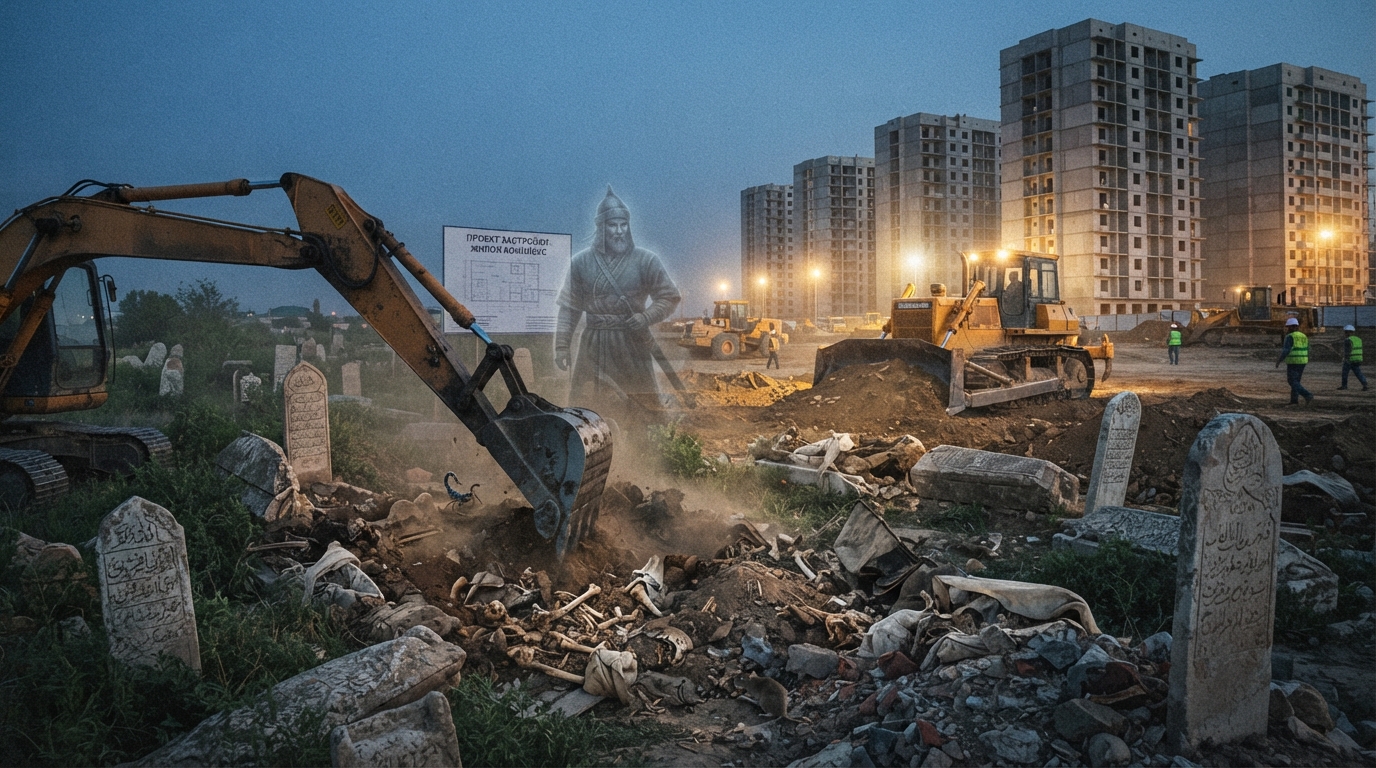
Those Risen from the Dust Will Mark the Living
In recent days, old cemeteries have once again become a topic of discussion in Uzbekistan. The catalyst was a publication discussing the possibility of relocating several ancient necropolises for the sake of large-scale urban development and infrastructure expansion. On paper, this sounds almost bureaucratic: relocation, reconstruction, beautification, land development. Paper loves such words. They are smooth, sterile, devoid of memory. But memory is never sterile. It lives in the earth. And it is the earth that is the first to resist when man attempts to rewrite its history.
There is an ancient Eastern thought that cannot be verified by instruments, yet cannot be definitively refuted either. It asserts that a person dies twice. The first time is when the heart stops. The second is when the last place where they are remembered disappears. As long as a grave exists, an invisible thread remains between the world of the living and the world of the departed. It may be weak, almost imperceptible, but it is precisely what maintains the balance.
In many traditions of Central Asia, a cemetery was never considered merely a plot of land. It was called a place of rest, not a place of death. The difference is immense. Rest is a state that cannot be disturbed without consequences. And the consequences were understood not as thunder from heaven, but as a disruption of the order of things.
Astrologers of the ancient East said that every space is governed by its own celestial seal. A house is ruled by one energy, a market by another, a road by a third. A cemetery is ruled by Saturn—the slowest and heaviest planet of ancient astrology. It was called the keeper of time, karma, and ancestral memory. Saturn is never in a hurry. It does not punish instantly. It simply returns to man what man himself has disrupted.
This is precisely why the elders always used a striking phrase: a cemetery must not be disturbed without extreme necessity. Not because the dead are more frightening than the living. But because memory is heavier than stone.
There are stories that humanity repeats over and over again. The most famous one for Central Asia began in the summer of 1941.
On June 19, Soviet scientists opened the mausoleum of Tamerlane in Samarkand. An expedition led by anthropologist Mikhail Gerasimov examined the remains of the great conqueror to reconstruct his physical appearance. This is a historical fact. But almost simultaneously, a legend was born that has survived for decades.
It is said that the elders warned the expedition members. On one of the stones, there was allegedly an inscription: "Whoever disturbs my peace will unleash the spirit of war." Three days later, the Great Patriotic War began.
Historians debate whether such an inscription actually existed. Many consider it a later folk legend. But what is surprising is something else. Millions of people in Uzbekistan, Russia, Tajikistan, and Kazakhstan know it almost word for word. The legend proved stronger than the document.
A few months later, Tamerlane's remains were reburied according to Muslim rites. And almost immediately, a new legend arose: after the return of the ashes, the fate of the war changed. A coincidence? Perhaps. But the East has never lived by facts alone. It has lived by signs.
There are things that become part of collective memory precisely because people sense meaning in them.
A similar story occurred long before Samarkand, in distant Egypt. When archaeologists opened the tomb of Tutankhamun, the world was swept by a wave of stories about the "curse of the pharaoh." Newspapers wrote about the mysterious deaths of expedition members, accidents, illnesses, and strange coincidences. Later, scientists found rational explanations for many of the events: infections, mold, climatic features, and ordinary human mortality statistics. But the myth lived on with a life of its own.
Why? Because humanity has always felt an internal boundary between exploring the past and intruding upon it.
In Japan, there are ancient cemeteries through which roads have not been built for centuries, even though it would have been economically more profitable. In China, the art of feng shui forbade the destruction of ancestral sites, believing that it disrupted the flow of energy of an entire lineage. In Orthodox culture, old cemeteries often became the centers of new churches, rather than construction sites.
Different religions. Different civilizations. The exact same fear. Probably because everyone understood one thing: the dead belong to time, not to man.
Esotericists like to speak of so-called memory places of the Earth. These are spaces where human energy has accumulated for centuries. One may believe this or not, but it is difficult to deny the emotional power of such places. One only has to stand in an old cemetery, where the trees are older than the state, where the inscriptions have been worn away by rain, and the stones have sunk halfway into the ground, and a sense of the presence of history arises—one that cannot be seen with the eyes.
Perhaps it is this very feeling that people once called energy.
It is said that any cemetery resembles a vast library. Only instead of books, there are destinies here. Instead of pages—the earth. Instead of words—silence. If you destroy a library, knowledge disappears. If you destroy a cemetery, memory disappears.
And then memory begins to search for another place.
There is an ancient belief that existed as far back as the Sogdians. They believed that the souls of the deceased remain guardians of the land for forty generations, as long as their place of rest exists. When the place disappears, the guardians become wanderers. They do not harm anyone on purpose. But the disrupted balance begins to reflect in the destinies of the living.
This is a beautiful legend. Perhaps only a legend. But why does practically every nation have a similar one?
Astrology also offers its own language of explanation. September is traditionally associated with the transition of the solar cycle to the autumn equinox. This is the moment when day and night become equal. In many esoteric schools, it is believed that it is at this time that the boundary between the past and the present thins. The Moon is responsible for ancestral memory, Saturn for generational debts, and Pluto for deep transformations and everything connected with the world of the departed.
Astrologers call such periods a time when one should not begin undertakings associated with the destruction of ancient places of memory. This is the language of symbols, not science. But symbols sometimes influence society more strongly than statistics.
In the old mahallas of Samarkand, one can hear a story about a house built on the site of a forgotten cemetery. The elders say that residents did not stay long, misfortunes constantly occurred, and then the place stood empty for years. There are no documents. There is only the story.
In Bukhara, there is a legend about a master who used old gravestones to build a wealthy courtyard. The house turned out to be beautiful, but the family gradually left it after a series of tragedies. The story has long dissolved into folk memory, and no one can say anymore where the truth ends and speculation begins. But it is these stories that shape the people's attitude toward their own land.
The strangest thing in human history is that people rarely fear destroying the past. They only fear the consequences when it is already too late.
Any old cemetery is a complex ecosystem. The soil has existed in a special state for decades or centuries. Trees, insects, microorganisms, and birds form a stable natural space. During large-scale excavation work, this balance is inevitably disrupted. Ecologists have long said that any such projects require an extremely cautious environmental impact assessment.
The popular consciousness translates this thought into an image: do not disturb the earth, and the earth will not disturb you.
There is a superstition that where ancient graves are dug up without respect, rats are the first to appear. In Eastern legends, the rat was never just an animal. It was considered a creature that senses the destruction of the underworld before man does. It is a symbol of the earth's unease.
The scorpion also holds a special meaning in desert culture. It appears where the shelter of stones and dry soil has been disturbed. Therefore, stories of scorpions near disturbed necropolises exist in many regions of Central Asia as an element of folklore. Legends linked these animals to the disruption of ancestral peace, though in reality, their appearance can be explained by the change in habitat during excavation work.
The same applies to diseases. Epidemics of plague, cholera, and anthrax have left such a deep mark on human memory that any old burial site is approached with extreme caution. This is precisely why modern sanitary standards require strict procedures during any exhumations and relocations of remains. Not because a curse exists, but because history has taught us to respect the unknown.
There is another almost forgotten Eastern thought. It says that every city stands on three foundations: water, prayer, and memory. If water disappears, drought comes. If prayer disappears, emptiness comes. If memory disappears, unease comes.
No one knows if heavenly punishment exists in a literal sense. Perhaps the heavens do not punish at all. Perhaps man does it to himself when he forgets his limits.
The story of Tamerlane is important not because it proves mysticism. It serves as a reminder of human responsibility to the past. The legend has survived for nearly a century precisely because it became a moral warning: there are doors that are best opened only when it is impossible to do otherwise.
And if even thousands of years of human memory, dozens of cultures, and a multitude of legends converge on one simple thought—not to disturb the peace of those who have already departed—then perhaps it is worth at least stopping and listening to this silence.
Sometimes the silence of the ancient earth sounds more convincing than the loudest of human projects.