

"To answer love with memory." A monument to the legendary historian and local historian Boris Golender may appear in Tashkent
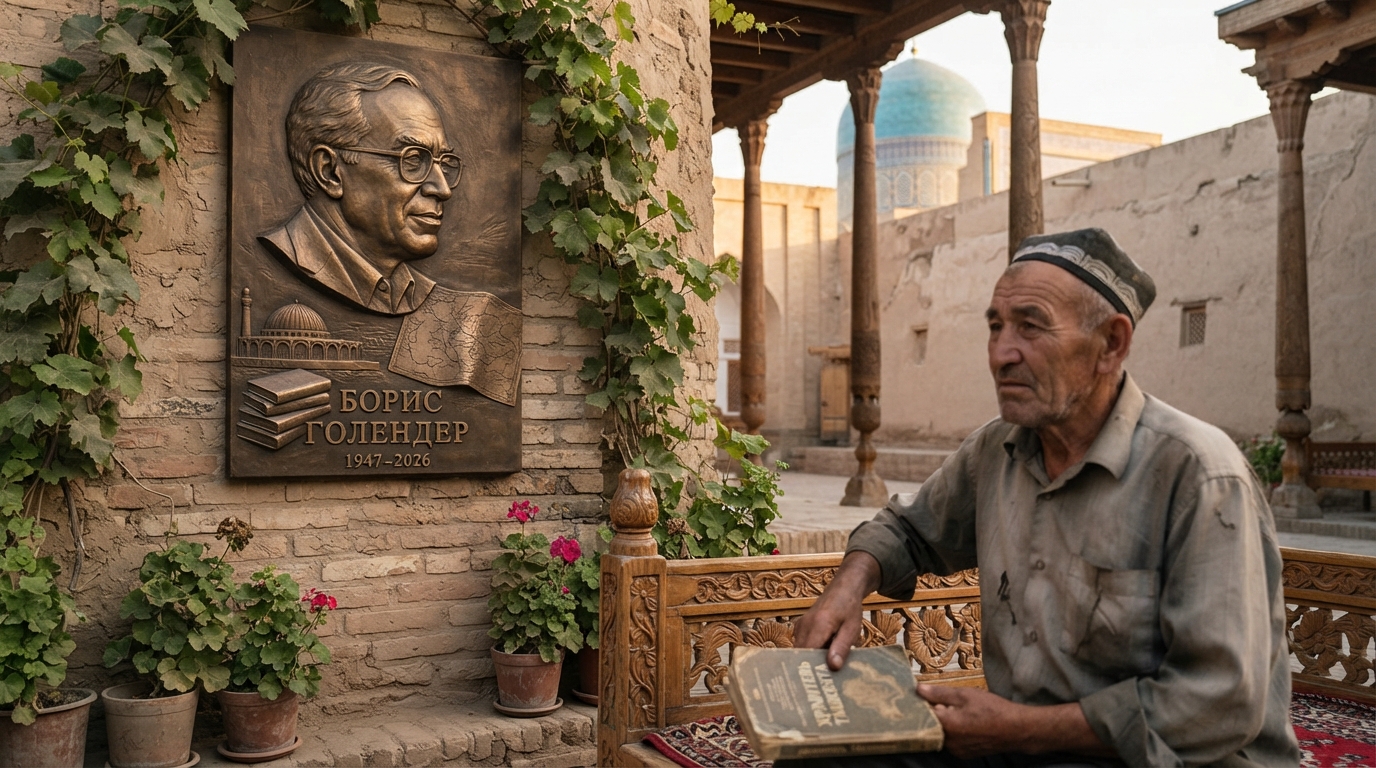
"To respond to love with memory." A monument to the legendary historian and local historian Boris Golender may appear in Tashkent
In Tashkent, several ways to preserve the memory of Boris Golender—a historian and local historian who for decades studied the history of Uzbekistan and introduced it to residents and guests of the country—are being discussed. Among the options mentioned are a monument in Tashkent, a memorial bas-relief on one of the historical walls, and a commemorative sign at Charvak.
Boris Golender died on February 5, 2026, in his 79th year of life. Over many years of work, he became one of the most recognizable experts on the history of Tashkent: he conducted excursions and lectures, wrote books, appeared on television, and spoke about the city in numerous media projects.
One of the initiators of the monument's installation was the Tashkent Business Club named after Ilkhom Karimov, of which Golender was a member for about 20 years. Alexey Arapov, Chairman of the Board of the club, is confident that the image of a man who dedicated a significant part of his life to Tashkent should remain in the urban space.
"The number of people who went on excursions with him in Tashkent is counted in the thousands, and those who listened to his television appearances, lectures, or video stories about the city—there are certainly hundreds of thousands, if not millions of them," Arapov noted in a conversation with a Podrobno.uz correspondent.
According to him, Golender's name has almost become a household word for many when referring to a person who thoroughly knows the history of a specific city.
The business club proposes to erect a monument on one of the capital's streets. Arapov compared this initiative to the discussion of a monument to Sergei Yesenin, who spent about a month and a half in Tashkent.
"Golender, on the other hand, gave his whole life to Tashkent, so returning this debt of love, memory, and knowledge to him is a direct duty of the city," he believes.
In addition to the idea of a monument, the business club and Boris Anatolyevich's close circle are already working on preserving his textual heritage. In particular, for the historian's 80th anniversary, it is planned to release a commemorative book under the working title "The Keeper of Tashkent."
Another initiative is connected with Charvak. The creators of the ZBS podcast, who filmed a documentary about the environmental problems of the Charvak Reservoir, are also considering the possibility of installing a monument to Golender there. The local historian participated in the filming of the project, and his stories and communication with the creators, according to them, became one of the reasons that prompted them to continue working on the topic and address the issues of landscaping the area.
According to the project team, the monument to Golender is planned to be installed after the reservoir area is cleaned up. They expect to start implementing this idea in approximately three years. Answering a question about funding, the project's creators said they hope to attract sponsors.
At the same time, among people who knew the historian well, there is no consensus on what exactly such a monument should be. Rustam Khusanov, moderator of the X-Place group, who cared for the local historian for a long time and considers him his main teacher, emphasized that for him this issue is very personal.
"I wouldn't want a monument to him to appear just for the sake of having a monument—so that people would leave bottles and trash nearby or treat it disrespectfully. For me, that would be almost an insult to his memory. I would very much like a monument on his grave and a bas-relief on a wall, but I cannot name a place for the bas-relief yet—I need to think about it," Rustam Khusanov shared with the Podrobno.uz correspondent.
So far, none of the initiatives has received official status, and the city authorities have not yet voiced their position. However, the very fact that the issue of a monument was raised simultaneously by a business club, creators of documentary media projects, and close friends of the local historian shows that there is a deep and sincere demand in Tashkent to preserve the memory of a man who spent his entire life carefully preserving the memory of the city itself.