

Bright plaques on monuments outraged Tashkent residents. They began to be removed.
Tashkent residents, including Gazeta journalists, began sounding the alarm after bright yellow "Under State Protection" signs appeared on architectural monuments. Following criticism from architect Alexander Fedorov, the sign was removed from the "Courage" monument.
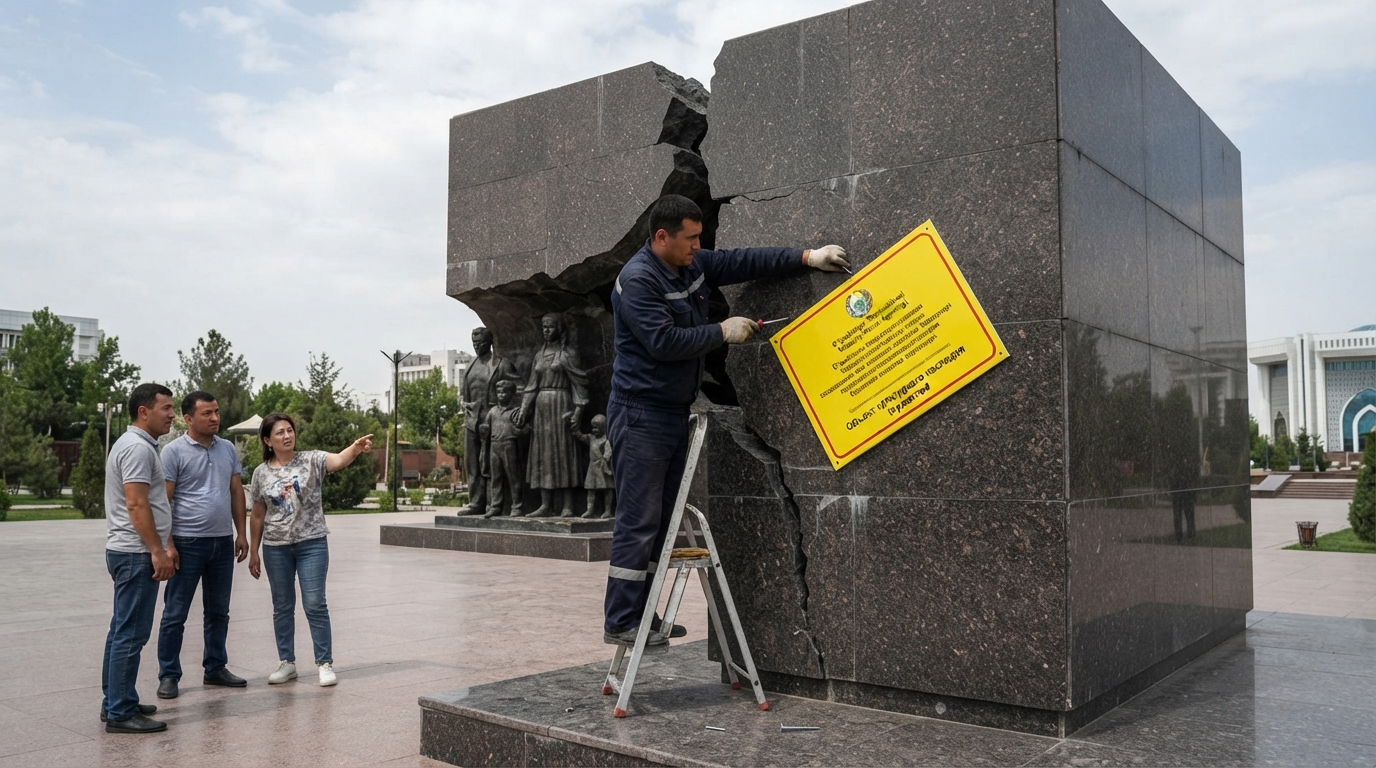
Bright yellow signs that have appeared on architectural monuments in Tashkent in recent weeks have sparked public outrage and are now being removed. These signs indicated that the site was under state protection.
They could be seen, in particular, at the entrance to the Kosmonavtov metro station, recently inscribed on the UNESCO World Heritage List, on the black cube of the Courage Memorial Complex, dedicated to the aftermath of the 1966 Tashkent earthquake, and on the monument to Indian Prime Minister Lal Bahadur Shastri, who died in the Uzbek capital in 1966.
The newspaper "Gazeta" contacted the Tashkent city administration and the Agency for Cultural Heritage, expressing concern that the garish signs were detracting from the monuments' appearance, drawing undue attention with their color, which is typically associated with danger. Furthermore, the signs were attached directly to the monuments with screws, causing physical damage to the structures.
Both agencies said they were investigating the situation and had communicated the information to the relevant officials. A source told Gazeta that the plaques had been approved by the Scientific Expert Council of the Agency for Cultural Heritage.
On Wednesday, architect Alexander Fedorov, author of the Instagram account Tashkent Modernism, published a post criticizing the treatment of the "Courage" monument. He called it "the heart of Tashkent's historical memory, where every stone bears an echo of 1966," and asked, "Are modern architectural solutions in the form of tasteless plaques and cheap plastic really worthy of a monument that has become a symbol of the resilience of an entire nation?"
The author emphasized that the placement of such a plaque in itself violates the protected status of the monument. He also noted that the crack on the cube, reminiscent of the earthquake, has been partially covered over.
The Cultural Heritage Agency's press service told Gazeta that the plaque on the "Courage" monument has already been removed. It will be relocated, and its design will be revised, the agency noted.