

There beyond the clouds
Tashkent and Astana expect to make money on virtual clouds. The digital plans of the two Central Asian countries require new energy solutions
There Beyond the Clouds
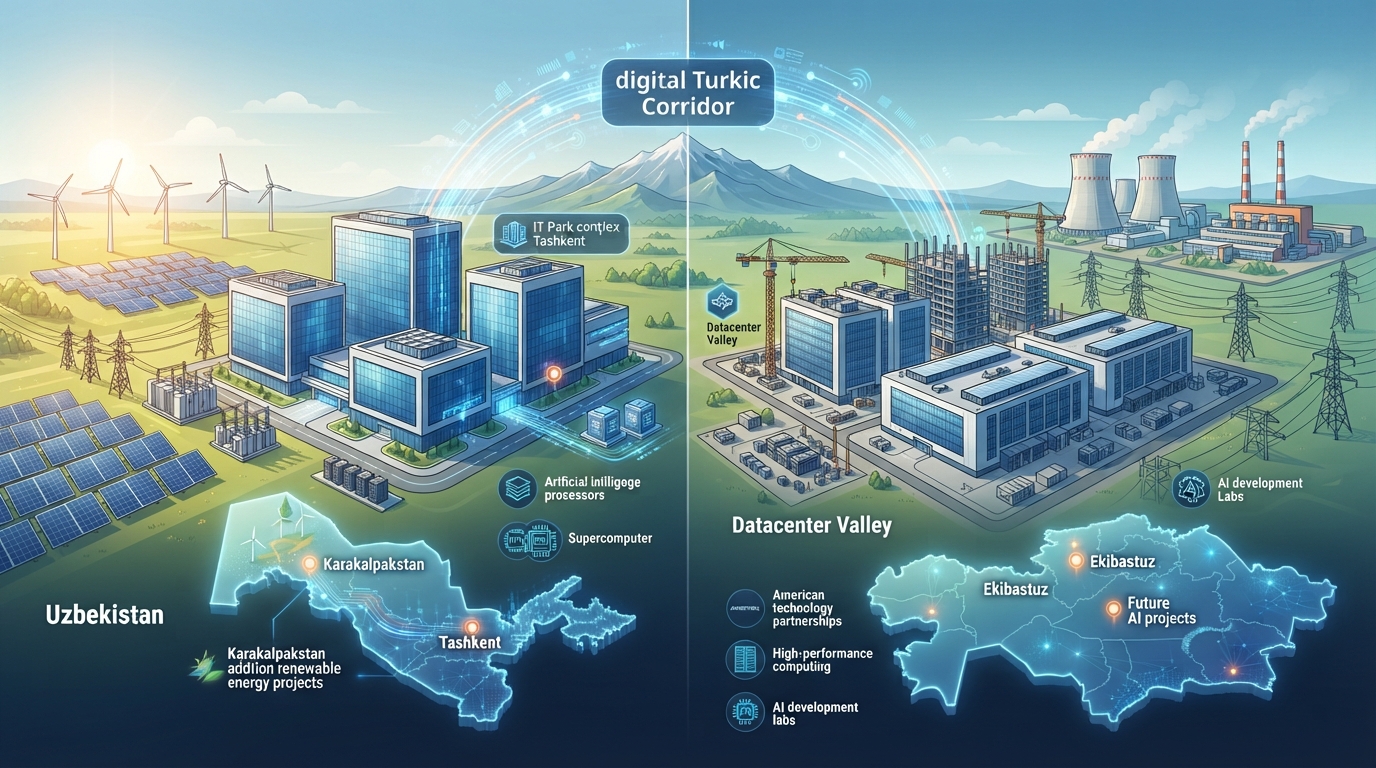
On November 3, Tashkent will host a forum dedicated to data centers and cloud services. Uzbekistan expects to transform itself into a hub for the international computing business. A similar goal is being pursued by Kazakhstan, where the "Data Center Valley" is being developed in Ekibastuz. Both countries intend to generate revenue from digital services; however, the scale of the announced initiatives warrants a closer look at the power sources and future clients.
The agenda of the Tashkent Eurasia Data Center & Cloud Forum highlights the power supply of artificial intelligence (AI) infrastructure, energy storage systems, and server cooling. Behind the technical agenda lies a calculation on the export of computing services.
"We have set ourselves an ambitious goal – to bring the export of IT services to $5 billion by 2030," President Shavkat Mirziyoyev said in his Address to the Parliament and the People at the end of 2025. At that time, he also announced the construction of four data centers, the installation of two supercomputers, and AI (artificial intelligence) laboratories in 15 universities. This refers to the development of the entire industry, including the creation of software and digital services. Implementation of these plans began this year.
Kazakhstan links the development of AI systems to cooperation with American technology companies. In October, Firebird reported receiving a US export license for 45,000 NVIDIA Grace Blackwell accelerators for the first stage of its project. Commercial launch is scheduled for the third quarter of 2027. The company estimates prospective investments at $5 billion, and subsequent expansion should increase the potential capacity of its infrastructure in the country to approximately 500 MW.
The "Data Center Valley" is a site for several projects. In August, the government of Kazakhstan reported the construction of the first facility with a capacity of 50 MW, to be commissioned in June 2027. The long-term energy potential of the site was estimated at 1 GW. These figures relate to different stages, rather than currently operating capacity.
In Uzbekistan, one of the projects closest to launch is being implemented by Saudi Arabia's DataVolt on the territory of the Tashkent IT Park. Previously, the company declared plans to build three data centers with a total capacity of 500 MW in the republic by 2032. The Tashkent facility is part of this program. According to documentation from the European Bank for Reconstruction and Development (EBRD), the capacity of its server equipment will be 12 MW, and the project cost is $250 million. The bank approved a loan of up to $78 million. In October, the Republic's Ministry of Digital Technologies discussed with the investor the completion of construction and preparations for the center's opening.
Another major Uzbek project is linked to China's Shanghai LinkWise. According to IT Park, the computing center in the Takhiatash district of Karakalpakstan is expected to reach a capacity of 300 MW after completing all stages. The site was selected adjacent to the Takhiatash thermal power plant.
The services themselves also differ. Firebird focuses on AI computing and promises to provide at least 10% of its GPU capacity to Kazakhstani enterprises and government agencies. Tashkent's DataVolt will host clients' equipment, including businesses, government institutions, and cloud providers.
Comparing Uzbekistan and Kazakhstan solely by the number of megawatts is insufficient. A center renting out server space and a seller of turnkey AI computing occupy different positions in the market. How accessible their services are to local developers is also important, IT specialists note.
According to President of Kazakhstan Kassym-Jomart Tokayev, "data centers are comparable in energy consumption to metallurgical plants." He urged the introduction of new energy capacity without waiting for the completion of the nuclear power plant (NPP). According to KEGOC, Kazakhstan produced 123.1 billion kWh and consumed 124.6 billion in 2025. In Uzbekistan, according to World Bank estimates, technical losses in distribution networks stood at around 13% in 2024, and more than half of the network facilities had been in operation for over 30 years. Therefore, increasing power generation must go hand in hand with upgrading grid infrastructure and boosting its throughput capacity. The authorities expect to introduce new capacity ahead of demand, creating a reserve for the growing economy. By 2030, the country's power plant capacity is planned to reach 46.1 GW, allowing for the generation of about 129 billion kWh per year. By 2035, these indicators should rise to 57.2 GW and 154.7 billion kWh, respectively.
In September, during a presentation on the prospects for the development of the power sector and the improvement of project management mechanisms in the fuel and energy industry, Shavkat Mirziyoyev considered various scenarios for growth in electricity consumption. Given the accelerated development of the economy, industry, electric transport, and digital infrastructure, Uzbekistan will require additional generating capacity.
It was proposed to link future wind power plants in Karakalpakstan to 1 GW data centers. This will require a new substation and transmission lines. According to the press service, the president instructed that the development of generation and power grids be coordinated, and energy storage systems be expanded. Now, the crucial question is whether the commissioning timelines for the energy facilities and the data centers will align.
Questions also remain regarding green energy supply. Initially, IT Park reported that Tashkent's DataVolt would use renewable energy and a battery storage station. However, according to EBRD documentation, the battery storage facility on the adjacent plot is no longer part of the project. This does not mean a rejection of green energy, but it requires clarification as to which scheme will ensure 24/7 operation.
At the same time, Tashkent proposes combining national computing capacities. Shavkat Mirziyoyev put forward the idea to "develop a concept for a digital Turkic corridor that will connect regional data centers with high-speed communication channels." For now, this is merely an initiative rather than an operating network. For both countries, success will be determined by export revenues, computing accessibility, and the emergence of domestic technology companies.