

The World Bank is preparing 100 million dollars for healthcare reform in Samarkand Region
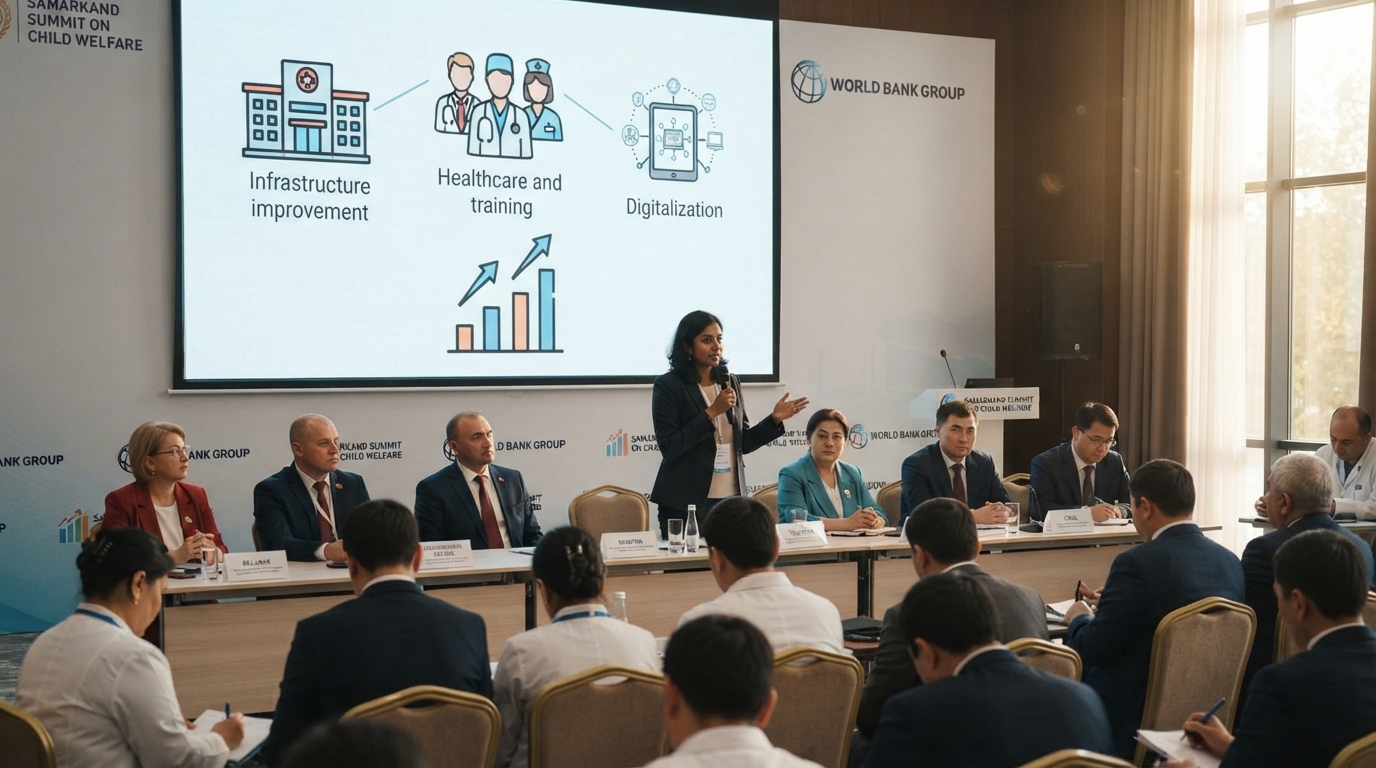
World Bank preparing $100 million for healthcare reform in Samarkand region
The World Bank is developing a $100 million program aimed at reforming primary healthcare in the Samarkand region. It includes improving conditions in family clinics, training medical staff, and digitalizing the healthcare system. A Podrobno.uz correspondent learned about the planned changes and difficulties with access to medical care at a session on child health protection held as part of the World Summit on Child Well-being in Samarkand.
According to Aparna Somanathan, World Bank Practice Manager for Health, Nutrition and Population in Europe and Central Asia, more than half of Uzbekistan's healthcare facilities lack functional toilets, and fewer than 10% have a proper medical waste management system.
According to Aparna Somanathan, the World Bank is preparing a program to support nationwide primary healthcare reform. The Samarkand region was chosen for its implementation partly because it is home to the country's largest number of low-income people.
At the time of the speech, the program was planned to be submitted for consideration to the World Bank Board of Directors next month. That is, this is a program in preparation, not an already approved financing package.
Aparna Somanathan outlined three key areas of the proposed reform.
The first is improving working conditions in family clinics. The amount of funding will depend on how well institutions meet the requirements for emergency preparedness, climate resilience, and energy efficiency. According to the World Bank representative, more than half of the healthcare facilities in the country lack functional toilets, and fewer than one in ten have a proper medical waste management system.
"Money will flow only as these gaps are closed," explained Aparna Somanathan, speaking about the proposed financing mechanism.
The second area is the training of medical workers. Nurses, midwives, and managers must undergo practical training based on necessary professional competencies. Certification is planned to be linked to remuneration. In particular, Aparna Somanathan reported a planned regular allowance for certified workers in the amount of 100% of their base salary.
She also noted that women make up about 80% of workers in this category, so changes in the remuneration system could also affect their employment conditions.
The third area is digitalization. Under the program, it is planned to modernize the DMED healthcare information system and integrate it with the state health insurance fund and the budget treasury. This should make it possible to calculate capitation payments to healthcare institutions based on actual population coverage.
According to Aparna Somanathan, data on the readiness of healthcare facilities is expected to be obtained within eight months and used for further work on the reform.
Aparna Somanathan said that a recent assessment of primary healthcare in the Surkhandarya region revealed several problems: insufficient clinical competencies, unjustified patient referrals to other specialists, and a payment system not backed by performance data.
According to her, the development of primary medicine requires not only the construction and equipping of clinics, but also sustainable financing for day-to-day operations. Even if a facility is equipped, administering vaccinations, routine checkups, or seeing a sick child depends on the availability of funds for operating expenses. In addition, a family needs to be able to reach the healthcare facility.
The World Bank representative emphasized that allocating resources solely based on the number of hospitals or beds does not always allow taking into account the real needs of the population. In her opinion, funding for primary healthcare should take into account the number of residents served and the actual services rendered.
She also drew attention to the need to account for climate risks. Heatwaves, floods, and droughts affect children particularly severely, so healthcare facilities must remain able to operate in emergency conditions. At the same time, infrastructure maintenance and operating costs must be budgeted for in advance.
At the same session, representatives of Belarus, Russia, Tajikistan, and China spoke about their approaches to child health protection. Their presentations showed that countries focus on different elements of the system — from prevention and early diagnosis to high-tech treatment and rehabilitation.
First Deputy Minister of Health of Belarus Elena Bogdan spoke about preserving the pediatric service and developing the early intervention system. According to her, 50 early intervention centers operate in the country, developing with the participation of healthcare, education, and social protection sectors.
Elena Bogdan also reported on the results of childhood cancer treatment and the introduction of CAR-T cell therapy. According to her, child survival rates in the relevant patient group increased after the introduction of new treatment methods. These figures relate to specific areas of therapy and require separate clarification if used for international comparison.
Representative of the Ministry of Health of Russia Evgeniya Kotova reported that infant and child mortality in the country has decreased by half over the past ten years. According to her, more than 26 million children from birth to age 17 undergo annual preventive examinations, representing over 97% of children in this age group.
Evgeniya Kotova also spoke about the expansion of neonatal screening. Since the launch of the relevant program, more than 4.5 million children have been screened, and rare hereditary diseases have been confirmed in over 2.5 thousand. Among other areas, she named telemedicine consultations, the development of pediatric rehabilitation, and the implementation of new treatment methods.
Minister of Health and Social Protection of the Population of Tajikistan Jamoliddin Abdullozoda drew attention to the problem of childhood disability and the need for joint research in Central Asian countries. According to him, expenditure on payments to people with disabilities in Tajikistan exceeds 95 million somoni per month, and more than 52% of recipients, as he stated, are people with disabilities from childhood.
Beijing representative Wei Gang spoke about the system for preventing congenital disorders and early disease detection. According to him, prenatal screening coverage in Beijing reached 98.24%, and medical services cover 99.39% of children under seven years of age.
The figures provided by the participants relate to different healthcare systems, age groups, and types of medical care. Therefore, directly comparing them without taking methodology into account is impossible.
The participants' speeches demonstrated different ways of organizing medical care for children: from preventive checkups and early diagnosis to specialized treatment and rehabilitation. However, the experience of each country depends on the structure of its healthcare system, available resources, and service organization.
In the case of the World Bank program in preparation, a key element will be linking financing to specific working conditions of healthcare institutions, staff training, and data on actual population coverage. This will allow evaluating the reform not only by the amount of funds allocated, but also by the changes taking place in the organization and accessibility of medical care.
At the same time, the final parameters of the program, the timeline for its approval, and the start of its implementation remain to be specified.