

The US-Canada trade war in 5 charts
The US-Canada trade war is being felt on both sides of the border.
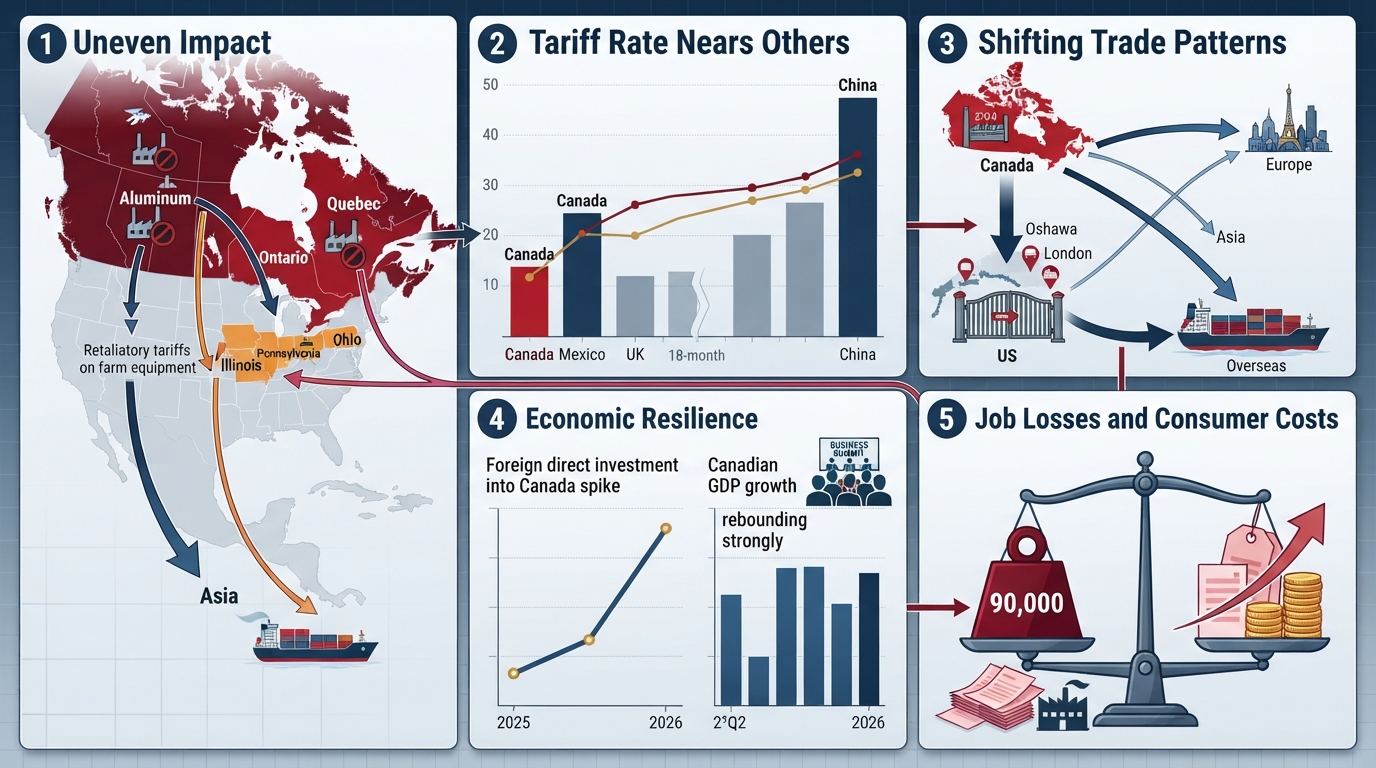
## The US-Canada Trade War: A Five-Chart Breakdown
The trade dispute between the United States and Canada shows no signs of abating. Tensions have been escalating for over 18 months, ever since President Donald Trump initiated a broad program of global tariffs upon entering the White House. Canada was among the first nations targeted by the Trump administration's levies and is one of only two countries to implement retaliatory measures.
Currently, the US has imposed tariffs on key Canadian sectors including steel, aluminum, lumber, and automobiles. Last week, an additional 50% levy was applied to approximately C$28 billion ($20 billion; £15 billion) worth of Canadian goods. Canada has responded with its own counter-tariffs on American products, announcing on Tuesday what it described as a "dollar-for-dollar" and "strategic" retaliation designed to mirror the US tariffs.
With no resolution in sight, how has this persistent trade war impacted Canada and the US, and what might the future hold? Here are five charts that help illustrate the situation.
### Uneven Impact Across Regions
The tariffs and counter-tariffs have affected certain states and provinces more severely than others.
In Canada, some provinces have greater exposure to US sectoral tariffs on steel, steel derivatives, aluminum, and automobiles and vehicle parts that do not comply with the current North American trade agreement, known as the USMCA. Ontario, the most populous province with a significant manufacturing sector, has been hit hardest by the auto and steel tariffs. Several auto parts and assembly plants in Ontario have announced layoffs and production cuts, with the province estimated to have lost tens of thousands of manufacturing jobs since early 2025.
Metal exports from Quebec, a producer of steel, copper, and aluminum, declined by 36% between February 2025 and 2026, and employment in the sector saw a 3.6% drop, according to data released in July. The Royal Bank of Canada estimates that Ontario and Quebec are the most affected by US sectoral tariffs, while Newfoundland and Labrador, New Brunswick, Alberta, Saskatchewan, and Prince Edward Island are the least exposed. Additional US tariffs on $20 billion worth of Canadian goods, which took effect on August 22, are expected to impact all provinces to some degree, though British Columbia, Quebec, and Ontario will bear the brunt.
The US economy is considerably larger, meaning the impact of Canada's counter-tariffs will be less pronounced. However, some states will feel the effects of Canada's retaliation more acutely. As of September 8, tariffs have been levied on C$28 billion worth of US goods, ranging from steel to furniture, cosmetics, and toilet paper.
According to data from Statistics Canada, the swing state of Ohio will be the hardest hit, with C$3.2 billion, or 12%, of its exports soon to be tariffed by Canada, followed by Illinois and Pennsylvania. For Ohio, the taxes on steel and laundry machines will be particularly damaging. In Illinois, home to farm equipment giant John Deere, the new tariffs on farm and construction equipment will be significant. Derek Holt, an economist with Scotiabank, observed that Canada's counter-tariffs appear to be "very deliberately oriented" towards certain swing states that could influence the US balance of power in the upcoming midterm elections.
### Canada's Tariff Rate Nears Other Nations'
Prime Minister Carney has assured Canadians that, despite the high-profile trade dispute, they face some of the lowest US tariff rates compared to other countries. However, with the latest 50% tariffs imposed on a range of Canadian goods, the average effective US tariff rate on Canada is now higher than Mexico's and is approaching the rates faced by nations like the UK and Vietnam. An average effective tariff rate reflects the average tariff paid across all imports.
According to data from the Royal Bank of Canada, the average effective US tariff rate on Canada in June was 2.9%, the lowest among major US trade partners. It has now nearly doubled to 5.7%. In comparison, the US effective tariff on the UK is 6.2%. China still faces the highest US tariffs, averaging around 20.5%.
### Shifting Trade Patterns
Due to its proximity to the world's largest economy, Canada is heavily reliant on US trade. This geographical closeness, combined with free trade agreements in place since the 1990s, has fostered one of the world's most deeply economically integrated trading relationships between the two countries. The US purchases over 70% of Canadian exports and is a top US trading partner alongside Mexico and China.
However, the tariff dispute has already begun to prompt Canadian businesses to explore other markets. Carney has pledged to double Canada's non-US exports over the next decade. Statistics from the Bank of Canada suggest that Canadian firms have been exporting more to countries other than the US since Trump's return to the White House in January 2025.
Some businesses are adapting by seeking customers elsewhere. Matteo Sgaramella, owner of Toronto-based menswear clothing company Outclass, informed the BBC that he has started attending trunk shows in Paris instead of New York, helping him reach more customers in Europe. "The reception has been amazing," he stated, adding that some European stores are particularly enthusiastic about supporting Canadian products due to the ongoing trade war with the US. "We're kind of seen as the one country that's kind of standing up to the Americans right now," Sgaramella remarked.
Other businesses, however, are struggling to diversify their trade, particularly in Ontario's manufacturing sectors that are deeply integrated with the US. A recent report by the Canadian Chamber of Commerce identified three such regions in Ontario—Oshawa, London, and Kitchener-Cambridge-Waterloo—as being particularly vulnerable. "These cities remain heavily tied to the US market, while growth in exports outside the US has been limited or insufficient to offset broader weakness in trade activity and local economic conditions," the report stated.
### Economic Resilience and Investment
While some businesses are lagging, foreign direct investment into Canada reached C$96.8 billion in 2025, marking the highest inflow of capital to the Canadian economy since 2007. Canada's economy also experienced a strong rebound in the second quarter of 2026, with 3.3% GDP growth, driven by a surge in exports and domestic investment. These latest figures have, for now, allayed recession concerns. Carney hopes to attract even more investment. In September, his government will host the inaugural Canada Investment Summit, bringing together major investors, CEOs, and business leaders in Toronto for two days.
### Job Losses and Consumer Costs
On both sides of the border, tariffs have impacted jobs and disposable income. According to an analysis commissioned by the Canadian American Business Council (CABC), if the US and Canada allow the USMCA to fail, tens of thousands of jobs would be lost, primarily in manufacturing industries directly affected by tariffs and highly reliant on the US market. Approximately 55,000 manufacturing jobs have already been lost in Canada from January 2025 to January 2026, according to Bank of Canada data.
However, not all figures are negative, as employment has steadily risen in Canadian sectors not vulnerable to US tariffs. Nevertheless, there is a risk of further Canadian job losses due to the recent 50% tariffs imposed by the Trump administration. Calgary-based economist Trevor Tombe estimates that a total of 90,000 jobs across Canada could be lost if these new US tariffs persist.
Even for those whose jobs remain secure, the tariffs have resulted in higher prices for everyday items. Canada's counter-tariffs are much more targeted and designed to limit the impact on Canadian consumers. However, economists suggest that businesses will likely now pay more to manufacture goods, as a bulk of the taxes will be applied to industrial supplies imported from the US.