

What tariffs will really cost Canadians and Americans
Households and businesses have become used to tariffs impacting the cost of living for more than year now, so what will change now?
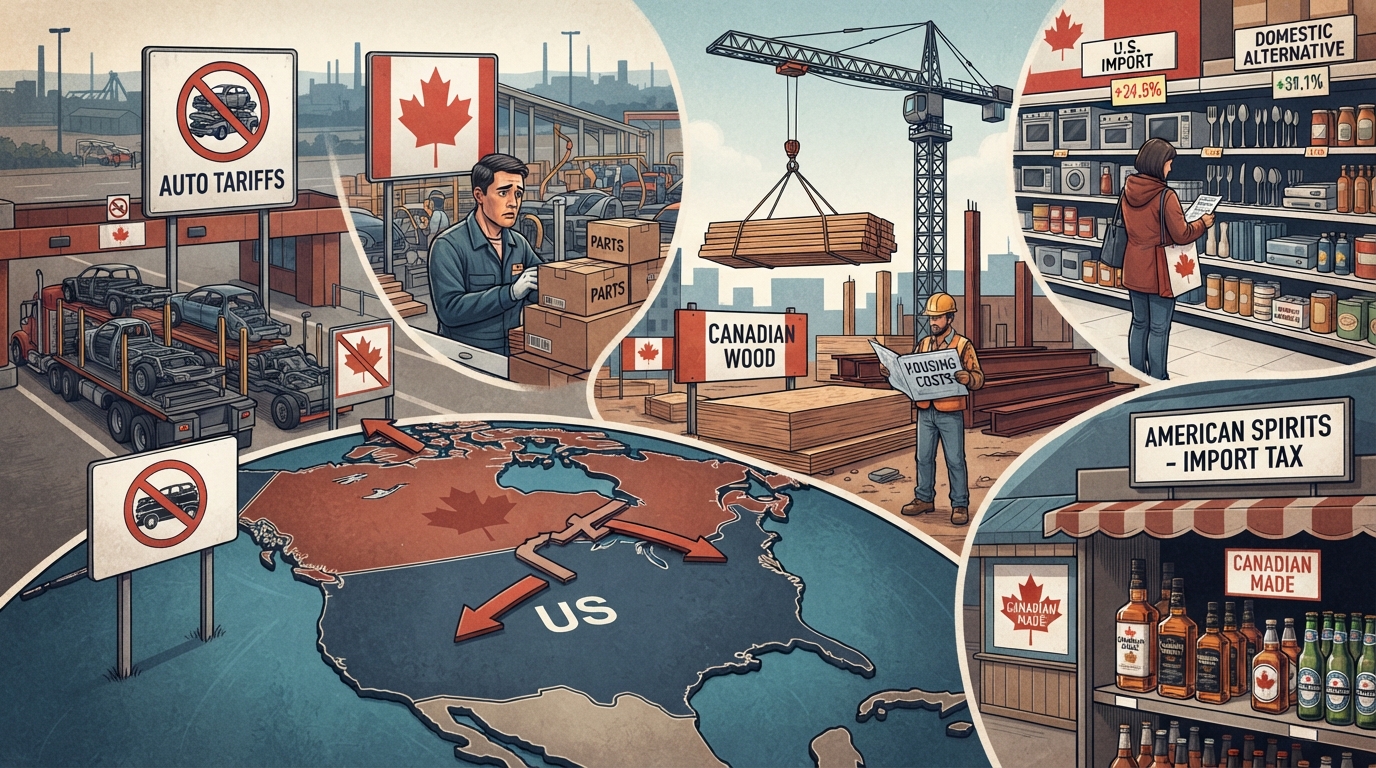
The recent escalation of the trade dispute between the United States and Canada, marked by new tariffs imposed by both nations, raises questions about the financial implications for their citizens. US President Donald Trump and Canadian Prime Minister Mark Carney have each announced import taxes on the other's goods.
This week, Canada responded to Trump's tariff threats by implementing retaliatory import taxes on various US products. The ongoing economic conflict began when President Trump initiated his trade policy upon returning to the White House.
**Impact on the Automotive Industry**
Should Trump's proposed increase of tariffs on Canadian vehicles from 25% to 50% take effect on January 1, 2027, it would significantly impact the automotive sector. Cars, trucks, and parts are major trade items between the US, Canada, and Mexico, with manufacturing and supply chains spanning all three countries.
Bernard Yaros, lead economist at Oxford Economics, notes that while car dealerships have largely absorbed increased costs from previous tariffs, this "cushion is wearing thin." He predicts that the threatened 50% tariffs on Canadian autos, trucks, and parts would more directly translate into higher consumer prices.
Yaros suggests that increased import costs for the US could accelerate a trend of manufacturers prioritizing luxury cars, SUVs, and pick-up trucks. This could also drive up prices in the used-car market if the supply of new, less expensive vehicles becomes constrained.
While Carney has not matched Trump's 50% tariff threat, a 25% import tax on certain American vehicles has been in place since last year.
**Construction Materials and Housing Costs**
Tariffs on construction materials like steel, aluminum, and lumber were already in effect before the latest escalation. Canada has now matched US rates on metals at 50%. Carney has also imposed import taxes on various US wood products, including plywood and even screws.
This means building firms importing these materials will face higher costs, which they may pass on to consumers through increased prices, potentially raising housing costs.
The Forest Products Association of Canada states that tariffs would "raise costs on both sides of the border." In the US, Bill Owens, chairman of the National Association of Home Builders (NAHB), has urged Trump to exempt building materials from tariffs due to an "ongoing housing affordability crisis," arguing that "Building material tariffs heighten market uncertainty, strain supply chains and increase construction costs."
A US Congress report indicates that in 2024, the US imported $23 billion (C$32 billion, £17 billion) worth of wood products, with nearly half originating from Canada. The "lumber wars" between the two nations over softwood used in housebuilding have a history spanning decades.
**Household Goods and Consumer Choices**
A notable aspect of this tariff dispute is the targeting of specific household items rather than just raw materials. Canada plans to apply tariffs to carpets, washing machines, furniture, refrigerators, and even cutlery.
While there's a risk of price increases for some US-imported goods, Bradley Saunders, North America economist at Capital Economics, believes it's more likely that consumers will opt for domestic alternatives. He suggests Carney's latest move intentionally targets goods where Canadians can "shift to domestic suppliers instead," citing hair care products as an example.
Saunders explains that Carney's strategy aims to "minimise the impact on Canadian households as much as possible by picking very fungible goods."
The Budget Lab at Yale, which monitors the economic impact of US government policy, anticipates marginal increases in furnishing and other household equipment for Americans, largely due to tariffs on lumber and other materials.
**Alcohol Sales and "Buy Canadian" Initiatives**
While the direct impact on alcohol prices may not be significant, the trade war has influenced Canadians' beverage choices. Last year, many Canadian provinces banned US alcohol sales in response to previous tariffs, leading to a more than 70% drop in US wine and spirits exports to Canada, according to the American industry.
Carney had requested provinces to reinstate US alcohol sales during trade talks, but with the collapse of those discussions, the ban is likely to return. Saunders notes a successful "buy Canadian" push from politicians, particularly for alcoholic beverages, which has "really had an impact on the American alcohol industry."
Saskatchewan and Alberta are the only provinces still selling American alcohol. However, Saskatchewan has announced its own 50% charge on US imported alcohol, effective September 8, coinciding with the broader Canadian tariffs.
**Broader Economic Impacts**
Beyond direct consumer costs, import taxes can complicate cross-border trade for businesses. The uncertainty generated by the trade war could deter investment and hinder job creation.
Saunders suggests that the most significant impact on households might not be through prices, but through job losses. He gives the example of a bespoke furniture producer in British Columbia facing a 50% tariff on US exports, which "could really shut the business down." He believes this would be a more direct impact on households than retaliatory measures.
Canada's forest industry, employing nearly 200,000 people, has urged the government to boost domestic demand through federal housing programs to increase the use of Canadian wood. However, the industry acknowledges that "no support package can replace reliable access to our largest export market."
For US consumers, the latest dispute with Canada is unlikely to significantly alter the cost of living. However, trade frictions can have longer-term economic consequences.
These tensions also raise concerns about the USMCA free-trade agreement between Canada, the US, and Mexico. Both Canada and Mexico desire a 16-year extension of the USMCA, but the US has stated it will not renew it in its current form. While the deal remains operational, tariffs risk delaying future talks, creating more uncertainty for cross-border trade.
John Iselin, associate director at the Budget Lab at Yale, estimates the average cost for American households from this specific instance with Canada will be about $3. However, when considering Trump's broader trade war with other nations, particularly China, the added costs for the average family rise to approximately $1,000.
"It's hard to view this particular instance with Canada in isolation because we've had similar interactions with a range of other countries, all of which makes doing business harder. It's just another in a series of tariff shocks," Iselin concludes.