

The Tashkent Khokimiyat has announced the elimination of the unpleasant odor from the "Salar" wastewater treatment plant
At the "Salar" wastewater treatment plant in Tashkent, an air filtration system has been installed for 9.5 billion soums. The capital's khokimiyat (city administration) stated that the wastewater basins have been sealed, and the concentration of hydrogen sulfide and ammonia in the purified air is now at zero. The equipment has been operating for more than two weeks.
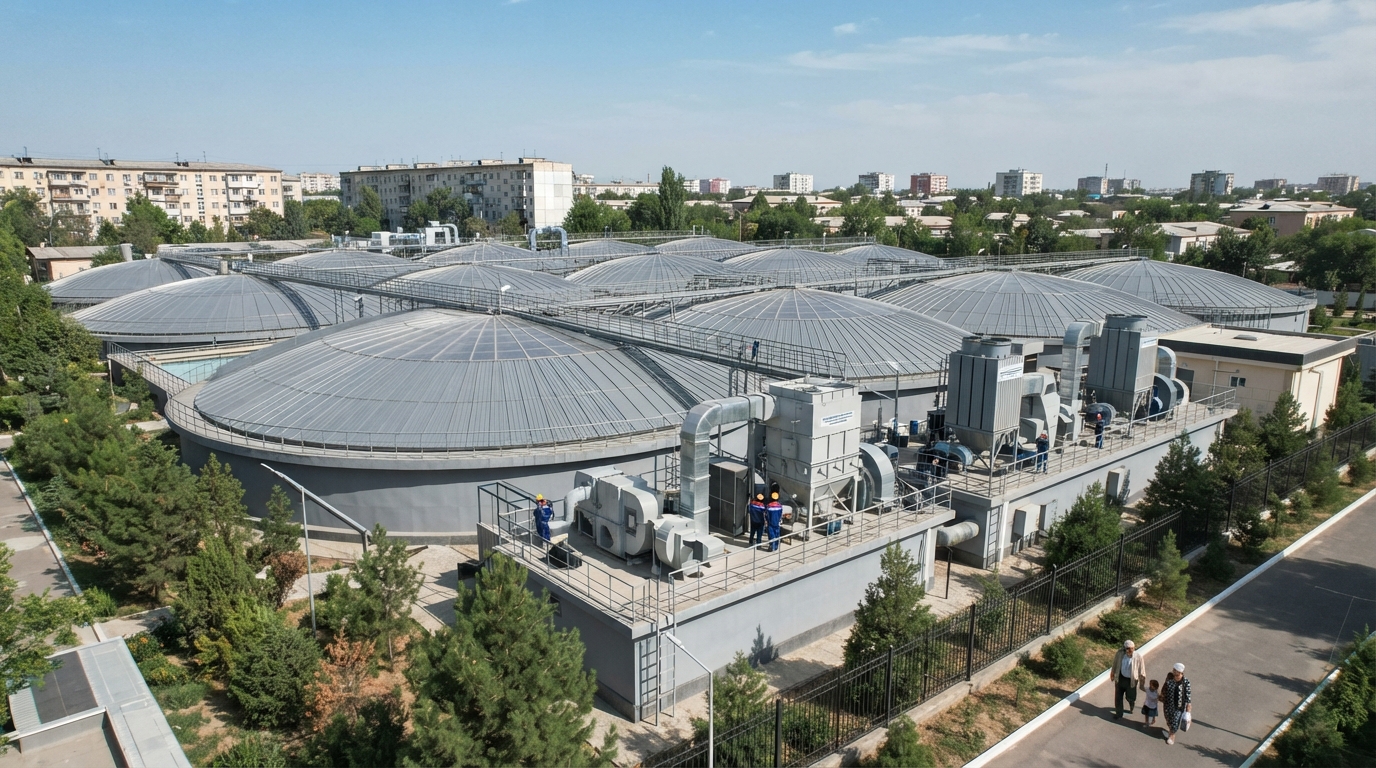
Tashkent Khokimiyat reported the elimination of the unpleasant odor emanating from the "Salar" wastewater treatment plant
To eliminate the unpleasant odor at the "Salar" wastewater treatment plant, filtering equipment worth 9.5 billion soums was installed, the press service of the Tashkent Khokimiyat reported.
According to the capital's administration, the wastewater basins are hermetically sealed, and the air is purified through filters.
"The equipment has been operating for more than 15 days. As a result, the unpleasant odor around the facilities has disappeared. This is also confirmed by residents of nearby areas," the Tashkent Khokimiyat reported.
Dunanbay Kazibekov, chief technologist of "Toshkent Shahar Suv Ta'minoti", said in the khokimiyat's video that the second-stage treatment facilities receive wastewater from Sergeli, Yangikhayot, Mirabad, and Yashnabad districts. The purification equipment was delivered from Russia.
The employee also explained the operating principle of the purification system.
"Air is drawn in using a fan. A material called catalytic sorbent is installed there in the amount of 11.5 tons. Ultraviolet radiation allows the air to be ozonated and oxidized. After that, it passes through activated carbon in the amount of 2.5 tons, and the concentration of the outgoing hydrogen sulfide is zero, and ammonia is also zero," Dunanbay Kazibekov explained.
As a reminder, the president ordered the elimination of the unpleasant odor from the treatment plant in Sergeli and Yangikhayot districts by September 1.
In May 2021, "Gazeta", citing the "Toshkent Shahar Suv Ta'minoti" enterprise, wrote that the main cause of the unpleasant odor spreading in the Uzgarish mahalla of Sergeli district was the discharge of wastewater and waste by enterprises into the aeration station and the Bozsu canal.
Later, the Senate Committee reported on the development of a draft government resolution, which planned to reconstruct the local treatment facilities of enterprises, as well as to relocate five tanneries outside of Tashkent.
As a reminder, the UAE company Abu Dhabi Sewerage Services Company (ADSSC) planned to start construction of a new water treatment plant for Tashkent in January 2024.
In August 2024, it was reported that a new wastewater treatment plant with a processing capacity of 1 million cubic meters of wastewater per day would be built in the Tashkent region. Over 500,000 city residents and 100 enterprises are expected to gain access to centralized sewerage. The project is being implemented by a consortium of companies from the UAE, France, and Japan.