

"The garden is alive as long as it is cared for." How artists reinterpretation the architecture of Tashkent at the "Garden of Modernism" exhibition in Haqiqiy
The exhibition "Garden of Modernism" at the Haqiqiy Gallery offers a look at the architecture of Tashkent modernism through the eyes of 11 artists — through their personal experience and relationship with the city. In addition to the 10 sites included in the UNESCO list, the authors showcase other iconic buildings of the capital that are important to preserve.
"The garden is alive as long as it is cared for." How artists re-evaluate Tashkent's architecture in a new way at the "Garden of Modernism" exhibition at Haqiqiy
The capital's Haqiqiy gallery is hosting the "Garden of Modernism" exhibition, dedicated to the architecture of Tashkent in the second half of the 20th century. This is a project by members of the "Tsekh 115" art community, which grew out of the creative development group of the gallery's founder, Alexandra Romanova, and invited authors.
The impetus for the project was the inclusion of ten Tashkent modernism sites in the UNESCO World Heritage List, including the "Zhemchug" residential building, the Palace of "Friendship of Peoples", the State Museum of Arts of Uzbekistan, the Central Exhibition Hall of the Academy of Arts, and other iconic structures.
Through personal stories and memories, the artists show the role architecture plays in the life of the city and draw attention to other sites that also need protection and preservation.
"We decided that such an important moment had to be captured and that we should create a project dedicated to our beloved city. We wanted to talk about buildings not only as architectural objects, but also about what they mean to people, what memories and emotions are associated with them," says gallery founder Alexandra Romanova.
In her view, Soviet architecture is simultaneously monumental and vulnerable — and this is not so much about the strength of the structures as it is about the attitude towards heritage.
Tastes and perceptions of the city change faster than reinforced concrete ages.
At some point, a building from the past ceases to correspond to the new era, and people begin to rebuild it, add elements uncharacteristic of it, or demolish it for new construction, as happened, for example, with the House of Cinema. Therefore, the artist believes, it is important to understand the value of the architecture of the past and preserve it precisely as heritage. This idea lies at the heart of the garden image used in the project's title.
"Like a garden, architecture needs constant attention and care — only in this way can it be preserved for future generations," Romanova explains.
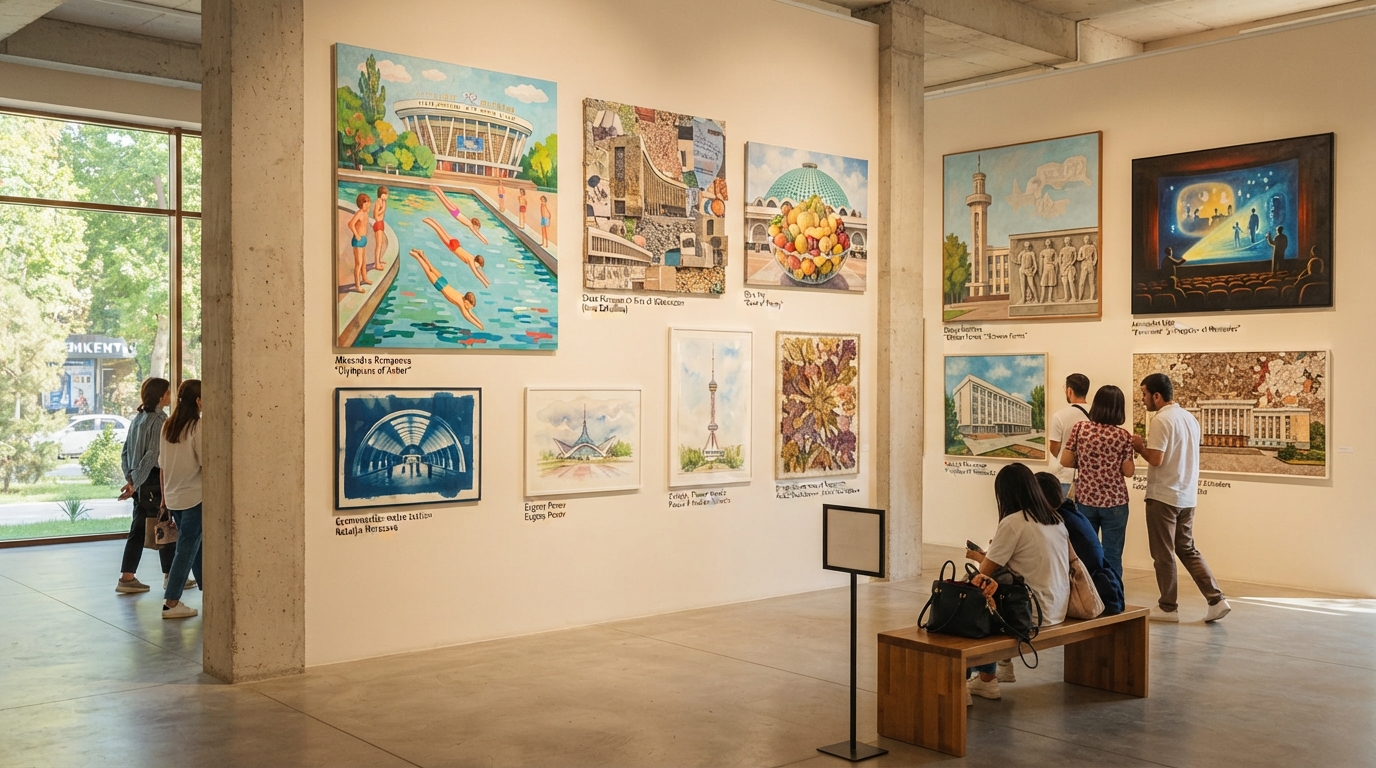
"Tsekh 115" community member Alexandra Kolo dedicated her painting "Projector of Memories" to the "Panoramic" cinema, which today houses the Palace of Cinema Arts of Uzbekistan. Studying its history, she gradually shifted the focus from architecture to people's memories of this place. The image of a boy emitting light is a metaphor for cinema as a way of understanding the world.
"Modernist buildings are often perceived as austere, cold, and monumental, but behind their facades lay completely warm and lively spaces — theaters, cinemas, libraries, teahouses. 'Panoramic', for example, was an iconic place for Tashkent residents. People came here not only to watch movies, but also to socialize and educate themselves. I wanted to show this inner life," Kolo explains.
Artist Olya Vis, in her work "Bowl of Abundance", depicted the dome of the "Chorsu" bazaar in the form of a kosushka (traditional bowl) with fruit. Beka Kayumova depicted the "Sun" heliocomplex based on a photograph taken by her father. The "hero" of Inna Safiullina's collage was the State Museum of Arts of Uzbekistan.
The exhibition project allowed the participants to expand the list of Tashkent modernism sites represented in the UNESCO World Heritage List in their own way.
Alongside the ten buildings that have received world recognition, the artists also drew attention to other objects of modernist architecture that do not have official status but are important for the city.
In choosing them, the artists relied heavily on their own experiences and memories.
Robiya Kodirova, in her painting "Between Forms", depicted the P. P. Benkov Art College. In the composition, she used recognizable elements of the building — the cylindrical tower and two figures from Vladimir Chub's large bas-relief dedicated to various types of art. For the artist, this is not only a place associated with her years of study, but also one of the examples of Tashkent modernism that has survived almost unchanged.
"The garden is alive as long as it is cared for. It is the same with architecture. We want to draw attention not only to the buildings that are already on the UNESCO list, but also to those that were left out. It is also important to preserve them for future generations so they can learn their history and be inspired by them. If we take care of this heritage today, it will continue to live," says Robiya Kodirova.
Alexandra Romanova, in her work "Olympians of Anhor", turned to the space around the Museum of Olympic Glory. On the canvas, three children dive into the bright blue water of the canal, with part of the building visible behind the trees. This place is particularly important to the artist — according to her, it was here that she first felt that she loved the city.
"For me, children diving into the canal is an image of sport in its natural, spontaneous, almost wild manifestation. And further up the stairs is the museum, which is already dedicated to sporting achievements. I like to think that one can grow out of the other: a simple children's game and the desire to jump into the water can one day become the beginning of a journey into professional sports. I wanted to convey this feeling, as well as the heat of the Tashkent summer, the coolness of the water, and the movement," Romanova explains.
In addition to the members of the "Tsekh 115" community, invited artists took part in the project. Watercolorist Evgeny Panov depicted the Tashkent TV Tower, and Farangiz Tashtemirova depicted the "Uzbekistan" hotel. Aziza Shavkatova recreated a fragment of the mosaic of the Palace of Aviation Builders using dried flowers, while Natalya Morozova created two works about the "Kosmonavtlar" and "Pakhtakor" metro stations using the cyanotype technique — a photographic printing process that produces images with a characteristic blue monochrome shimmer.
The "Garden of Modernism" exhibition will run until September 10.
The gallery is open daily from 11:00 to 19:00. Admission is free.