

"The price of supporting one industry will fall on others." Business criticized sugar import quotas
The UzBev Association has opposed the quotas on white sugar imports starting from 2027. According to its head, Alfiya Musina, this measure could lead to rising prices, increased expenses for food industry enterprises, and a decline in their competitiveness. The business sector also demands the disclosure of a restricted government decree.
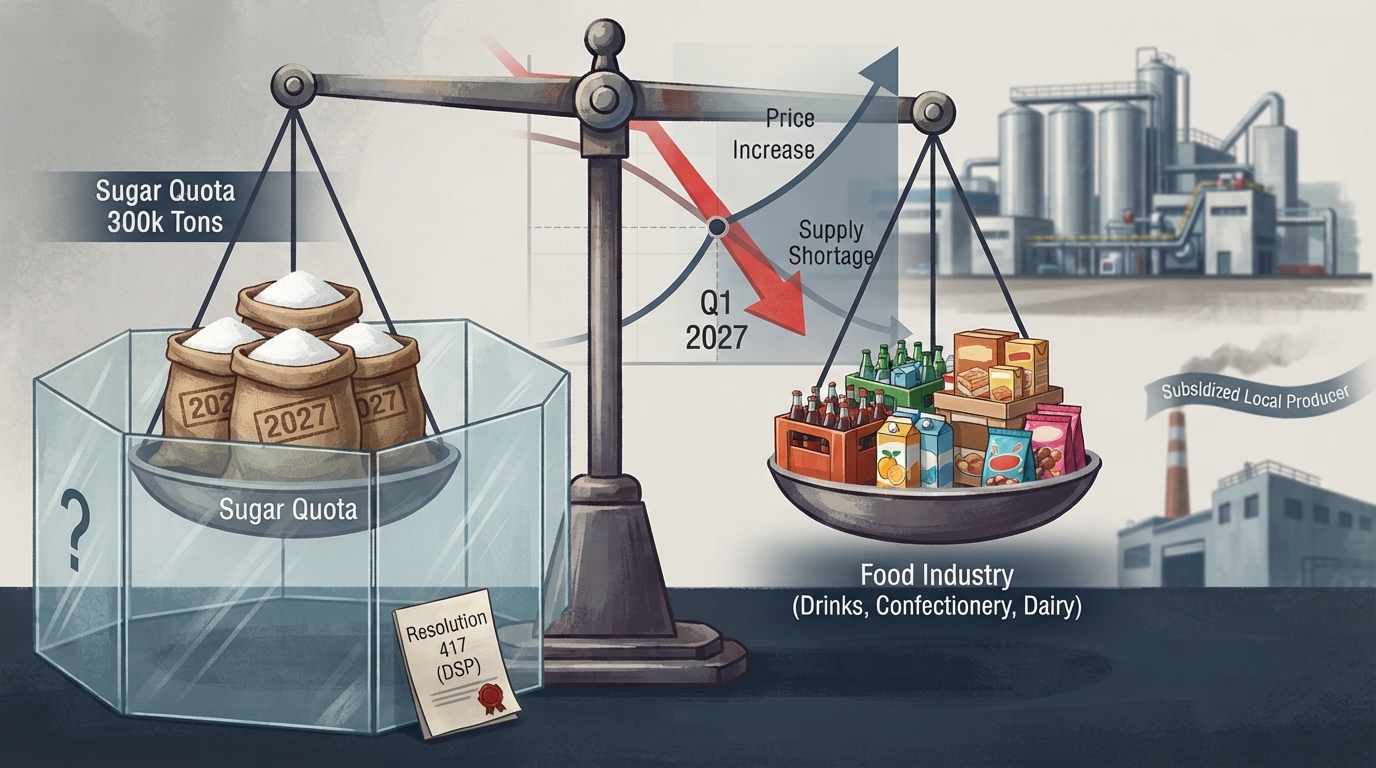
"The cost of supporting one industry will fall on others." Business criticizes sugar import quotas
The Association of Non-Alcoholic Beverage and Juice Producers of Uzbekistan (UzBev) has opposed the introduction of an annual quota of 300 thousand tons for the import of white sugar starting from January 1, 2027. The association's executive director, Alfiya Musina, informed "Gazeta" about this.
In her opinion, such restrictions could result in higher raw material costs, increased production costs, and stronger inflationary pressure. Business also raises questions about the legal basis of the new mechanism, its compliance with World Trade Organization (WTO) rules, and the lack of public access to the government decree.
"Such a measure is capable of restricting access to critically important raw materials, increasing the costs of domestic producers, and shifting the price of supporting one industry onto the entire food industry and consumers," the statement reads.
UzBev points out that the volume of the established quota does not correspond to the needs of the domestic market.
Uzbekistan's annual demand for sugar is estimated at 650–700 thousand tons. According to the Customs Committee, in January–September 2026, the country imported 652.8 thousand tons of sugar and raw sugar worth $440.1 million. This is 36% more than in the same period last year.
Against this background, the association believes the government should clarify how the 300-thousand-ton quota will meet the needs of enterprises and how a potential shortage of raw materials will be prevented.
At the same time, total imports cannot be directly compared with the new quota: customs statistics include raw sugar used for processing, whereas the restriction applies to white sugar for specific categories of manufacturers.
According to Alfiya Musina, state support for sugar mills, which remain dependent on imported raw materials and financial assistance, should not create additional difficulties for other domestic enterprises.
"Restricting access to sugar threatens to increase production costs, reduce the competitiveness of Uzbek products, and build up inflationary pressure," warned the head of UzBev.
She emphasized that the food industry provides investments, exports, jobs, and tax revenues. Therefore, the consequences of the restrictions could affect not only beverage and confectionery manufacturers, but consumers as well.
Separate grievances of the association pertain to the quota implementation mechanism.
Cabinet of Ministers Decree No. 416 of July 29, 2026, establishes the general procedure for applying tariff quotas. It provides for the possibility of importing products in excess of the established volume upon payment of the current customs duty.
However, Decree No. 417, adopted the following day, which introduces the quota on white sugar, does not specify duty rates within and above the quota, nor does it clarify whether imports can continue once the limit is exhausted, the statement notes.
"In its actual content, such a mechanism may turn out to be not a tariff quota, but a quantitative quota that restricts the very possibility of importing," believes Alfiya Musina.
According to her, this raises questions from the perspective of WTO rules, an organization Uzbekistan is preparing to join.
Article XI:1 of the General Agreement on Tariffs and Trade (GATT 1994) establishes a general prohibition on quantitative import restrictions, except in cases provided for by the rules.
"Simply renaming an import quota to 'tariff' will not solve the problem: the WTO evaluates not the name of the measure, but its content and actual impact on trade," the statement says.
Another discrepancy pointed out by UzBev relates to the distribution of quotas. Decree No. 417 provides for electronic auctions, whereas general procedure No. 416 contains no such mechanism.
The association considers it necessary to publish the bidding eligibility criteria, volume allocation rules, equal access guarantees, and measures against the concentration of quotas among a limited circle of importers.
Without transparent distribution conditions, industry representatives believe, there is a risk of restricting competition.
UzBev also drew attention to the advantages provided by the decree for domestic sugar producers.
The document envisages priority supply of locally produced sugar to state organizations and enterprises. The association fears that in practice, this could lead to the exclusion of imported sugar from procurements based on country of origin.
According to UzBev's assessment, such an approach requires verification for compliance with the national treatment principle enshrined in Article III:4 of the GATT. While the agreement allows exceptions for certain government procurements, they do not automatically apply to procurements for commercial activities or resale.
Another issue concerns financial support for sugar mills.
Decree No. 417 provides for the restructuring of their credit debt, attraction of $50 million in investments, compensation for part of interest expenses, as well as the preparation of tax incentives.
UzBev stresses that subsidizing enterprises in itself is not prohibited by WTO rules. However, targeted support for specific companies or industries, especially if tied to the use of domestic goods instead of imported ones, requires a legal assessment.
The association calls for reviewing the conditions under which such aid is provided, its impact on competition, and international trade.
One of Alfiya Musina's main grievances was the lack of public access to Decree No. 417.
The document, which affects the activities of a wide range of entrepreneurs, carries a "for official use" (DSP) classification and has not been published in the national legislation database Lex.uz.
In the opinion of the head of UzBev, this prevents companies from assessing the consequences of the new requirements in advance and adjusting their production plans and investment decisions.
The association deems it necessary to obtain clarifications from the Ministry of Justice on three questions: on what grounds access to the decree is restricted, whether it is permissible to apply the requirements of an unpublished normative act to entrepreneurs, and how the provisions of the two government decrees — No. 416 and No. 417 — correlate.
Musina recalled that President Shavkat Mirziyoyev has repeatedly called on state authorities for "shaffoflik" — openness, transparency, and accountability.
According to her, against this backdrop, the adoption of closed decrees directly affecting the operations of entire sectors of the economy raises questions.
"The principle called for by the President must become the foundation of every state decision, especially when it affects business, investments, jobs, and the well-being of citizens," the head of the association emphasized.
UzBev calls for publishing Decree No. 417, organizing an open discussion involving business, experts, and state bodies, and conducting an economic impact assessment of the restrictions along with a legal evaluation.
"Protecting one infant industry should not weaken thousands of other enterprises. Sustainable growth is achieved not by closing the market, but through predictable rules, fair competition, and equal access to raw materials," concluded Alfiya Musina.
As reported by "Gazeta", Cabinet of Ministers Decree No. 417 of July 30, 2026, provides for the introduction of an annual white sugar import quota of 300 thousand tons starting January 1, 2027.
The volume is distributed among three categories of enterprises:
The quotas are planned to be distributed through electronic auctions. A special platform has been instructed to launch by December 1, 2026. The government will be able to review volumes every six months, taking into account consumption, factory capacity utilization, and the price situation.
The decree also provides for support to the two main sugar producers — Angren Shakar and Xorazm Shakar. The enterprises are allowed to extend the repayment terms of loans to "Uzpromstroybank" up to five years, including a two-year grace period. In addition, compensation for part of interest expenses and the preparation of tax incentives until 2031 are envisaged.
Sugar production in Uzbekistan has been declining in recent years. According to the National Committee on Statistics, output in the first half of 2025 stood at 165.5 thousand tons, compared to 227.8 thousand tons in the same period of 2024 and 332.6 thousand tons in 2023.
At the same time, the combined design capacity of the two operating sugar mills exceeds 900 thousand tons per year. A significant portion of the raw materials they use is imported.
On October 1, 2025, Uzbekistan abolished the 20 percent excise tax on white sugar imports, but the 20 percent customs duty remained.
In January 2026, Alfiya Musina had already raised the issue of high sugar costs during a business meeting with the government, calling it "the pain of all local producers." At that time, Deputy Prime Minister Jamshid Khodjaev announced two major projects expected to boost domestic sugar production within two to three years.
The question of whether food industry enterprises will be able to import white sugar above the 300-thousand-ton quota and under what conditions remains open. There are no official public clarifications regarding this mechanism yet.