

The Government of Uzbekistan has approved sugar import quotas by a classified decree
The government of Uzbekistan has established annual quotas for white sugar imports in the amount of 300 thousand tons. They will be distributed among manufacturers of beverages, confectionery, and other products. The decision was made by a classified decree. Local sugar factories will receive priority in public procurement.
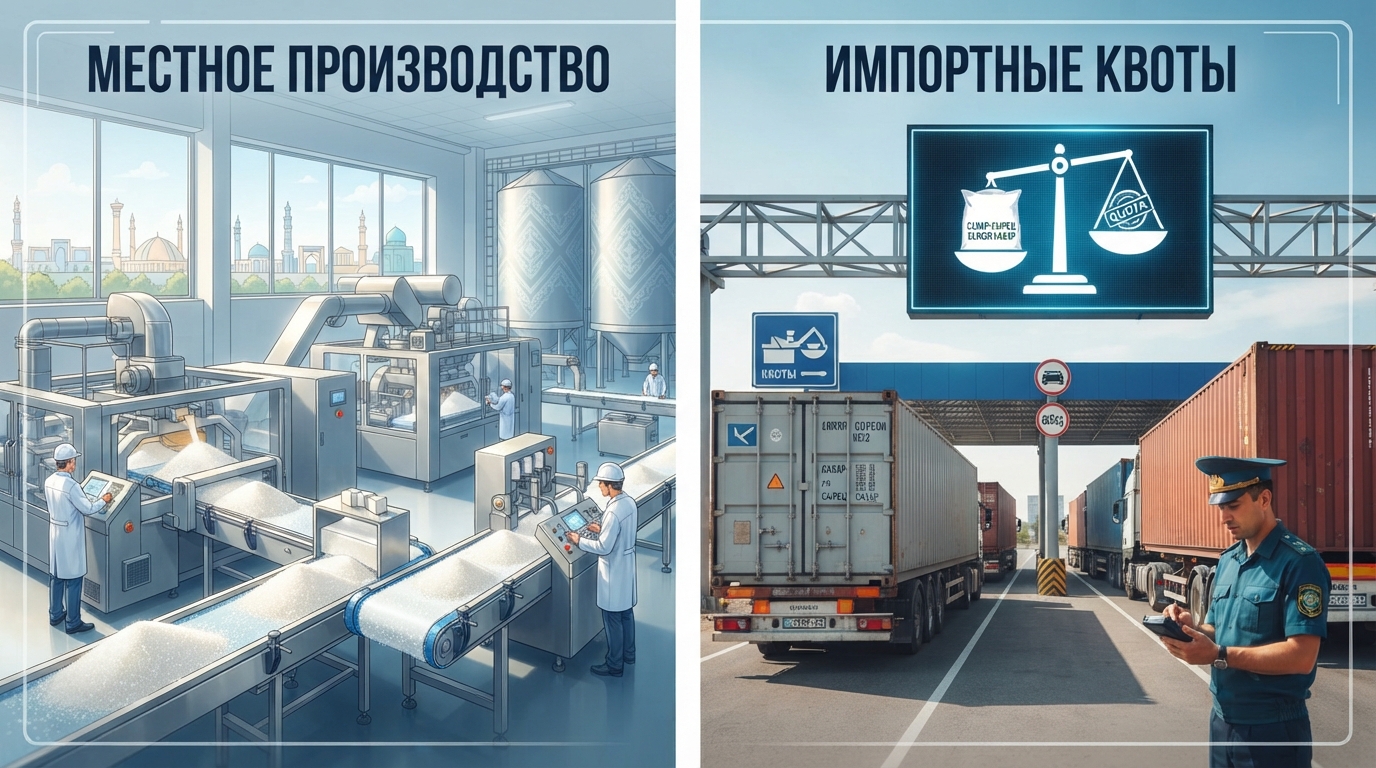
The Government of Uzbekistan Approved Import Quotas on Sugar by a Classified Resolution
Starting January 1, 2027, import quotas for white sugar are being introduced in Uzbekistan for food industry enterprises. Their total volume will be 300 thousand tons per year. This is established by Cabinet of Ministers Resolution No. 417 of July 30, 2026, "On measures to develop local sugar production, ensure food security, and stabilize the sugar market."
The Cabinet of Ministers approved annual quotas for the import of white sugar in a total volume of 300 thousand tons across three areas:
At the same time, the document allows for a review of the quotas every six months, taking into account domestic consumption, production capacity utilization, imports, and prices on the domestic market.
Proposals on the quota volumes will be prepared by the Ministry of Economy and Finance, the Committee for Competition Development and Consumer Protection, and the National Committee on Statistics. Every year in November, the government must approve the quotas for the following year.
By December 1, 2026, the Ministry of Investments, Industry and Trade, jointly with the Ministry of Digital Technologies, the Customs Committee, and the Competition Development Committee, was instructed to launch an electronic platform for distributing quotas among importers through online auctions.
The system will be integrated with the Customs Committee's "Single Window" information system. The results of the auctions will be published in the public domain.
The resolution does not clarify how deliveries exceeding 300 thousand tons will be processed, whether any restrictions apply to other importers, and whether a special tariff regime is provided.
Starting January 1, 2027, state organizations and enterprises, when purchasing white sugar, will be required to cover their needs on a priority basis through local producers.
In addition, the entire volume of products from domestic sugar factories must be sold through the commodity exchange.
For the export of finished products from local manufacturers, the possibility of supplies without additional special restrictions is provided.
The State Reserve Management Committee was instructed to form stocks of white sugar using products from domestic enterprises.
At the same time, the Industrial Cooperation and Public Procurement Agency received the right, as an exception, to accept certificates for goods from local sugar factories without charging fees, as well as to include manufacturers in the relevant register.
The resolution provides for financial support measures for local sugar producers.
The Ministry of Economy and Finance, the Reconstruction and Development Fund, and Uzpromstroybank must agree on a revision of the terms of existing loans for sugar factories. The repayment period for debt to Uzpromstroybank (its shares are included in the National Investment Fund) is allowed to be extended up to five years, including a grace period of up to two years.
At the same time, the parties must revise payment schedules and interest rates based on the bank's current tariffs.
By the end of 2026, enterprises must ensure full repayment of existing accounts receivable and attract 50 million dollars in private investments to support operations.
In addition, for the period from August 1, 2026, to August 1, 2031, compensation is provided for part of the interest expenses on foreign currency loans attracted by local sugar factories.
At the expense of the Interest Expense Compensation Fund under the Entrepreneurship Development Company, 50% of interest expenses can be covered, but no more than 5 percentage points.
This measure should be applied regardless of the sustainability rating of the enterprises and their credit classification, with the exception of overdue debt.
The government also instructed the Ministry of Economy and Finance to draft a bill providing for the exemption of local sugar factories from corporate income tax and property tax until January 1, 2031.
The funds freed up thanks to the benefits must be fully directed to paying off loan obligations.
The relevant amendments to the Tax Code were instructed to be prepared within a month and submitted to the Cabinet of Ministers.
A separate section of the resolution is dedicated to financial management and control over the operations of enterprises.
Local sugar factories were recommended to introduce positions of financial directors with the appointment of representatives from creditor banks.
It is envisaged that banks will be able to participate in general meetings of enterprises and will receive the right to block decisions that could worsen the financial condition of borrowers.
It is proposed to direct the free cash flow of enterprises toward early repayment of bank loans using a cash sweep mechanism — mandatory use of free liquidity to reduce debt.
The document also provides for the involvement of foreign consultants to audit the financial condition and develop recovery plans.
To strengthen control, it is planned to introduce video surveillance of production processes with the capability for real-time monitoring by banks, digital production management systems, and continuous accounting of finished products.
Until the full repayment of loans, sugar factories are advised not to distribute profits in the form of dividends.
In addition, under certain conditions, the pledging of production equipment, the use of assets for new projects, and changes to loan payment schedules without the necessary approvals are restricted.
In January, Alfiya Musina, executive director of the Association of Producers of Non-Alcoholic Beverages and Juices UzBev, called the high cost of sugar the "pain of all local producers."
Deputy Prime Minister Jamshid Khodjaev then reported on two major projects that would increase domestic production within two to three years.
From October 1, 2025, Uzbekistan canceled the 20 percent excise tax on white sugar imports, but the 20% customs duty remained.
Economist Otabek Bakirov criticized the decision to introduce sugar import quotas, expressing concern about potential consequences for consumers and entrepreneurs.
According to his assessment, restricting imports could lead to higher sugar prices, increased costs for beverage, confectionery, and other food product manufacturers, as well as reduced production and export opportunities for enterprises.
Bakirov notes that in 2026, Uzbekistan could import at least 750−800 thousand tons of sugar. Against this background, setting a quota of 300 thousand tons, in his opinion, creates risks of significantly restricting competition.
In Bakirov's view, a return to administrative distribution of import quotas also creates corruption risks, as access to supplies may depend on decisions by government agencies. He believes that such mechanisms are capable of leading to market concentration in the hands of a limited number of participants.
The new measures are being taken against the backdrop of a noticeable increase in imports of sugar and raw sugar.
According to Customs Committee data provided to Gazeta, in January–September 2026, Uzbekistan imported 652.8 thousand tons of sugar and raw sugar worth 440.1 million dollars. Over the same period in 2025, imports amounted to 480.1 thousand tons worth 321.3 million dollars. Thus, over the year, the physical volume of supplies increased by 172.6 thousand tons, or 36%, and their value grew by 118.8 million dollars, or 37%.
At the same time, in 2025, imports of sugar and raw sugar for the entire year totaled 732.3 thousand tons worth 481.9 million dollars, compared to 776.4 thousand tons worth 540.8 million dollars in 2024.
Thus, at the end of 2025, imports decreased by 5.7% in physical terms and by 10.9% in monetary terms.
It should be taken into account that customs statistics include both refined sugar and raw sugar used for further processing. Therefore, the total volume of imports cannot be directly compared with the 300 thousand ton quota, which is provided only for white sugar for certain categories of industrial consumers.
The main sugar producers in Uzbekistan are the Angren Shakar enterprises in Tashkent region and Xorazm Shakar in Khorezm region.
In April 2024, the Ministry of Agriculture estimated the country's annual sugar requirement at 650−700 thousand tons. The combined design capacity of the two existing sugar factories at that time exceeded 900 thousand tons per year.
However, actual sugar output has been declining in recent years.
According to the National Committee on Statistics, in the first half of 2025, the country produced 165.5 thousand tons of sugar, compared to 227.8 thousand tons in the same period of 2024 and 332.6 thousand tons in 2023. That is, production over two years fell by more than half, and compared to the first half of 2024 — by 27.3%.
At the same time, a significant portion of raw materials for local factories is traditionally imported. In particular, the Ministry of Agriculture previously reported that the main volumes of raw sugar come from Brazil and India.
Against the backdrop of declining domestic output, supplies of finished sugar from abroad are growing.
According to the Russian federal center Agroexport, in 2025 Russia supplied 417 thousand tons of sugar to Uzbekistan — 170 thousand tons more than a year earlier.
The organization noted that one of the factors for growth was the abolition of the 20 percent excise tax on white sugar imports to Uzbekistan from October 1, 2025.
In 2024, the authorities of Uzbekistan set a task to gradually bring the output of finished sugar to 1 million tons by 2028. As part of this program, daily listing of sugar on commodity exchange trading was also provided for, depending on demand.
In February 2026, plans of the Egyptian company Nile Sugar to invest about 450 million dollars in creating a full-cycle production facility in Uzbekistan became known, including growing sugar beets and building a processing plant. The design capacity of the enterprise should be 200 thousand tons of sugar per year.