

Uzbekistan's accession to the WTO: what will change for ordinary citizens and businesses
**Uzbekistan's Accession to the WTO: What Will Change for Ordinary Citizens and Businesses**
Uzbekistan intends to complete the process of joining the World Trade Organization this year. But what will this bring to ordinary citizens? Will imported goods become cheaper, will their range expand, how will this affect local producers, and will Uzbek companies be able to enter foreign markets more easily?
As the specialist noted, accession to the WTO should not be viewed merely as a reduction in customs duties.
"First and foremost, it is about creating a more open, competitive, and predictable market," the specialist explained.
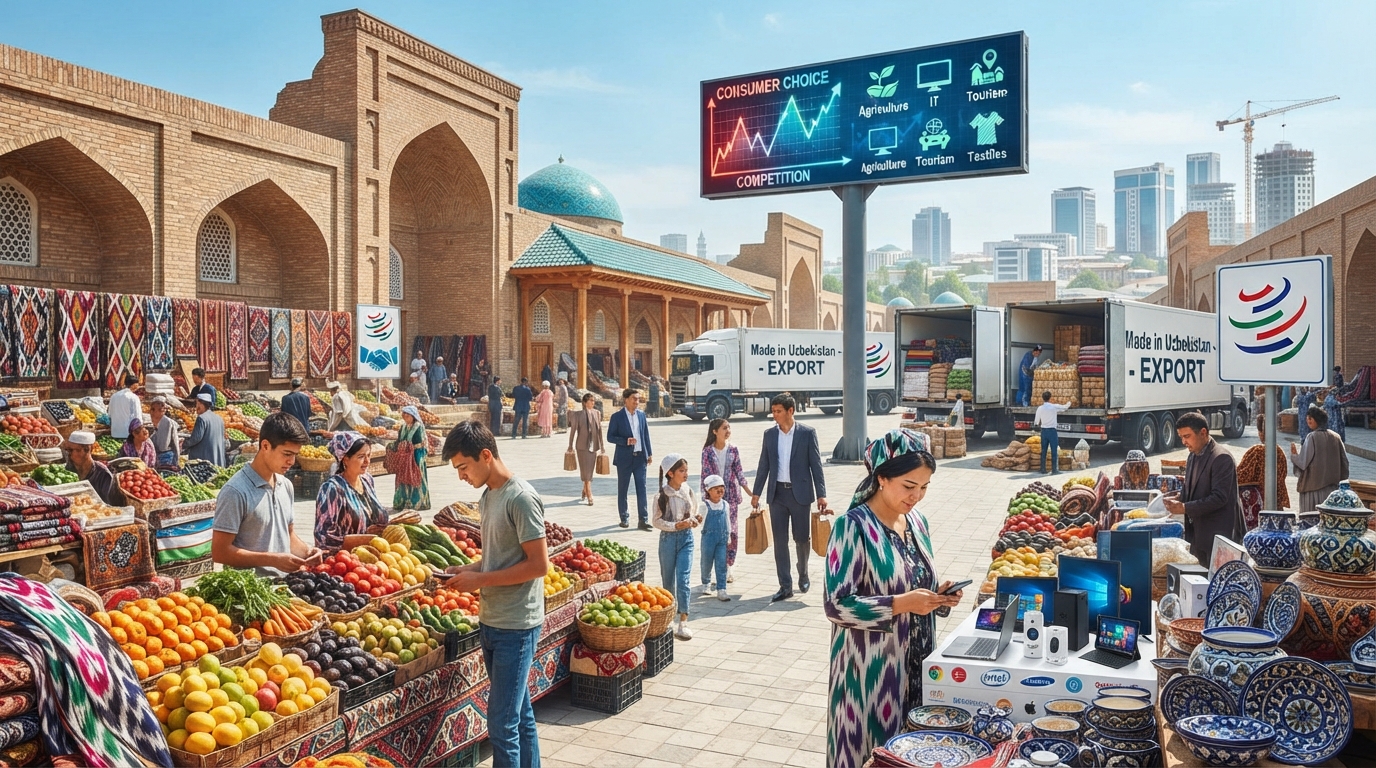
According to Akhror Kholmanov, ordinary citizens will be able to feel the changes in several areas at once. First of all, the choice of goods and services may increase. If barriers to imports are reduced and competition intensifies, local and foreign companies will have to compete more actively for customers by offering more attractive prices, high quality, and better service.
At the same time, prices will depend to a greater extent on the market situation. According to the expert, already during the preparations for WTO accession, Uzbekistan has abolished a number of export subsidies, reduced certain special rights of state-owned enterprises, and begun to align customs and technical regulations with international standards.
Changes may also affect the service sector. Competition could intensify in telecommunications, finance, insurance, logistics, tourism, and other industries. This, in turn, could lead to the emergence of new technologies, improved service, and a wider choice of services.
"For an ordinary citizen, the main result of joining the WTO is more accurately described not by the words 'everything will become cheaper,' but like this: choice will increase, competition will intensify, and quality requirements will rise," Akhror Kholmanov emphasized.
### Will Imported Goods Become Cheaper?
The expert admits that some imported goods may indeed become cheaper. However, one should not expect a price drop on all imports at once. According to him, the cost of imported products depends not only on customs duties. It is also influenced by the exchange rate, transport and logistics costs, taxes, supplier markups, and the level of competition in the domestic market.
Nevertheless, where duties are reduced or imports become easier, prices may go down. According to the expert, this could primarily affect equipment, technologies, components, and certain consumer goods that are either not produced in Uzbekistan or are manufactured in insufficient quantities.
At the same time, cheaper imports can benefit more than just buyers. If a local factory or company purchases equipment, raw materials, or components abroad, reducing the cost of importing them can also lower the cost of production of their own goods.
### Could Some Goods, on the contrary, Become More Expensive?
The specialist does not rule out such a scenario either.
"Some enterprises currently receive special subsidies, tax, or customs privileges. If these support measures have to be modified after joining the WTO, the expenses of individual companies may rise. If businesses pass these additional costs on to buyers, certain goods may become more expensive," the specialist explained.
The cost could also be affected by the gradual transition from state-regulated prices to market prices. At the same time, Akhror Kholmanov points out that not all such changes are directly related to WTO accession. Some of them are being carried out as part of Uzbekistan's general transition to a market economy.
Additional costs for manufacturers may also arise due to stricter requirements for the safety and quality of goods, including sanitary, phytosanitary, and technical standards. For buyers, however, this should mean safer products that better comply with established standards.
Thus, as the specialist notes, prices in certain areas may indeed rise initially. However, the goal of joining the WTO is not to artificially lower prices, but to increase competition and improve economic efficiency.
### What Will Change for Local Producers?
After joining the WTO, some benefits and subsidies for businesses may be revised. In particular, this applies to support measures provided on the condition of exporting products or using domestic goods instead of imported ones. According to Akhror Kholmanov, WTO rules allow for the support of scientific research and innovation, infrastructure development, personnel training, small businesses, and the implementation of international standards. The state will also be able to provide information and consulting services to exporters.
"Policy will shift from the model of 'who to grant a privilege to?' to the model of 'how to create good conditions for all enterprises?'" the expert explained.
### What Opportunities Will Open Up for Exporters?
According to the ministry, after joining the WTO, it will be easier for Uzbek companies to operate in the markets of the organization's member countries under more stable and clear international rules. This will allow businesses to better plan long-term investments and expand production for export.
However, WTO membership itself does not guarantee an automatic increase in exports. According to the expert, the result will depend on the quality and cost of products, logistics, international certificates, marketing, and the ability of the companies themselves to compete in foreign markets.
### For Whom Will WTO Accession Open New Opportunities?
Akhror Kholmanov believes that joining the WTO can help Uzbekistan transition to a more open and competitive economy, where private business plays a major role.
In addition, membership in the organization can improve conditions for investors. As the specialist explains, what matters to them is not only taxes, but also clear, stable rules that do not change unexpectedly.
According to the ministry's assessment, more opportunities may be gained by industries that already possess good export potential. Among them are textiles and ready-made garments, agriculture and food processing, IT, tourism, transport, logistics, and professional services. Enterprises that use imported equipment and components may also benefit, as access to them may become easier.
Difficulties may be faced by companies that have long operated under strong protection from foreign competition, enjoyed special rights, preferential financing, or other advantages, and at the same time lag behind foreign manufacturers in terms of efficiency.
At the same time, as the specialist emphasizes, the task is not to leave local business without support. It is about gradually preparing companies for stronger competition, rather than constantly protecting them from it. To achieve this, the main focus should be on modernizing enterprises, increasing productivity, implementing international standards, developing exports, and improving business access to finance.
"Joining the WTO is not the end of reforms. On the contrary, it will serve as an external institutional anchor for reforms and Uzbekistan's further transition to a market economy," the specialist concluded.