

The new wind farm in Bostanlyk will provide energy to about 20,000 homes.
Uzbekhydroenergo, with a grant from the Chinese government, built its first wind farm, Chorbog, with a capacity of 20 MW, in the mountains of the Tashkent region. The plant will provide electricity to approximately 20,000 homes and save over 13 million cubic meters of gas per year.
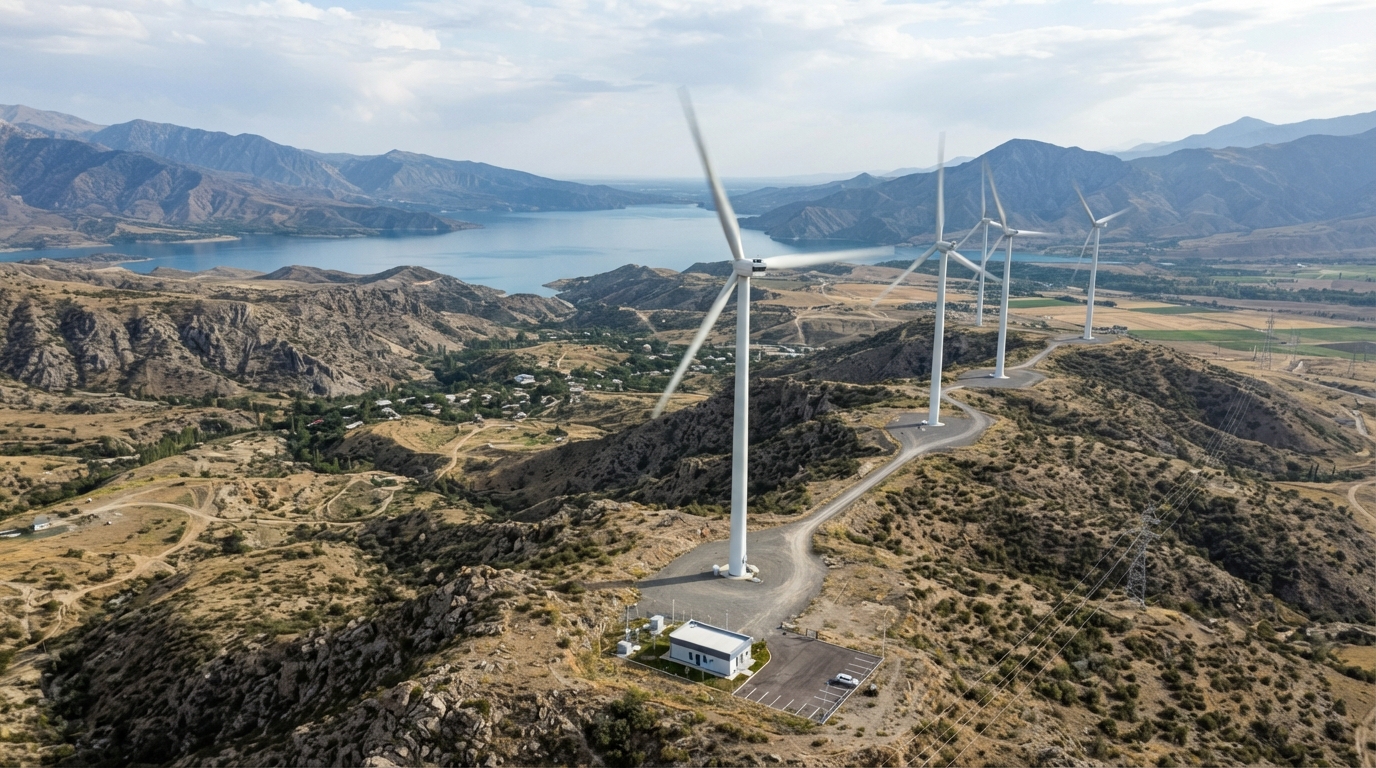
The 20 MW Chorbog wind farm has been commissioned in the Burchmulla area of the Bostanlyk district of the Tashkent region, near the Charvak reservoir. According to a Gazeta correspondent, this facility is the first of its kind for Uzbekhydroenergo, a company previously focused exclusively on hydropower.
The project was implemented thanks to a $28 million grant from the Chinese government. The general contractor was the Chinese company TBEA. Li Bianqu, director of the corporation, noted that this is TBEA's fourth project in Uzbekistan; the company is also involved in the modernization of the Lower Bozsu Cascade Hydroelectric Power Plant (HPP-19), Hydroelectric Power Plant-22, and Hydroelectric Power Plant-23 in the Tashkent region.
Construction of the power plant began in July 2025. Four wind turbines, each with a capacity of 5 MW, have been installed at the facility. Each turbine is 105 meters tall, the generator blades are 90 meters long, and the rotor diameter is 183 meters.
According to Azimjon Akhmadjonov, First Deputy Chairman of the Board of Uzbekhydroenergo, the most challenging stage was transporting the blades along winding mountain roads to the station's construction site.
The station is fully automated. Specialists monitor it remotely from a nearby control center. An elevator is located inside each turbine for servicing.
Rustam Ergeshov, Head of Operations at the Chorbog station, explained that sensors detect wind direction and automatically rotate the turbines for maximum efficiency. The wind turbines begin generating electricity at a stable wind speed of 3 m/s. At a wind speed of 11.4 m/s, they reach their nominal capacity of 5 MW. When the wind weakens, the system automatically shuts down the equipment.
"The control center is the brain of the entire station." From here, the generators' operation is constantly monitored, and equipment can be switched on and off remotely. We monitor wind speed and weather conditions in real time. Based on this information, daily forecasts for electricity generation volumes are generated," Ergeshov explained.
The station is connected to Uzbekistan's unified power grid. According to Ayubkhon Musulmonkulov, a leading specialist at Uzbekhydroenergo, it is capable of generating an average of approximately 50 million kWh of electricity per year, enough to power approximately 20,000 households in the Bostanlyk district. Musulmonkulov estimates this will save over 13 million cubic meters of gas annually.
Following the station's launch, specialists from the Chinese company trained local staff on the equipment and its operational features. Currently, the station's team independently manages all production processes.
Uzbekhydroenergo does not currently plan to develop wind energy as a separate business. Ayubkhon Musulmonkulov noted that the company's strategy through 2032 does not include the construction of new wind farms. Hydropower remains the company's core business.
In the Bostanlyk district, the company is developing hydropower projects, including the Mullalak Hydroelectric Power Plant (140 MW) on the Pskem River, the Yukori-Pskem Pumped Storage Power Plant (160 MW), the Korongitugay Hydroelectric Power Plant (325 MW), and the Khodjikent Pumped Storage Power Plant (600 MW).