

The long road to America
An Overseas Mirage: Why Kazakhstan Is Stuck on the Runway on Its Way to America
**The Long Road to America**
Kazakhstan's years-long efforts to establish direct air service with the United States have finally stalled in a mire of manufacturing disruptions and consular caution. Behind the outer shell of high-profile statements about strategic partnership lies a harsh reality where the path across the ocean runs through humiliating visa refusals and exhausting transit layovers.
**Alien Wings and the Uzbek Breakthrough**
The story surrounding the launch of a direct flight from Astana to New York is increasingly resembling an endless TV series whose finale is postponed to the following year time and again. The Kazakh side has done an enormous amount of work adjusting its aviation infrastructure to meet the strictest global requirements. In October, a delegation from the US Federal Aviation Administration visited the republic. The inspectors spent a week in the country, checking literally every element of the safety system, and provided high marks based on the results. But the paperwork procedure is relentless. Vice Minister of Transport of Kazakhstan Talgat Lastaev was forced to acknowledge the postponement of the deadline on the sidelines of the ICAO Safety Week: "We expect the final official report in November from the US Federal Agency and think that by the end of the year Kazakhstan will officially receive the right to operate flights to the territory of the United States."
However, even obtaining the long-awaited access category does not mean an immediate launch. The main obstacle has been the global supply chain. Air Astana had expected to receive a new long-haul Boeing 787 Dreamliner back in September, but production problems at the concern's plants pushed the aircraft's delivery to December. After that, crews will still have to log flying hours for months to confirm their right to operate the machine.
While Astana is waiting for a single plane, its regional neighbor is already flying in the American skies. Uzbekistan has not only established regular flights on the Tashkent–New York route, but is also actively expanding its presence. The national carrier and private airlines operate flights several times a week, and in October 2026, discussions regarding a new route to Miami turned up on the agenda. US Secretary of State Mark Rubio personally noted Uzbekistan's tourism potential, while local holdings are already purchasing American Boeings and opening specialized universities in Florida. Against this backdrop, Kazakhstan's ambitions look like treading water.
**The Economics of Emptiness and a Transit Deadlock**
Even if the first Dreamliner takes off from the Astana runway in 2027 after all, the airline will face a tough question of economic feasibility. Officials try to remain optimistic, citing the investment climate. "The flight is quite long, but taking into account how relations between the countries are developing, how much Kazakhstan is currently in demand, and given the development of investments in the economy, I think this flight will be profitable," says Talgat Lastaev, while admitting that the route will require a long time to build up passenger traffic.
However, geography and geopolitics dictate their own rules. The shortest and most economically viable route to New York passes through Russian airspace. Under current global conditions, this route is closed, which means having to fly around it, consuming significantly more fuel, and reducing the commercial appeal of the ticket. A direct flight risks turning into an elite pleasure for a narrow circle of businesspeople and government delegations, rather than becoming a mass product.
Central Asia is changing rapidly, and the region's aviation market is becoming an arena of fierce competition. While Uzbek cargo and passenger aircraft are integrating into American logistics, Kazakhstan continues to live on promises.
**A Visa Palisade and Shattered Illusions**
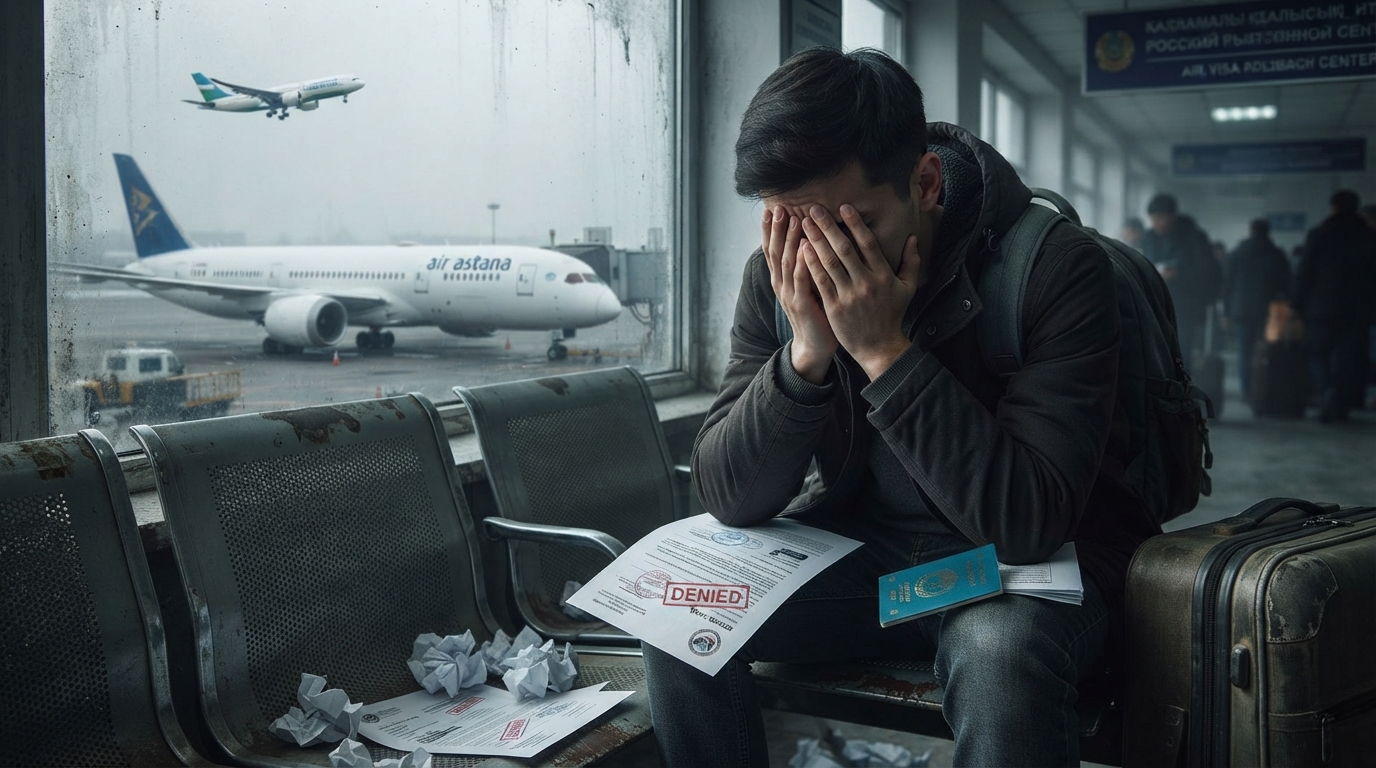
The absence of a direct flight is only part of the problem. A real wall between the two countries has been built out of visa refusals and consular barriers. Getting an American visa in Kazakhstan today is almost the same as completing an obstacle course. The embassy in Astana has become the main hub for applicants from all across the post-Soviet space, which has turned interview slots into a scarce commodity. The consulate in Almaty stopped accepting non-residents altogether, canceling appointments. Submitting the application itself requires paying a fee of $185 and filling out a multi-page form where any typo can derail the trip.
The climax comes at the moment of the interview. Leaving phones and smartwatches in storage lockers, the applicant is left one-on-one with a visa officer who, by default, considers every visitor a potential illegal immigrant. A two-minute conversation through bulletproof glass often ends with the issuance of a refusal sheet under the notorious Section 214(b), which signifies insufficient ties to the homeland. The officers are not interested in income certificates or property documents; they study social networks and pick up on uncertainty.
This bureaucratic fortress gives rise to a monstrous shadow market and tragedies. A cultural exchange program that was supposed to become a bridge of friendship turned into a real nightmare for two hundred Kazakh students. Having paid the organizers $1,100 each for a promised transfer and accommodation in Los Angeles, the young people found themselves on the street without money or communication just a few days later. The consulate had to rescue the deceived citizens. This glaring case clearly demonstrates the gulf between the glossy storefront of the American Dream and its cruel reality, where White House migration restrictions create fertile ground for fraud and despair.
The transatlantic bridge, which was meant to symbolize openness and global integration, in reality turns out to be a fragile structure dependent on the whims of foreign aircraft manufacturers and the suspiciousness of consular clerks. And until this frame of reference changes, America will remain for most Kazakhstanis a distant, hard-to-reach, and unfriendly territory across the ocean.