

The leather and footwear industry in Uzbekistan and Central Asia in the first half of 2026
The Center for Economic Research and Reforms has prepared an infographic on the dynamics of the development of the leather and footwear industry in Central Asian countries in the first half of 2026.
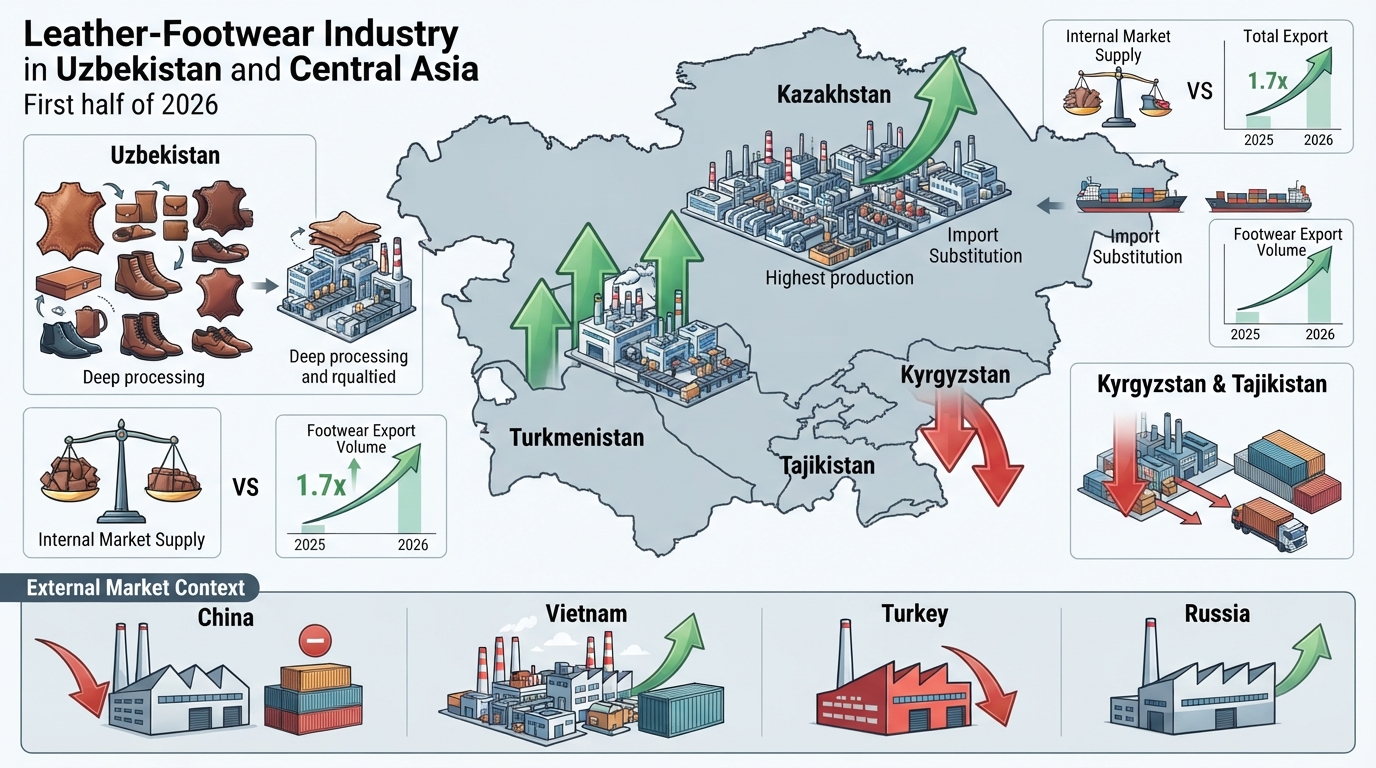
**Leather and Footwear Industry of Uzbekistan and Central Asia: Analysis of the First Half of 2026**
In the first half of 2026, the leather and footwear industry developed in the context of volatility in foreign markets and increased global competition. In such a situation, increasing production volumes, deep processing of raw materials and expanding export routes became the main factors of the industry's stability. This is especially important for Central Asian countries with their own raw material base and development potential. This analysis considers the situation in four Central Asian countries, data on Turkmenistan is not available in open sources.
**Leather and Footwear Industry in Uzbekistan**
In the first half of 2026, high growth rates were observed in the production of leather, leather goods and footwear in Uzbekistan. Production volume reached 2.8 trillion soums ($227 million), an increase of 16.9% compared to the same period in 2025. For comparison, a year ago this figure was 4.8%.
At the same time, a slight slowdown in growth rates was noted during the first half of the year. In particular, production growth over the first four months amounted to 39.4%, and over the first five months - 44.3%.
The dynamics of foreign trade were not the same. In January-June 2026, exports of leather and footwear products (groups 41-43 and 64 of the TIF TN) amounted to $31.5 million, a decrease of 6.1%. At the same time, footwear exports increased significantly - by 1.7 times, from $7.4 million in the first half of 2025 to $12.4 million.
As a result, the share of footwear in total exports of leather and footwear products increased from 22% to 39%. This means that despite the decrease in the total volume of exports of the sector, its composition improved in favor of finished products with a high level of processing.
The difference between the growth in production and the decrease in exports by 6.1% indicates that the expansion of production was largely directed to the domestic market. Import statistics also confirm this: imports of leather and footwear products decreased by 3% and amounted to $ 33 million.
**Leather and footwear industry in Central Asian countries**
In the first half of 2026, the highest production growth rates in the region were recorded in Kazakhstan. The production volume of leather, leather goods and footwear increased by 30.1%. For comparison, in the first half of 2025, production decreased by 11.4%. Thus, a transition from a decline to an active recovery of production was observed in Kazakhstan.
At the same time, external demand grew much more slowly. In January-May, exports of leather and footwear products increased by only 1.3%, amounting to $26 million. Footwear exports increased by 10.6%, reaching $17 million. They account for almost two-thirds of total exports.
Imports of leather and footwear products in Kazakhstan decreased by 33% in the first five months of 2026, to $154 million, including footwear imports, which decreased by 25%, to $100 million.
The situation in Kyrgyzstan was much more sluggish. In the first half, production decreased by 12.4%. The decline in production was accompanied by a decrease in exports. In January-May, product deliveries decreased by 25.8% to $8.7 million. Direct footwear exports almost doubled – by 50.2% to $3.7 million.
Imports of leather and footwear products also decreased significantly compared to last year – by 65% to $35 million. Such sharp changes may be associated with changes in transit and re-export flows through Kyrgyzstan.
Production dynamics in Tajikistan were also negative. In January-June, production decreased by 28.1% compared to the same period last year.
In general, the situation in the region is not the same. Uzbekistan and Kazakhstan are increasing the production of leather and footwear products, while Kyrgyzstan and Tajikistan are experiencing a decline. At the same time, Uzbekistan is distinguished by the highest growth rates of finished footwear exports.
**Situation in foreign markets**
In the first half of 2026, the global leather and footwear industry developed in conditions of high competition, limited demand in some markets, and different dynamics in major manufacturing countries.
In the world's largest footwear producer and exporter, China, the volume of external supplies decreased. Exports of leather and footwear products decreased by 5.2% to $40 billion. Footwear exports decreased by 7.3% to $22 billion.
Vietnam, on the contrary, continued to increase production. In January-June, the production of leather and footwear products increased by almost 4%.
The difficult situation in the leather and footwear industry in Turkey remained. In May, production in this sector was almost 6% lower than in May 2025. In January-June, product exports decreased by 8% to $829 million. Footwear exports decreased even more - by 13.2% to $462 million.
After the weak dynamics of last year, production in Russia began to gradually recover in the first half of 2026. According to the results of the first half of the year, the volume of production of leather and footwear products remained practically at the level of last year, with growth of 0.4%. By June, the dynamics had improved significantly.
Thus, among large manufacturers, Vietnam maintained the most stable positive production dynamics during the period under review, while export deliveries decreased in China and Turkey. In addition, China's exports to Central Asia decreased by 20% to $1.5 billion, and Turkey's deliveries decreased by 4% to $50 million.
The weakening of the dynamics of large exporters theoretically creates additional opportunities for Central Asian manufacturers in the regional market. However, the gap between production and export volumes remains significant.
**Conclusion**
In the first half of 2026, the highest production indicators in the region were recorded in Kazakhstan and Uzbekistan. In Kyrgyzstan and Tajikistan, on the contrary, a decrease was observed. At the same time, Uzbekistan is distinguished by high growth rates of footwear exports. This creates an opportunity to strengthen the country's position as one of the centers of the Central Asian leather and footwear industry.
The results of the first half of the year show that the further development of the leather and footwear industry in Uzbekistan and the region will largely depend on the ability to transition from the production of raw materials and intermediate products to the formation of full-fledged value chains and the expansion of competitive finished footwear production.
In general, for Central Asian countries with their own livestock and raw material base, the consistent development of leather and footwear production will allow the formation of complete production chains within the region, reduce dependence on imports of finished products, and increase the competitiveness of national manufacturers in foreign markets.