

Industrial development in Central Asian countries in the first half of 2026
CERR has prepared infographics on the dynamics of industrial development in Central Asian countries in the first half of 2026.
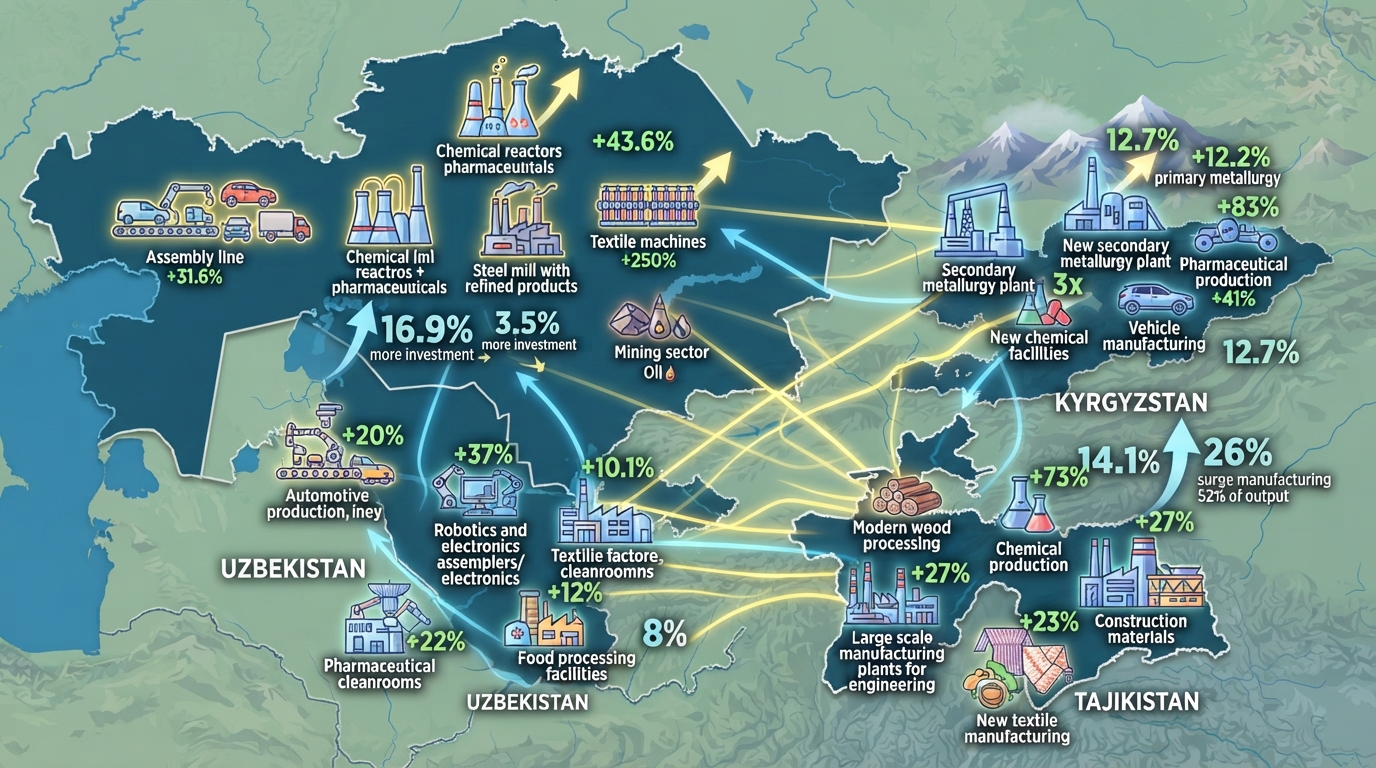
Industrial Development of Central Asian Countries in the First Half of 2026
Industry is a key element of Central Asia's socioeconomic progress, serving as one of the main drivers of economic growth and a source of export revenue, investment, and employment. The development of manufacturing industries contributes to the diversification of the region's economies, enhanced processing of local resources, the creation of high-value-added products, and a reduction in import dependence.
In this context, a generally positive trend was observed in the first half of 2026, with industrial production growing across all countries in the region (data for Turkmenistan is unavailable, so the analysis covers four Central Asian countries).
**Country Trends in Industrial Development**
**Kazakhstan**
Kazakhstan's industry grew by 3.5% year-on-year, reaching a value of $71 billion.
Mining, a constraining factor, was its output, which declined by 4%, including oil and gas production, which fell by 8.3%. Considering that the mining sector accounts for approximately 46% of total industrial output, this trend significantly slowed the country's overall economic growth.
Manufacturing, on the other hand, grew by 9.8% and, in terms of volume ($33 billion), has already slightly surpassed the mining sector. Thus, processing has become the main source of positive industrial growth.
By industry, the fastest growth was demonstrated by textile manufacturing (2.5 times), pharmaceuticals (43.6%), finished metal products (39.9%), machinery and equipment repair and installation (34.7%), and automotive manufacturing (31.6%). Overall mechanical engineering increased by 23.1% and accounted for 8.1% of industrial output.
However, one of the largest industries—basic metallurgy—decreased by 2.7%, while oil refining declined by 0.8%. Against this backdrop, the structural turnaround remains uneven: growth in higher-value-added products is combined with weak performance in the largest raw materials and primary processing industries.
Industrial growth was supported by investment, which increased by 16.9%.
Kyrgyzstan
Kyrgyzstan's industrial output grew by 12.7%, reaching $5.2 billion. The mining industry expanded by 12.8%, primarily due to the extraction of metal ores and other minerals. The manufacturing sector grew by 15.1%, accounting for 79.1% of total output.
The largest industrial sector, primary metallurgy, which accounted for 48.7% of output, grew by 12.2% after a 2.2% decline last year. At the same time, a number of smaller industries expanded: the chemical industry grew almost threefold, paper and cardboard by 2.2 times, oil refining by 70%, printing by 66%, pharmaceuticals by 83%, construction materials by 33%, and vehicle manufacturing by 41%. This picture indicates a gradual expansion of the range of growing industries, although their contribution to the overall output remains significantly smaller than that of metallurgy.
The weakest link remained the electric power industry, which saw a 2.6% decline, and light industry: its output fell by 12.2%, including textile production by 27.6% and clothing production by 2.4%.
**Tajikistan**
Tajikistan demonstrated the highest industrial growth among the countries analyzed – 14.1%, with an output value of approximately $3.6 billion. However, compared to the first half of 2025 (growth of 24%), the dynamics have slowed.
Manufacturing grew by 26% and accounted for 52% of output (compared to 47% in the first half of 2025). Electricity, gas supply, and air conditioning increased by 16.8% (in particular, electric power by 17.1%), and the energy sector's share in industry reached 21% (compared to 19% in the first half of 2025).
In processing, the following sectors showed particularly significant growth: woodworking by 73%, chemical industry by 56%, paper and cardboard production by 46%, furniture and other manufacturing by 43%, food industry by 25%, mechanical engineering by 27%, and construction materials production by 23%. This demonstrates a fairly broad sectoral growth front. At the same time, the mining industry contracted by 6.7%, primarily due to a 7.4% decline in metal ore production and a 41.9% decline in oil and gas production.
**Uzbekistan**
Uzbekistan's industrial sector grew at a faster pace of 8% (6.6% in the first half of 2025), and the value of its output reached $53 billion.
The manufacturing industry expanded by 8.8% (7.1% in the first half of 2025), and its share of industrial output increased from 85% to 86%. The mining sector grew by only 2.1%. Electricity, gas supply, and air conditioning also grew by 7.9% (3.1%), while water supply, waste collection, and disposal increased by 15.9% (9.7%). By industry, the highest growth rates were demonstrated by: other machinery and equipment production (up 1.6-fold), woodworking (up 48%), computer and electronic equipment production (up 37%), furniture (up 31%), pharmaceuticals (up 22%), and automotive manufacturing (up 20%). Food production also increased by 12%, textiles (up 10.1%), and construction materials (up 12%).
However, it should be noted that relatively low growth rates remained in the largest industry—primary metals production (29% of industrial output)—at 1.3%.
**General Regional Industrial Development Trends**
In all four countries, processing grew faster than the overall industry: in Kazakhstan (9.8%) versus 3.5%, Kyrgyzstan (15.1%) versus 12.7%, Tajikistan (26%) versus 14.1%, and Uzbekistan (8.8%) versus 8%. This shift was particularly pronounced in Kazakhstan and Tajikistan, where the extractive sector contracted, but the overall industrial index remained positive.
Accelerated growth was also observed in mechanical engineering and certain high-tech industries. Automotive manufacturing grew in all four countries: by 31.6% in Kazakhstan, 40.4% in Kyrgyzstan, 34.2% in Tajikistan, and 19.6% in Uzbekistan.
At the same time, these countries remain highly dependent on metallurgy and raw materials production. Metallurgy accounted for almost half of Kyrgyzstan's industrial output; metal production accounted for 28.7% of Uzbekistan's output and 20.4% of Kazakhstan's. In Tajikistan, metallurgy, ore mining, and electric power continued to play a significant role.
Another notable trend in 2026 was the expansion of production linked to domestic demand and the investment cycle. In all countries, the food industry, construction materials production, chemical industries, rubber and plastics production, finished metal products, automotive manufacturing, and furniture manufacturing grew.
The investment base for industry remained significant, but varied in scale and structure. Industry's share of total investment reached 47% in Uzbekistan, 41% in Kazakhstan, 35% in Tajikistan, and 17% in Kyrgyzstan. These investments provide the foundation for further growth, but their effectiveness will depend on the introduction of capacity, the localization of intermediate production, and access to external markets.
**Conclusions**
The results of the first half of 2026 show that industry in Central Asia continued to grow, with the main positive impetus increasingly coming from manufacturing.
The key structural result of the first half of the year was the growth of higher-value-added industries: mechanical engineering, automotive manufacturing, electronics, chemicals, pharmaceuticals, finished metal products, and building materials. However, a significant portion of output remains concentrated in mining, metallurgy, and energy, and the rapid growth of some new segments is largely due to the small initial base. Therefore, the sustainability of the industrial recovery will be determined not only by the introduction of new capacity, but also by the deepening of inter-industry ties, the development of regional supply chains, productivity growth, and the expansion of non-resource exports.
In the near term, countries in the region should focus on processing local raw materials into higher-value-added products, developing cooperation, and eliminating infrastructure constraints—primarily in energy, transport, and access to industrial financing. These factors will help transform current growth into sustainable structural modernization of Central Asian industry.
Ruslan Abaturov, CERR