

The gap in the regional infrastructure rating reached 54.74 points
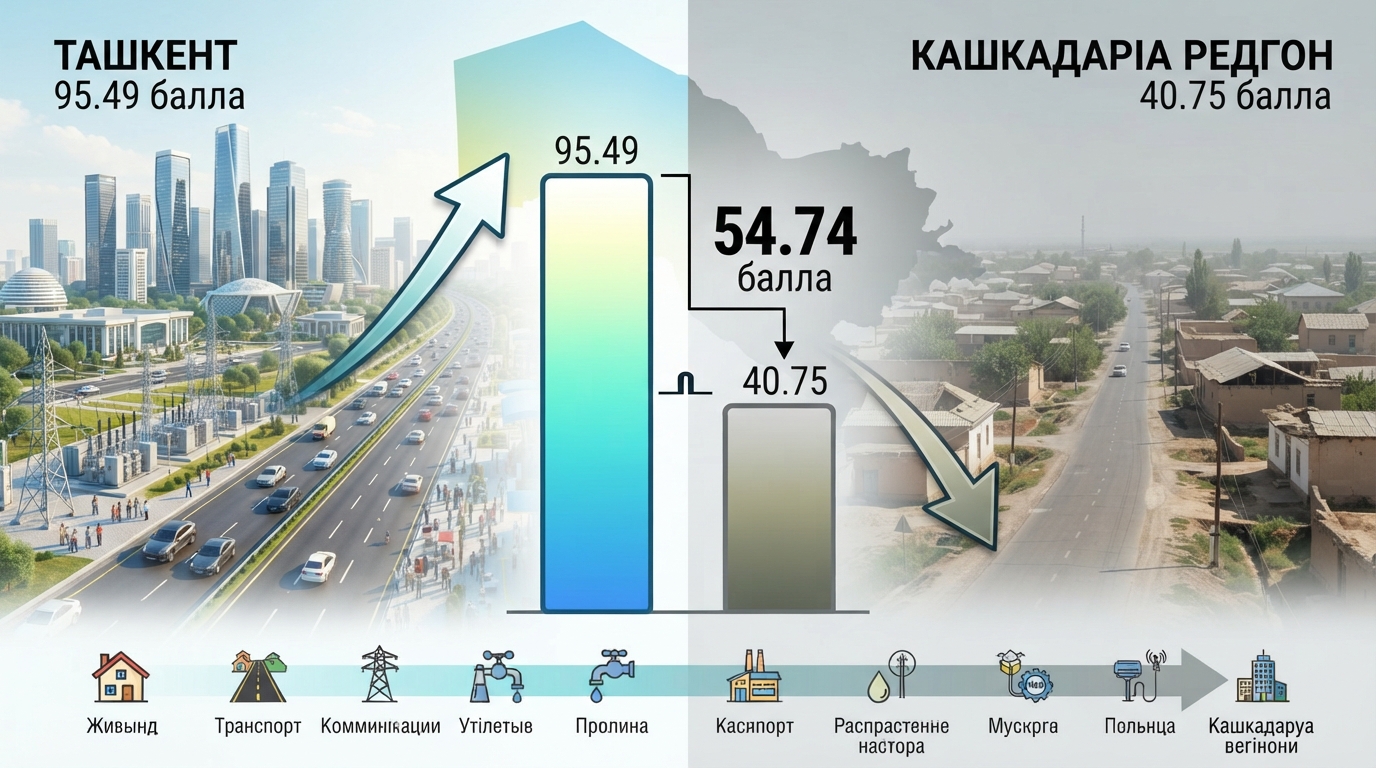
Tashkent topped the infrastructure ranking of Uzbekistan's regions with 95.49 points, while Kashkadarya Region scored 40.75 points.
Gap in regional infrastructure rating reaches 54.74 points
Tashkent took first place in the infrastructure rating of Uzbekistan's regions for 2026, receiving 95.49 points.
Kashkadarya region ranked last with a score of 40.75 points. The lag between the leader and the region with the lowest result amounted to 54.74 points — the maximum gap among the seven areas of the rating. This was reported by the Center for Progressive Reforms.
The infrastructure block accounts for 13.7% of the overall regional assessment and consists of eight indicators. Four of them relate to housing, while another four describe transport and communications. Thus, the assessment considers not only road infrastructure, but also conditions affecting the daily life of the population and economic activity.
The average unweighted result of the 14 regions was 56.15 points, with a median of 53.59. Only three regions crossed the 60-point threshold, while five received less than 50 points. Excluding Tashkent, the average indicator for the remaining 13 regions was 53.13 points.
Following the capital in the rating is Tashkent region with 73.54 points. Third place went to Fergana region, scoring 60.04 points. Next were Navoi region (59.13), Bukhara region (57.59), Samarkand region (54.99), Namangan region (54.30), Syrdarya region (52.88), and Khorezm region (52.31).
Fewer than 50 points were received by Andijan region (48.55), the Republic of Karakalpakstan (47.46), Jizzakh region (45.76), Surkhandarya region (43.34), and Kashkadarya region (40.75). The difference between Fergana and Navoi regions, which ranked third and fourth, was only 0.91 points.
According to the analysis, the infrastructure area shows the largest spread among the seven blocks of the rating.
For comparison, the difference between the maximum and minimum results is 45.69 points in the "Crime and Correctional System" category, 37.21 in the natural environment assessment, 27.35 in education, 26.50 in the economy, 25.97 in the "Opportunities" block, and 14.05 in healthcare.
A comparison of data for 2024–2026 shows that Tashkent held the leadership position throughout the entire period: 93.53 points in 2024, 93.21 in 2025, and 95.49 in 2026. Fergana region received 60.57, 62.07, and 60.04 points, respectively.
Over the same period, Jizzakh region improved its indicator from 39.93 to 45.76 points. The increase was 5.83 points, but the region remains among the territories with the lowest infrastructure scores. At the same time, the high result of Fergana region in the infrastructure block does not imply a similar position in the overall rating: the analysis indicates that the region ranks 14th in it.
The authors also point out a discrepancy between economic and infrastructure evaluations. In Navoi region, the economic indicator is 86.73 points, while the infrastructure one is 59.13. In Khorezm region, these values are 79.69 and 52.31 points, in Karakalpakstan — 78.71 and 47.46, and in Kashkadarya region — 74.69 and 40.75 points.
The largest gap between the two areas was recorded in Kashkadarya region — 33.94 points. In Karakalpakstan it is 31.25 points, and in Surkhandarya region — 30.94.
According to the authors of the analysis, such differences require additional study of the availability and quality of infrastructure, including power supply reliability, transport accessibility, logistics, and housing services.
At the same time, the difference in rating scores is not a monetary expression of infrastructure deficit or losses in economic production.
Regional differences are also noticeable in internet connection metrics. According to data from the National Committee on Statistics for 2025, there were 67.7 subscriber internet connections per 100 residents in Kashkadarya region, 67.9 in Surkhandarya, 107.3 in Navoi, and 96.9 in Syrdarya region. The national average was 94.7 connections per 100 residents.
At the same time, the number of subscriber connections does not equal the share of the population using the internet, as one person may have multiple connections.
In addition, the statistics for Tashkent take into account the activities of individual operators that also operate in Tashkent region. The authors note that without the primary methodology, it is impossible to determine the weight with which this data is factored into the rating.
As additional context, the analysis cites World Bank recommendations from the 2025 Country Economic Memorandum report on Uzbekistan.
The document suggests modernizing energy and transport infrastructure, improving road connections along the Tashkent — Samarkand — Navoi route, and strengthening railway links between Karakalpakstan and Khorezm and the central regions of the country.
These recommendations are not viewed as a direct explanation of the rating results, but they can be taken into account when defining investment priorities.
For a more detailed analysis, the authors propose preparing "infrastructure passports" for districts and cities based on the rating's eight indicators.
This will help identify which specific indicators lower the scores of Kashkadarya, Surkhandarya, and Jizzakh regions, as well as examine in greater detail the gap between economic and infrastructure performance in Navoi region, Khorezm, and Karakalpakstan.
Among the additional indicators suggested for regular monitoring are the duration of power outages, continuity of water supply, and the time required to travel to public transport.
These parameters are not included in the current list of eight infrastructure rating indicators, but, according to the authors, they could help assess changes in the daily living conditions of the population and business operations.