

Tashkent: pros and cons
Where in Central Asia is it better to live and do business — Global Cities Index 2026
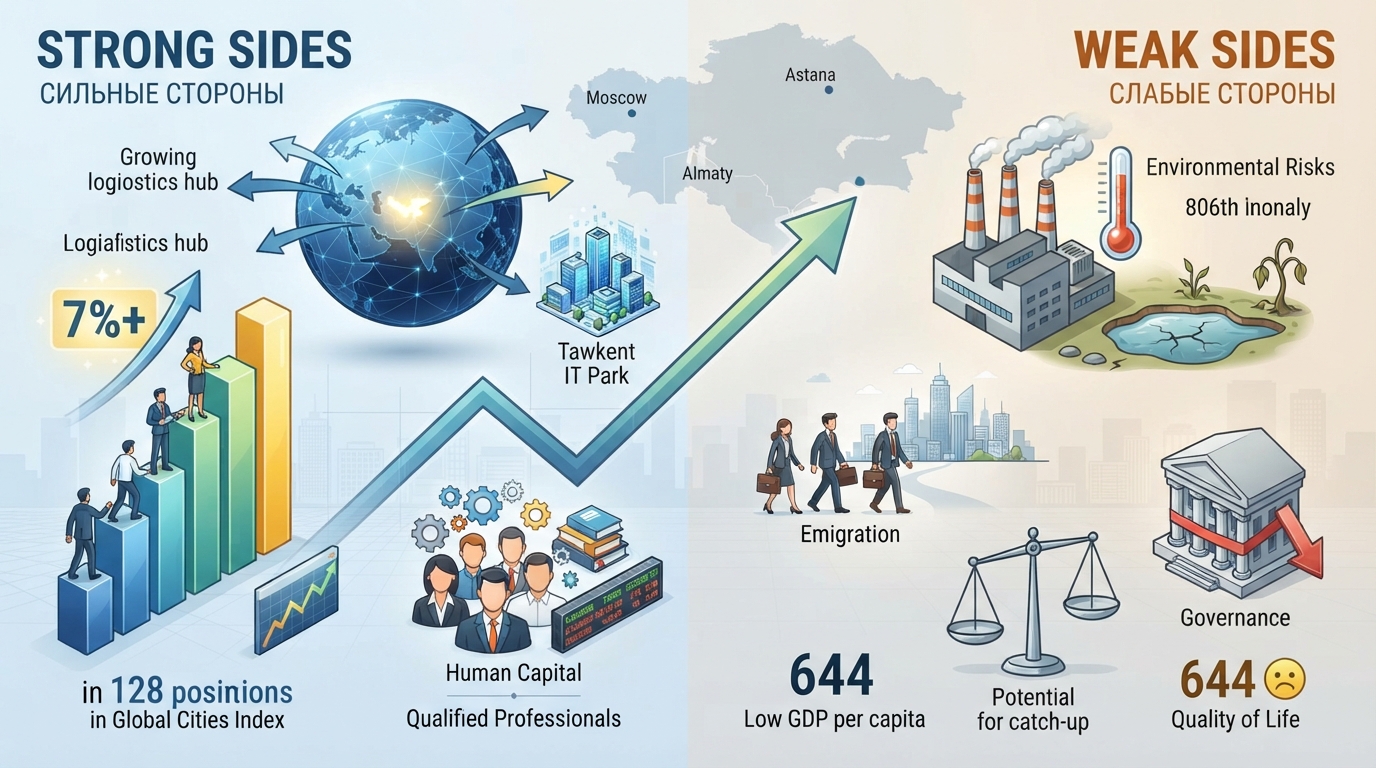
Tashkent: strengths and weaknesses
In the overall Global Cities Index 2026 ranking, the capital of Uzbekistan took 343rd place among the world's 1,000 largest cities. At the same time, in terms of economy, Tashkent ranked higher than Almaty and Astana, and in terms of human capital, it entered approximately the top 11% of cities in the global list.
In the overall standings, Tashkent settled in 343rd place, improving its result by 128 positions compared to last year.
Economics — 188th place
Human Capital — 108th place
Quality of Life — 644th place
Environment — 806th place
Governance — 825th place
In the cumulative ranking, Tashkent lags behind Astana and Almaty, which hold leading positions in the regional list, but it outperforms both cities in terms of economy. It is in this category that the capital of Uzbekistan showed the most notable growth — from 558th to 188th place.
According to the Oxford Economics forecast, in 2026–2030, Tashkent's GDP will increase by an average of more than 7% per year — this is the highest rate among urban economies in Central Asia and Eastern Europe.
In the overall ranking, Tashkent lags 30 positions behind Moscow, but in terms of economy, it is higher than the Russian capital — 188th place against 205th.
The capital of Uzbekistan is the only city in Central Asia that Oxford Economics included in its Cities to Watch list. It includes five cities from each region that show notable dynamics and, according to analysts, are capable of improving their positions in the ranking in the coming years.
Oxford Economics separately notes Tashkent's human resource potential: in terms of human capital, the capital took 108th place in the world and sixth in the region of Central and Eastern Europe and Central Asia. The growth in the number of qualified specialists makes the city more attractive for business.
Tashkent is also strengthening its status as a regional hub for technology and finance. Among the key projects, analysts name the Tashkent IT Park and the "Uzbekistan — 2030" strategy, which provides for the creation of an international financial center. Another factor of transformation is construction, including the New Tashkent project.
The city's location on the Middle Corridor, which connects Europe and Asia bypassing Russia, also enhances its role as a regional logistics hub. Oxford Economics points out that after the start of the war in Ukraine, part of Russian business and capital began to look for more neutral destinations.
Among the risks, Oxford Economics highlights the relatively low GDP per capita: it creates potential for catch-up growth, but at the same time increases the risk of qualified specialists outflowing to wealthier countries.
Environmental risks could also hold back further development. Analysts draw attention to high emission intensity, temperature anomalies, and Uzbekistan's dependence on external water sources. In the environment category, Tashkent took 806th place.