

The Expulsion of the Thief of Baghdad
Middle East: Will Iran exploit the consequences of the US troop withdrawal from Iraq?
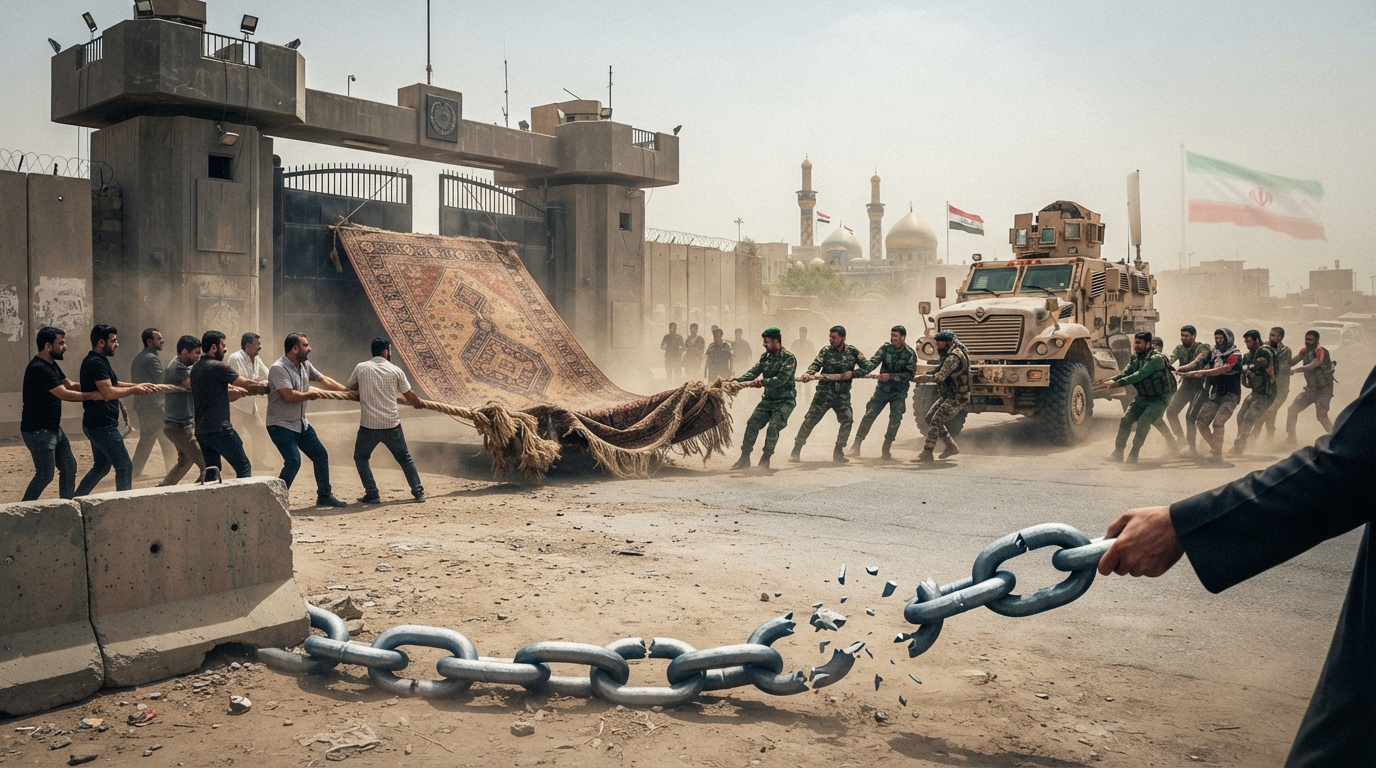
**The Expulsion of the Thief of Baghdad**
The final withdrawal of US troops from Iraq on September 30, after 12 years of Operation Inherent Resolve, evoked positive emotions not only in Baghdad but also in Tehran. Brigadier General Esmail Qaani, commander of the Quds Force of the Islamic Revolutionary Guard Corps, called the withdrawal a "humiliating expulsion," claiming that it was Iraqi armed groups that forced Washington to leave.
Speaking on October 1 at an event in Tehran commemorating the late leader of the Lebanese Hezbollah movement, Hassan Nasrallah, Qaani emphasized that the remaining American presence would also disappear. "America must be expelled from Iraq – both from its land and from its sky," Tasnim News Agency quoted him as saying.
The pro-government newspaper Iran called the troop withdrawal "the beginning of the end of the American presence in the region," while the hardline conservative newspaper Vatan-e Emrooz described it as the "expulsion of the thief of Baghdad," referencing the imagery from the collection of fairy tales "One Thousand and One Nights." Comparing the situation in Iraq with Yemen and the Persian Gulf, Qaani urged Arab states to abandon their dependence on Washington.
Tehran perceives the end of the US military mission not simply as a matter of a neighboring country's sovereignty, but as part of a broader regional confrontation in which the United States has constantly faced pressure from Iran and its allied armed groups, Al-Monitor writes. Since the start of Operation Roaring Lion, Israelis and Americans have been making particularly active efforts to defeat the pro-Iranian "Axis of Resistance," and in this context, Iraq acquires special significance: Tehran's influence here remains deeply rooted, even as supporting other elements of its regional strategy becomes increasingly difficult.
However, the actual departure of the military does not necessarily mean the disappearance of American influence, the Western publication notes. Washington and Baghdad have agreed to transition their relations in the military sphere. In addition, the White House retains significant economic leverage through international financial institutions. The oil revenues of the government in Baghdad remain tied to an account at the Federal Reserve Bank of New York, giving Washington serious leverage over access to dollars and international settlements. Oil accounts for approximately 90% of Iraq's state budget revenues. Therefore, Qaani's demand to remove America from Iraqi "land and sky," if implemented, will inevitably affect more than just purely military matters.
Iraq has traditionally served as a "bridge" between Iran and the Arab world, as well as a key arena of rivalry between the Islamic Republic and Washington. Following the US invasion of the banks of the Tigris and Euphrates and the start of Operation Inherent Resolve, pro-Iranian armed groups gained significant military, political, and economic influence. The capabilities of some of the most numerous formations are comparable to individual security structures of the Baghdad government. The US departure removes the most obvious military counterweight to these groups, which is particularly important in the context of the ongoing confrontation.
The Prime Minister of Iraq, a far from poor man, Ali al-Zaidi, has tried to achieve the disarmament of influential armed groups and their transition under state control. Initially, the deadline for the US troop withdrawal — September 30 — was linked to efforts to disarm these groups. On August 17, special forces reporting directly to the Prime Minister arrested the head of intelligence for Harakat Hezbollah al-Nujaba — an Iran-linked group that the US has designated as a terrorist organization, accusing it of involvement in drone attacks on American facilities. The detention, which lasted 48 hours, triggered threats of retaliation from the group and prompted intervention by senior Shiite figures trying to defuse tensions.
A week later, Iraqi special forces arrested four militia members, including a local commander, on charges including anti-American activities. In turn, representatives of Harakat al-Nujaba and the Shiite community warned that harsh measures against the militia members would make disarmament impossible and could lead to instability. According to them, there can be no question of surrendering weapons at a time when they are supporting Tehran in the war against the US. In the same month, the most powerful militia, Kata'ib Hezbollah, issued a statement criticizing Zaidi and setting conditions for dialogue, including guarantees that US troops would never return, as well as measures to rid Iraq of any US influence on political and economic decision-making.
The mentioned and some other formations are part of the "Islamic Resistance in Iraq" — an umbrella group uniting about 10 radical Shiite armed groups with a total strength of about 50,000 fighters, possessing long-range missiles, drones, and anti-aircraft systems. At the same time, the Shiite formations do not form a single bloc, are oriented toward different forces, and by no means all of them are linked to Tehran. In the past, militia members have also refused to surrender their weapons, stating that they could not do so while US-led coalition forces remained in Iraq. On September 21, al-Zaidi extended the disarmament deadline to the end of June 2027, but there is no certainty that this deadline will not be pushed back again. Turkish authors also point to probable risks in the event of a delay or disruption of the process, hinting at difficulties in the process of handing over the Bashiqa base in northern Iraq to the Baghdad government.
For decades, Iran has tried to strengthen its influence in the neighboring country through political parties, religious networks, trade, energy ties, and armed groups. The withdrawal of US troops potentially strengthens this system, but at the same time sharpens its internal contradictions. Nationalist-minded Iraqis welcome the end of the US military presence, perceiving it as a restoration of sovereignty, which should not automatically be equated with support for Iranian influence.
Tehran seeks to have a friendly government and strong allies in Baghdad, but is interested in avoiding instability in Iraq that could turn the country into a source of security threats or provide a pretext for new foreign intervention.
Another complicating factor remains the activity of radical terrorist groups, including the Islamic State. If the authorities in Baghdad are unable to contain terrorist attacks without the intelligence, surveillance, and other capabilities previously provided by the US, Tehran could face a weakening of the Iraqi state, which means potential instability that will have to be managed one way or another, rather than simply exploited for its own benefit.
The US departure gives Tehran more opportunities to expand its presence, but does not ensure complete freedom of action. Washington retains financial and diplomatic tools, and the Sunni Gulf monarchies continue to participate actively in Iraqi affairs.
If Iran manages to help maintain a political order friendly to it in the neighboring country, keep its armed partners within the framework of political rather than military confrontation, and prevent Iraq from turning into a platform for renewed US military pressure, then the conclusion of Operation Inherent Resolve could become a significant strategic acquisition for Tehran after the war.
At the same time, if rivalry between local groups intensifies, the disarmament of armed formations could trigger a confrontation after the US departure — and then that same vacuum could turn into an additional source of problems for Iran. Presumably, this is precisely the scenario that the Islamic Republic's opponents in the Middle East will strive for.