

The average salary in Uzbekistan has exceeded 7 million soums. Where it grew the fastest
The average salary in Uzbekistan has exceeded 7 million soums. Where it grew the fastest
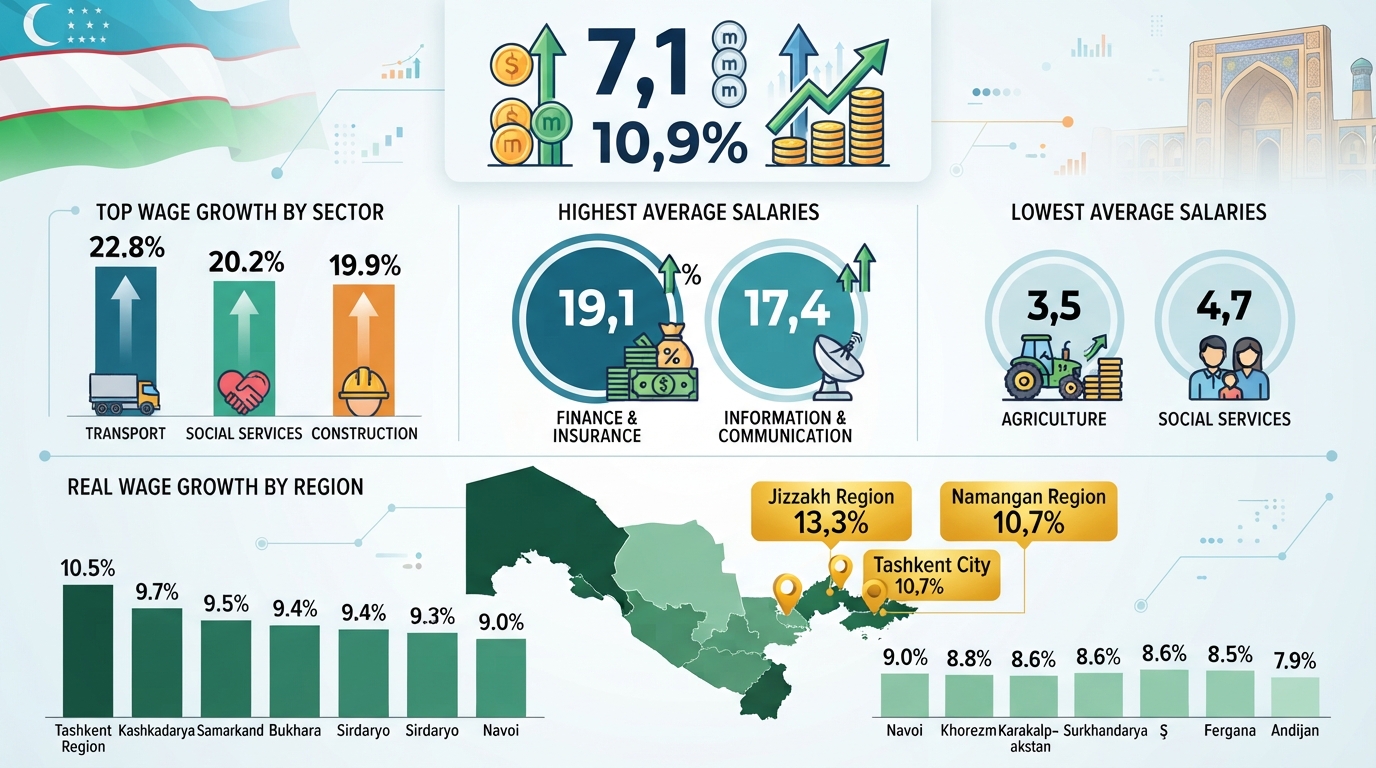
According to the results of the first half of 2026, the average monthly salary in Uzbekistan reached 7.1 million soums. The real salary increased by 10.9% compared to the same period last year. This is the highest growth rate in recent years.
As stated in the Central Bank's labor market review, the nominal salary for January-June grew by 18.4% in annual terms. At the same time, real incomes are increasing not due to salary growth, but because of slowing inflation. The difference between nominal and real growth narrowed to 7.5% as of July 1, 2026.
Salaries grew fastest in the transport and storage sector (22.8%), social services (20.2%), and construction (19.9%).
The highest average salaries were still in the financial and insurance sector (19.1 million soums), as well as in the information and communications sector (17.4 million soums).
The lowest figures were recorded in agriculture (3.5 million soums) and social services (4.7 million soums).
According to the report, in the second quarter, the most notable growth in real salaries was recorded in Jizzakh region (13.3%), Namangan region (11.8%), and Tashkent (10.7%).
In Tashkent region, the real salary grew by 10.5%, in Kashkadarya — by 9.7%, Samarkand — by 9.5%, Bukhara — by 9.4%, Syrdarya — by 9.3%, Navoiy — by 9.0%, Khorezm — by 8.8%.
In Karakalpakstan and Surkhandarya region, the growth was 8.6% each, and in Fergana region — 8.5%.
The lowest figure was recorded in Andijan region (7.9%).
The Central Bank notes that in 2026, the growth of real salaries became more even: it was observed in all regions, and the differences in rates compared to previous years narrowed.
The regulator also points out that salary growth in high-paying industries has stabilized, while in certain low-paying ones — social services and agriculture — it has accelerated. According to the Central Bank's assessment, this indicates a slow narrowing of the income gap.