

The art of reading is the art of thinking
The joys of sovereignty: Uzbekistan's literacy rate has plummeted
The Art of Reading: The Challenge of Functional Illiteracy in Uzbekistan
Uzbekistan faces a serious problem of functional illiteracy, as confirmed by international studies and sociological surveys. The country is experiencing a profound cultural shift, characterized by a widespread rejection of reading as a habit and a tool for thinking. This situation extends beyond education, affecting national competitiveness.
Shocking PIRLS Results: Children Don't Read
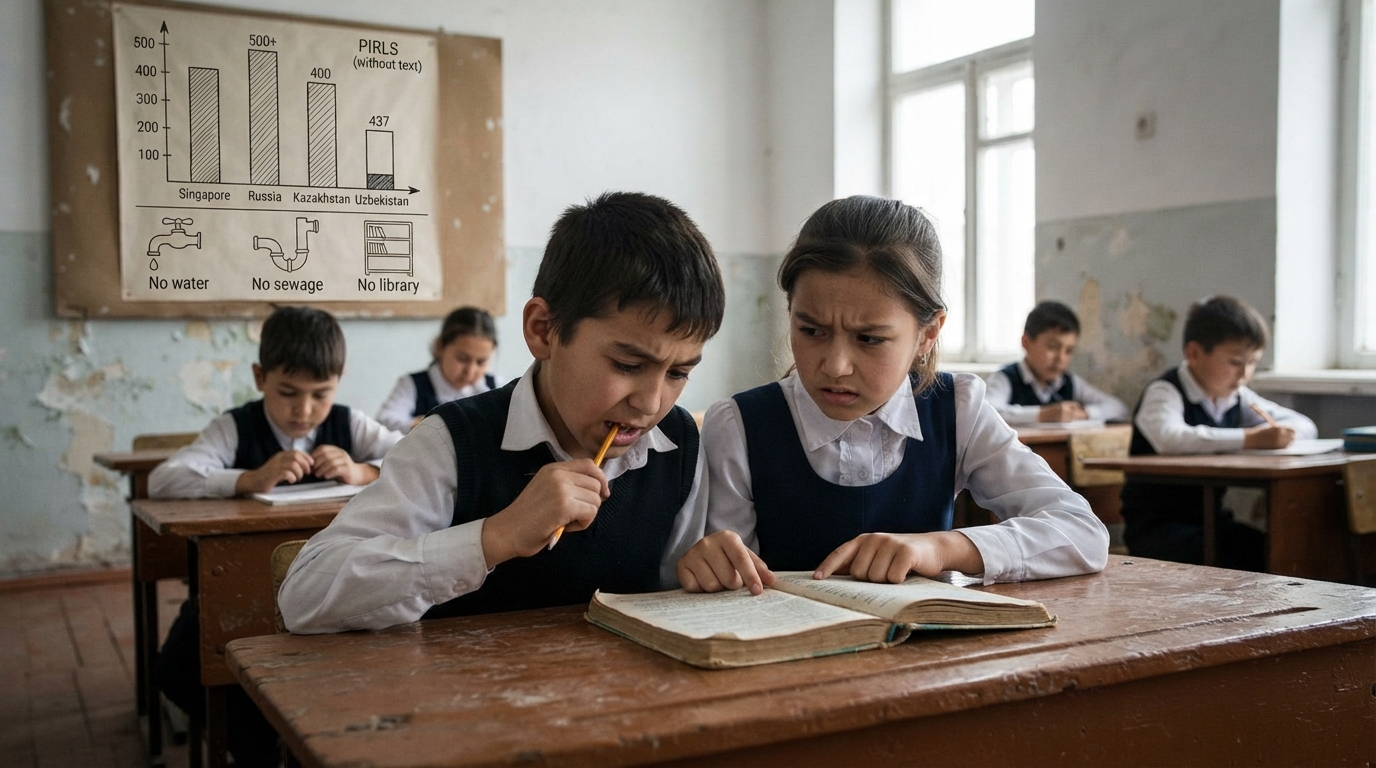
In 2021, Uzbekistan participated for the first time in the PIRLS International Reading Literacy Study, which assesses the reading literacy of fourth-grade students. The results were extremely unsatisfactory: the country ranked 49th out of 57 countries, scoring 437 points, significantly below the average of 500 points. 70% of students demonstrated low reading skills, 34% average, and only 7% high. Not a single Uzbek student achieved an advanced level of reading comprehension.
By comparison, the proportion of students in Singapore with an advanced level was 35%, in Russia with a high level – 63%, and in Kazakhstan – 28%. Kazakhstan, incidentally, scored 504 points, exceeding the international average.
Of particular concern is the low score of Uzbek students (430 points) in complex reading skills such as interpreting, integrating, and evaluating information. They perform better only in searching for explicitly presented information (441 points). This indicates that by fourth grade, most children are unable to fully comprehend what they read, extract hidden meanings, and draw conclusions.
The gap between girls and boys in Uzbekistan was 24 points (425 for boys versus 449 for girls), one of the widest among the participating countries.
The study also found a direct correlation between parents' attitudes toward reading and their children's academic achievement. Students whose parents "really enjoy reading" scored 449 points, children of "somewhat enjoy reading" scored 431 points, and children of parents "dislike reading" scored only 401 points. This "lack of habit" of reading is passed down from generation to generation.
Infrastructure Factor
The PIRLS results are inextricably linked to the state of school infrastructure. According to the Institute for Macroeconomic and Regional Studies (IMRI), 70% of schools in Uzbekistan are not connected to a sewer system, 29.5% have no water supply, 35.8% lack a cafeteria, and 5% do not even have a library.
49% of Uzbek schoolchildren who participated in PIRLS attend schools with resource constraints, and 35% attend schools with discipline problems. Under such conditions, it is extremely difficult to talk about high-quality reading instruction.
Adults Don't Read Either
Socio-political surveys paint an equally depressing picture among adults. A comparison of studies in Uzbekistan (the Ijtimoiy Fikr Center) and Russia (VCIOM) reveals fundamentally different attitudes toward books. In Russia, regular reading is the norm for the majority: 33% of Russians read books daily, and another 31% read weekly. In Uzbekistan, almost half the population (42.2%) reads almost nothing. Only 25% of citizens read daily, even among those with higher education.
Contrary to stereotypes, young people in Uzbekistan read more often than older generations. Among people aged 25-34, the share of "non-readers" is 41.4%, and among those aged 45-54, 42.2%. This means that books become less relevant in adulthood. In Russia, on the contrary, people read more often with age. In January 2026, the Ijtimoiy Fikr Center launched a large-scale sociological study of the population's reading culture. This is recognition of the problem at the state level, but research alone is not enough – systemic changes are needed.
The Paradoxes of the Book Market
The situation in Uzbekistan's book market is full of contradictions. On the one hand, there is growing interest in certain segments. Sales of Russian-language books increased by 21% in the first nine months of 2025. The Russian book service Litres entered the Uzbek market, offering 1,500 titles and planning to expand to 4,000 books.
On the other hand, bookstore owners are noticing a paradox: Russian-language literature is being purchased more actively than Uzbek-language literature. Even attempts to promote books in the state language are met with low audience response. The problem lies in the absence of a reading culture on a mass scale.
At the same time, encouraging trends are emerging: the number of publishing houses in the country has grown from 168 in 2020 to 532 by the beginning of 2024. Turkish classics, foreign bestsellers, and contemporary Uzbek literature are being translated and published. However, these positive changes so far affect a narrow segment of the reading public, without changing the overall picture.
It is important to emphasize: the reading crisis in Uzbekistan is not a language issue. PIRLS data show that the problem is not the language children read in, but whether they can read and understand text at all. Schoolchildren struggle to interpret and integrate information, regardless of the language of instruction.
A Threat to the Country
Low reading literacy is not just a cultural problem. It is a direct blow to the quality of human capital. Officials who are unable to analyze documents and grasp the essence of the problem make ineffective decisions. Functional illiteracy in government is a systemic failure. A worker who doesn't understand instructions and a specialist who isn't capable of learning from texts are a drag on the entire economy. In a world of information warfare and fake news, a person who doesn't read lacks the primary filter for verifying information. PIRLS and PISA results (where Uzbekistan ranked 80th out of 81 in reading literacy) directly correlate with countries' economic development.
It's clear that Uzbekistan is facing an institutional reading crisis. It stems not from a loss of interest in literature, but from the fact that schools aren't developing this basic skill, and society isn't supporting it in adulthood. This leaves the country vulnerable: hundreds of thousands of people who received a formal education remain functionally illiterate.
Therefore, it can be concluded that unless attitudes toward reading at the family level and the education system are overhauled, the country risks becoming a stagnant country in terms of human capital quality. And the question here is not how to force people to read, but how to build a modern economy and an effective state without reading skills.