

Revised Curriculum: Who Do We Want to See by Graduation? Part 2
Discussions regarding updated state education standards and school curricula continue in Uzbekistan. A review of these standards was published in Part 1 of this article. Part 2 analyzes the underlying educational philosophy and the alignment of subject competencies with the stated goals and pedagogical principles.
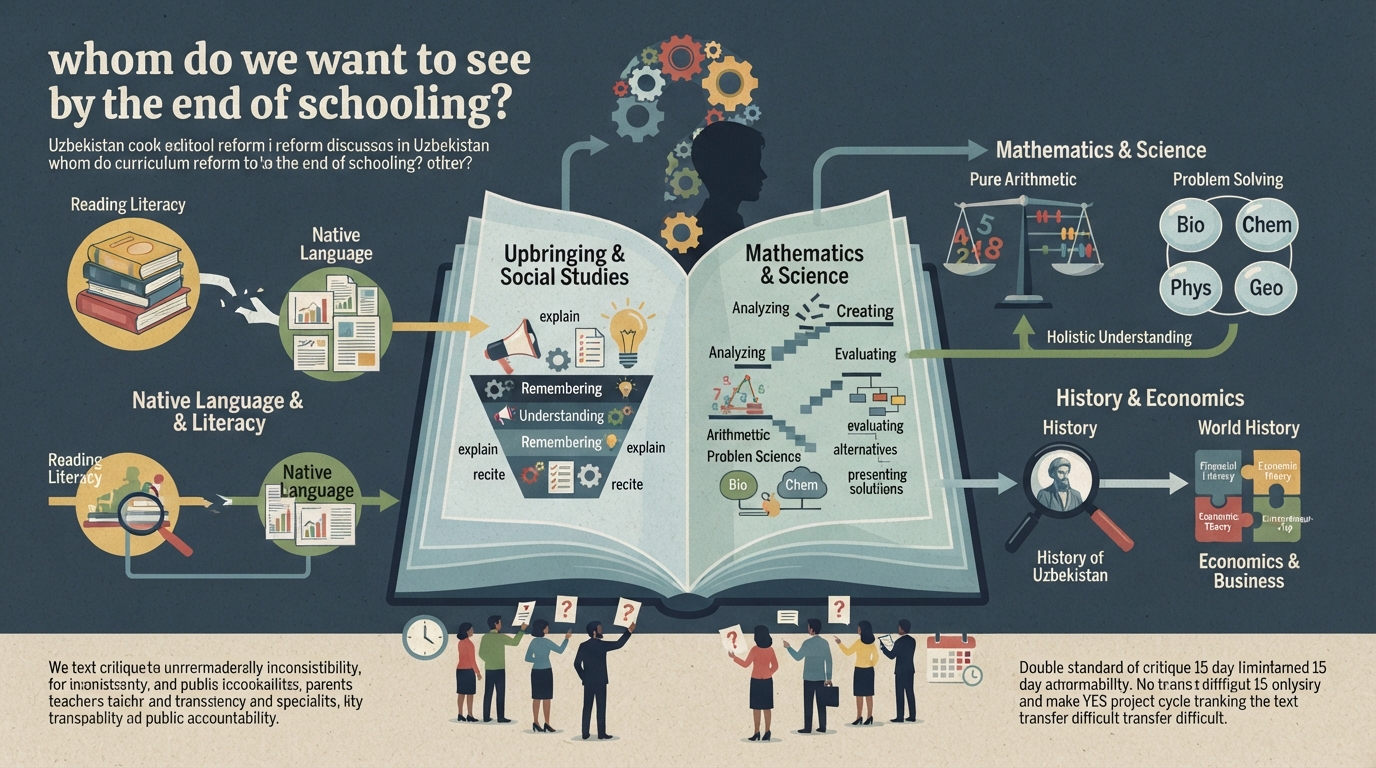
Revised Curriculum: Who Do We Want to See by Graduation? Part 2
Active discussions regarding updated state educational standards and curricula for secondary schools continue in Uzbekistan. Part 1 examined the prerequisites and specific features of these changes. This section analyzes the educational philosophy embedded in the curricula, as well as the alignment of subject competencies with the stated goals and pedagogical principles.
Only 15 days have been allocated for discussion, which is extremely short, especially given the imminent start of the school year. It would be appropriate to extend this period and engage all stakeholders: teachers, specialists, and parents, in the discussion. Transparency in the discussion process and public reporting are essential. Furthermore, it is important to consider the mechanisms for implementing educational standards and curricula.
The philosophy of education defines the ultimate goal of education: what kind of person, citizen, or member of society we strive to create and, most importantly, why. It shapes the content, teaching methods, and assessment approaches.
Currently, there are numerous philosophical approaches to education, which can be roughly divided into several main schools.
A careful examination of the key goals and expected learning outcomes in the draft state standards (items 9 and 16) reveals elements of both traditional and progressive philosophical schools.
Thus, the emphasis is on integrating school graduates into the existing social model. However, as will be shown below, greater emphasis is placed on traditional philosophies—the transmission of knowledge and values—than on progressive philosophies—the development of the individual. School is not viewed as an institution that develops citizens capable of transforming society.
Many developed countries, such as Canada, which ranks in the top 10 in PISA results, recognize the role of future generations in improving society and incorporate elements of reconstructionist philosophies into their curricula.
The appendices to the draft state education standards present the goals and expected learning outcomes for all subjects by the end of each stage (primary – 4th grade, basic – 9th grade, and middle – 11th grade). The competencies embedded in subject curricula must ensure the achievement of these goals and objectives.
However, the ambitious macro-goals declared in the standards (critical thinking and analysis, problem solving, digital and media literacy, and civic engagement) are designed unevenly across the curricula of various subjects, and the actual design of subject curricula in a number of disciplines hinders the achievement of these goals.
The draft state standards for the initial stage of education declare the development of:
The native language curricula (for schools with Uzbek, Russian, and Karakalpak as the languages of instruction) retain the communicative approach embodied in the 2021 National Curriculum: language rules and concepts are studied not in themselves, but to develop language skills (reading, writing, listening, and speaking). However, despite the fact that reading and understanding skills—both fiction and non-fiction—are defined as one of the core subject competencies of the "Native Language" course, another subject, "Reading Literacy," has been introduced.
The stated goal of the "Reading Literacy" course is to develop students' interest in reading, aesthetic taste, and reading culture through familiarization with works of national and international children's literature. Essentially, it is structured as an introductory literature course, focusing exclusively on fiction, and the subject competencies (there are five of them) are completely aligned with the "Literature" course taught in senior grades.
However, if we analyze the definition of "reading literacy" in international documents such as the UNESCO Global Reading Framework for Grades 1-9, the PIRLS Reading Assessment Framework, or the PISA Reading Framework, reading literacy is defined as the ability to understand a variety of texts, including non-fiction and even non-linear texts (graphs, tables, etc.). The international PIRLS program, which assesses the reading literacy skills of primary school students, includes both fiction and non-fiction texts. Incidentally, it also showed that students in Uzbekistan have a poorer understanding of non-fiction texts.
Therefore, by focusing solely on fiction in the "Reading Literacy" subject, the program's authors render the subject inconsistent with its name.
If this subject is intended as a foundation for further study of literature at the basic secondary level (as indicated in Section 1.3 of the "Reading Literacy" curriculum), then it should be given a title that more accurately reflects its essence. Alternatively, one could return to developing reading skills, understanding, and analyzing all types of texts within the native language, as is typically done in the communicative approach.
In the "Parenting" subject, there is a noticeable gap between the declarative framework of the program and the actual expected learning outcomes.
The primary school standard requires the development of independent thinking, goal-setting, and self-assessment skills, but most of the goals are formulated using low-cognitive verbs according to Bloom's taxonomy: "explain," "tell," and "provide information." Examples: "explain that protecting nature is everyone's duty" (T1.I.04), "talk about the need to show compassion, help, and be compassionate to others" (T2.I.09), "explain the importance of friendship" (T3.I.06), "explain the need to respect the state language" (T4.M.02).
Note: In the learning outcome codifiers, the first digit after the subject code indicates the grade; for example, code T4.M.02 refers to grade 4.
Of the four subject areas, all learning outcomes in the first area—"patriotism" (except one outcome, T4.V.04)—assume the ability to explain, narrate, retell, and provide information. Within the remaining subject areas, the overwhelming majority of outcomes also relate to low cognitive levels.
Thus, instead of stimulating independent thinking and encouraging students to reflect on various life situations and evaluate their actions based on simple criteria, as outlined in the standards, the program seeks to force them to memorize and repeat pre-existing social dogmas.
The state standards for the subject "Education" also include the interesting goal of "developing individuals who are able to set goals," but the learning outcomes do not demonstrate the achievement of this goal. The fourth-grade curriculum includes the competency of "expressing ways to achieve goals and dreams set for the future through the acquisition of knowledge" (T4.F.02). However, "goals and dreams set for the future" are very distant and abstract concepts for fourth-graders. The program completely lacks practical objectives for short-term planning and goal-setting for each day or week. Students are not taught to set and achieve simple, measurable goals, such as planning their time for homework, creating a lesson preparation schedule, or developing a personal physical activity plan.
The State Standard for Mathematics for Primary School sets one of its goals as "developing initial problem-solving skills through understanding simple real-life problems, creating models of them, applying solution methods, and interpreting results." In the primary school mathematics curriculum, this goal is translated into measurable learning outcomes through the implementation of the subject area "Application of Mathematics to Problem Solving" (code M). Problem solving is broken down into five sequential stages: problem understanding, mathematical modeling, problem solving, interpreting and evaluating alternative solutions, and presenting the best solution. Competencies within each of these stages develop in a spiral fashion from grades 1 to 4. For example, in understanding a problem, a first-grade student "understands a simple word problem in a real-life situation based on objects, pictures, diagrams, or a short text" (M1.M1.01). By the fourth grade, they already "independently identify problems in real-life situations and formulate questions to solve them" (M4.M1.01).
However, if we analyze the entire codifier for grades 1-4, we can see that the overwhelming majority of learning outcomes are devoted to purely technical arithmetic (addition and subtraction, multiplication of multi-digit numbers, working with fractions). The volume of this routine is so great that the average teacher, given a crowded classroom and a 40-minute lesson, may not have time to develop higher stages of modeling (such as M4 – evaluating alternative paths or M5 – presenting and defending a solution).
The natural sciences curriculum proclaims a unified, holistic understanding of the natural sciences (Section 1.7), but the codifiers of learning outcomes reveal disciplinary segregation.
All outcomes are strictly divided between individual subjects: B – Biology, K – Chemistry (TF3.Kmt.01), F – Physics, and G – Geography. The curriculum lacks hybrid topics that allow for the simultaneous study of natural phenomena or patterns through the prism of multiple sciences.
The draft state standards for grades 5-9 and 10-11 call for the development and deepening of competencies developed in elementary school. New subjects are being introduced, such as literature, history, foundations of state and law, economics and business, and starting in grade 7, the single subject "Natural Sciences" is broken down into separate subjects: physics, chemistry, biology, and geography. At this level, a discrepancy can be observed between the progressive goals declared in the standards (development of critical and creative thinking, media literacy, etc.) and the learning outcomes at the subject level in a number of subjects.
One striking example of such a discrepancy is the subject "Fundamentals of State and Law." While the state standard for grades 5-9 proclaims the goal of developing critically thinking members of society with an active civic stance and a sense of involvement in the governance of state and society, the majority (45 out of 52) of the measurable learning outcomes in the 8th-9th grade curriculum are formulated using the same verb: "izohlash" (to explain, to interpret). The curriculum itself officially defines "izohlash" as "clarification of the content of a concept," which is the second lowest cognitive level in Bloom's taxonomy (understanding). Skills for analyzing, evaluating, or applying law to real-world cases are practically nonexistent at the 8th-9th grade codification level, making it impossible to achieve the stated goals of developing critical thinking, proactive attitudes, or a sense of belonging.
Even in 10th-11th grades, where higher-level verbs such as "analyze" and "evaluate" appear, and some practical and procedural institutions are introduced, such as the presumption of innocence, the ombudsman institution, or labor disputes, critical analysis is still strictly localized: students only evaluate violations of laws by citizens or employers (e.g., DHA.11.XH.08), but they are not tasked with evaluating the fairness or effectiveness of decisions or acts of government agencies.
The program is also overloaded with abstract definitions such as "the concept of man and personality" (DHA.8.OH.01), "the concept of society" (DHA.8.OH.02), "characteristics of the state" (DHA.8.OH.03), and the foundations and sources of various branches of law. These abstract concepts are divorced from the life experience of adolescents, making the transfer of knowledge to a real-world context extremely difficult. The program places a strong emphasis on prohibitions and responsibilities, crimes, misdemeanors, elements of offenses, and the criminal liability of minors, but legal remedies (for example, how to file a complaint with government agencies, where to complain about non-payment of wages during a summer job, or how the children's ombudsman works in practice) remain unexplained.
The subject “Education” is also replete with abstract slogans that require the student to “explain,” “understand,” and “justify” “ready-made” truths: for example, “explain that protecting nature is everyone’s duty” (T5.I.06), “explain the importance of harmony and mutual assistance in the family” (T5.V.08), “understand that pure feelings in a person are cultivated primarily in the family” (T8.V.02), “justify that acquiring knowledge is a force that educates a person and moves him toward high goals” (T8.I.04), or “justify that cultural behavior in public places is a civic duty” (T9.I.08). In the senior grades (10th and 11th grades), the subject also remains largely lecture-based and passive, with a "moralizing" slant: students are expected to "explain" and "understand" the importance of "being responsible in the family" (T10.I.01), "national and universal values and customs" (T11.M.01), or "cooperation for sustainable development" (T11.I.06).
The history curriculum is structured in an interesting way. State standards declare goals such as "developing critical and creative thinking through working with historical sources, comparing historical events and processes, and identifying their interrelations" or "cultivating a conscious citizen capable of analytical thinking." The curriculum exhibits a double standard of critical thinking: external historical processes are studied with a deeply critical eye (e.g., decolonization, imperial expansion, totalitarian methods). However, when the objectives shift to the history of Uzbekistan, students must analyze the actions of their ancestors (e.g., public administration or conquests) from the perspective of "historical empathy." For example, students must "evaluate the attitudes of Timurid statesmen toward the well-being of the people and justice, relying on historical empathy in the context of the principle 'Justice is the foundation of the state'" (O'T8.II5.02) and "evaluate the conformity of Amir Timur's decisions to establish order and construct buildings in the lands he conquered with the values and policies of that time" (O'T8.S6.03).
The history curriculum remains linear-chronological and fact-centered: learning outcomes are strictly tied to specific historical events. This makes knowledge transfer—the student's ability to extract universal patterns from a specific historical narrative and apply them to the analysis of other situations, historical or contemporary—impossible. For example, a student analyzes the construction of railways by the Russian Empire in Turkestan through the lens of colonial interests (O'T10.IK4.01). Since they are not expected to identify a general abstract model ("infrastructure imperialism" or "extractive economy"), they perceive the railway in Turkestan as an isolated historical fact and will not be able to draw parallels with other, similar infrastructure megaprojects of major powers in their colonies or developing countries.
Another example. The codifier includes a case study of Mikhail Gorbachev's reforms and geopolitical changes in Europe (JT10.II1.02). However, due to the learning outcome being tied to a specific period and individual, the student does not learn to apply the logic of perestroika's failure to the analysis of any other unsuccessful top-down state reforms around the world.
The "Economics and Business" curriculum incorporated the subject areas established by the YES (Youth Employment Skills) project: financial literacy, economic literacy, entrepreneurship, and employment skills. The YES project, which operated in pilot schools in several regions until 2025, implemented a comprehensive, cross-curricular program in which these three areas were taught in parallel in a modular format from grades 9 to 11. This facilitated knowledge transfer: for example, while studying demand theory (economic theory), students could calculate a personal budget based on their needs (financial literacy) and explore the unmet needs of their community to develop a business idea based on these needs (entrepreneurship).
The updated curriculum returned to grade-based segmentation: 9th grade is devoted to financial literacy, 10th grade students study economic theory, and 11th grade students study entrepreneurship. From a constructivist perspective, this makes knowledge transfer difficult: for example, while studying theoretical economic laws in 10th grade, a student cannot immediately apply them to developing their business idea. Furthermore, despite the inclusion of "labor market competition skills" in the subject titles, employability-related competencies included in the YES project curriculum, such as resume writing, job posting analysis, job interview skills, and others, have been removed from the learning outcomes.
The new standards introduce an advanced, constructivist concept known as universal design for learning (UDL). UDL involves providing students with a variety of options for engaging in learning, absorbing information, and presenting learning outcomes.
However, analysis reveals a significant imbalance in the implementation of UDL principles across subjects. In subjects such as computer science and mathematics, a high level of UDL integration can be observed, for example, through the "unplugged" concept—learning algorithms without digital devices—through physical flashcards, role-playing, and movement, or through working with visual 3D models and the freedom to choose mathematical models when solving problems. However, in some other subjects (e.g., law and history), the level of UDL integration remains nominal: programs remain strictly text-centric, and codifiers do not include alternative ways to demonstrate goal achievement for students with different cognitive abilities.
Overall, given the importance of draft educational standards and curricula, which determine what and how children will study in the country's schools in the next decade and what kind of individuals they will become as they enter independent life, a broader and more comprehensive discussion of these documents is necessary with all stakeholders: teachers, parents, and specialists.
A more in-depth analysis is needed of both the alignment of subject competencies with the goals declared in the standards and an analysis of the overall philosophy and methodology of the programs. The 15 days allocated by the Republican Education Center are insufficient for this. Given that the school year has already begun and the new programs will not be implemented by then (there is simply not enough time), there is nothing to prevent the discussion period from being extended.
It is also necessary to analyze the curricula from the perspective of reforms in the vocational education system: if the basic minimum of key concepts in all general subjects is extended to the 11th grade, won't we end up with a situation where 50% of 9th-grade graduates entering technical schools risk acquiring fragmented knowledge? How will high school standards be integrated into the general education block of technical schools to avoid such a situation?
The above is also true for the advanced level (3+) of secondary education. Standards for grades 10-11 require the study of subjects at both the standard and advanced levels, but the advanced level curricula have not yet been put up for discussion. A comparative analysis is needed: how do the standard and advanced levels of subject curricula compare to each other? If, to free up time for in-depth study of certain subjects in grades 10-11, other subjects are removed from the schedule, as is done in elective classes, wouldn't this lead to a sharp imbalance in the 11th-grade advanced level: in-depth knowledge of some subjects and a minimal lack of knowledge of others?
To ensure transparency in the discussions and public accountability of government agencies, all comments submitted to a special portal must be made visible, as is done in legislative discussions. This way, the public can track which comments were accepted by the drafters, which were not, and why.
It is also important to discuss the mechanisms for their implementation after revision and approval, along with the draft educational standards and curricula, to avoid a repeat of previous programs, whose implementation was discontinued without explanation.