

Tax incentives are in effect, but they have not yet been added to the code. Deputies asked questions to the Ministry of Economy and Finance
Some of the tax incentives in Uzbekistan provided for since the beginning of 2026 are still not codified in the Tax Code, even though businesses are already using them. Deputies asked why the amendments are being introduced with a delay. The Ministry of Economy and Finance explained this by lengthiness of procedures and the large number of changes.
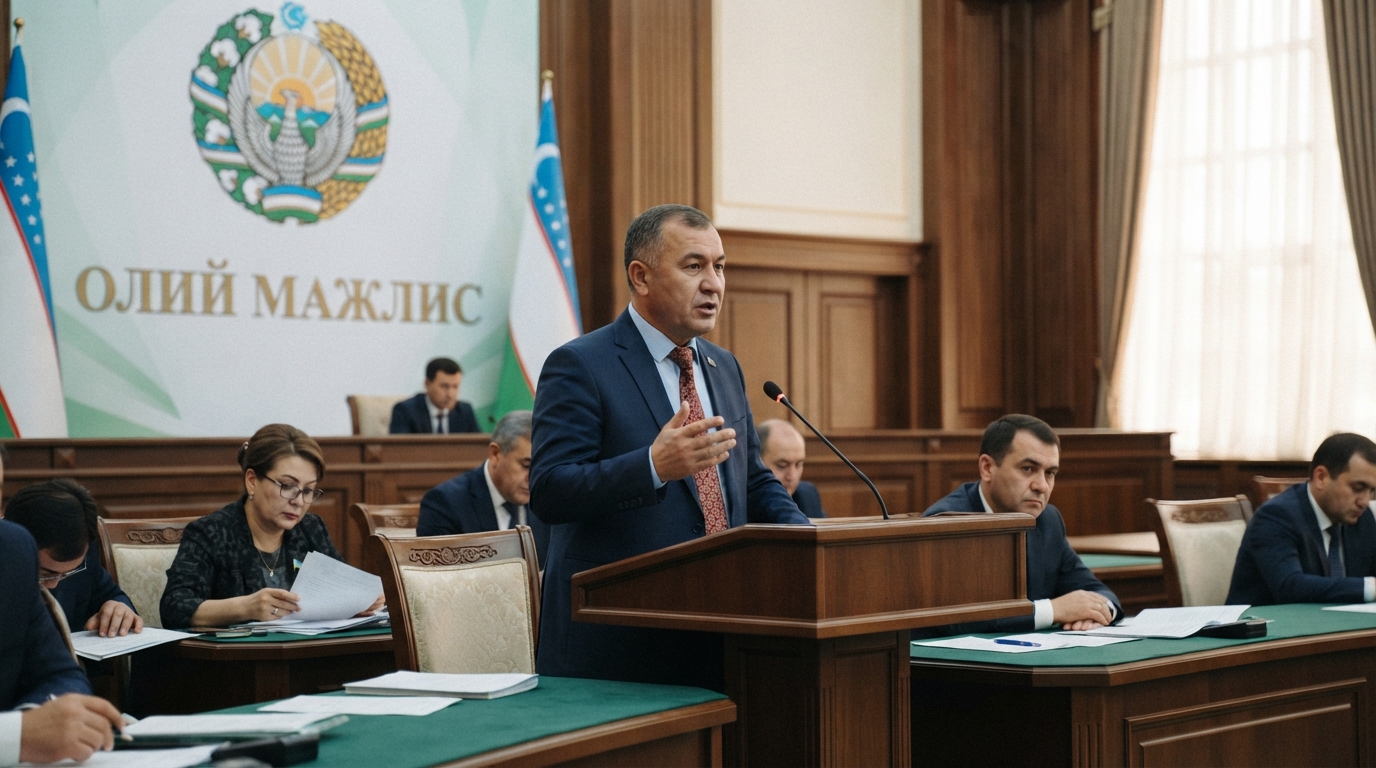
Tax incentives are already in effect, but have not yet been added to the code: deputies posed questions to the Ministry of Economy and Finance
In Uzbekistan, it is proposed to allow entrepreneurs to use tax incentives established by presidential decisions even before they are codified in the Tax Code. Deputies drew attention to the fact that part of the incentives that were supposed to come into force from the beginning of 2026 have still not been added to the code, although businesses are already using them.
These questions were raised on October 27 at a meeting of the Legislative Chamber of the Oliy Majlis during the consideration of a draft law aimed at further supporting entrepreneurship. The document was presented by Deputy Minister of Economy and Finance Ahadbek Khaydarov.
The draft law provides for the extension and introduction of tax incentives for a number of sectors, as well as changes in tax administration. Amendments are proposed, in particular, to Articles 75 and 483 of the Tax Code.
Zafar Khudoyberdiyev, a deputy from the Milliy Tiklanish Democratic Party faction, called attention to the untimely introduction of amendments to the legislation.
"Most of the incentives now proposed to be added to Article 483 of the Tax Code were supposed to be effective from January 1, 2026. It is already October, and some time may pass before the law is adopted," he noted.
According to the deputy, under the current procedure, taxpayers must use incentives established by presidential decisions after the relevant provisions are introduced into the Tax Code. However, in practice, they are already being applied.
"When we asked about this yesterday, we were told that these incentives are already being used. But under the current procedure, they can be used after amendments are made to the Tax Code," Khudoyberdiyev stated.
The deputy drew attention to the proposed addition to Article 75 "Tax Incentives".
According to the draft, if tax incentives aimed at developing individual sectors of the economy are established by presidential decisions, taxpayers are allowed to use them. At the same time, the relevant provisions must be introduced into the Tax Code during the period of validity of the incentives.
Thus, it is proposed to legally enact the possibility of applying such incentives before the procedure for amending the code is completed.
Zafar Khudoyberdiyev questioned the advisability of such a mechanism.
"Will the introduction of this norm not reduce the authority of the Tax Code? Will this not lead to even further delays in introducing into the code the incentives established by presidential decisions?" the deputy asked.
Deputy Minister of Economy and Finance Ahadbek Khaydarov acknowledged the validity of the question, but said that "we live in an era of rapid change."
According to him, during the president's meetings with business representatives, including during trips to the regions, many issues requiring a quick solution are raised.
"To promptly resolve the problems of entrepreneurs, decrees and resolutions of the president issue instructions to provide corresponding incentives. After that, we formulate them as amendments to the Tax Code. But in practice, passing through the established procedures requires a certain amount of time. Because of this, objections arise among entrepreneurs," the deputy minister explained.
In his opinion, the proposed change will eliminate the time gap between the decision to grant an incentive and its codification in law.
"We do not see anything here that could undermine the authority of the Tax Code. First and foremost, we proceed from the interests of entrepreneurs," Khaydarov stated.
He also explained why this time the amendments reached the parliament with a delay.
"This time there turned out to be a great many changes. The process of discussing them was somewhat delayed, so the draft law was a little late. In reality, we try to introduce changes to the legislation as quickly as possible," the deputy minister said.
Deputies pointed out a possible contradiction with the prohibition of individual incentives
During the discussion, Zuhriddin Mavlonov, a deputy from the Adolat Social Democratic Party faction, raised another issue regarding the compliance of new tax preferences with the current provisions of the code.
He recalled that part four of Article 75 of the Tax Code explicitly prohibits the provision of tax incentives of an individual nature.
At the same time, according to the deputy, the draft amendments to Article 483 provide for separate incentives for specifically named organizations, including the directorate for waste landfill management and the directorates of leather and footwear industrial zones.
"Will it not turn out that the new version of Article 483 will contradict the current Article 75? Are we not creating norms within the same Tax Code that contradict each other?" Mavlonov asked.
Ahadbek Khaydarov replied that the tax relief for the directorates of industrial zones is related to the specific nature of their activities.
According to him, before land plots and facilities are transferred to entrepreneurs, they are at the disposal of management organizations that do not engage in production activities themselves. Therefore, the question arises regarding the payment of property and land taxes before the start of operations of the enterprises.
The deputy minister noted that a similar approach is already applied to the directorates of free economic zones.
"This is not a separate individual incentive. Such a procedure is established for all directorates of free economic zones," Khaydarov stated.
Following the discussion, the Legislative Chamber approved the draft law in the first reading. The presiding officer noted that the issues raised by the deputies could be additionally considered during the preparation of the document for the second reading.
As a general rule, tax incentives are provided by the code itself, subject to the exceptions provided therein. At the same time, they cannot be of an individual nature.
In particular, current legislation already allows individual incentives to be provided by presidential decisions. However, such a mechanism is limited: it permits reducing the rates of certain taxes by no more than 50% and for a period of up to three years. For VAT, corporate income tax, and a number of other taxes, special restrictions or separate rules are provided.
These provisions were clarified by the law of December 25, 2025, on tax and budget policy for 2026, which entered into force on January 1.
The initiative under discussion provides an additional mechanism allowing the application of sectoral tax incentives established by presidential decisions prior to the inclusion of the relevant norms in the Tax Code.
At the same time, it is unclear from the speeches at the meeting precisely how many incentives are already being applied without corresponding amendments to the code, how many taxpayers have used them, and what volume of lost budget revenues is associated with them.
In early May this year, Aziz Umirzakov, director of a department of the Tax Committee, following a meeting with the president, reported that tax incentives provided for by subordinate acts would be introduced into the Tax Code. Prior to the adoption of the relevant amendments, entrepreneurs in Uzbekistan will be allowed to use these incentives.