

Tashkent Roads Recorded 1.47 Million Vehicles on September 5
A total of 1,469,948 vehicles traveled on Tashkent’s roads on September 5, while public transport served more than 1.84 million passengers.
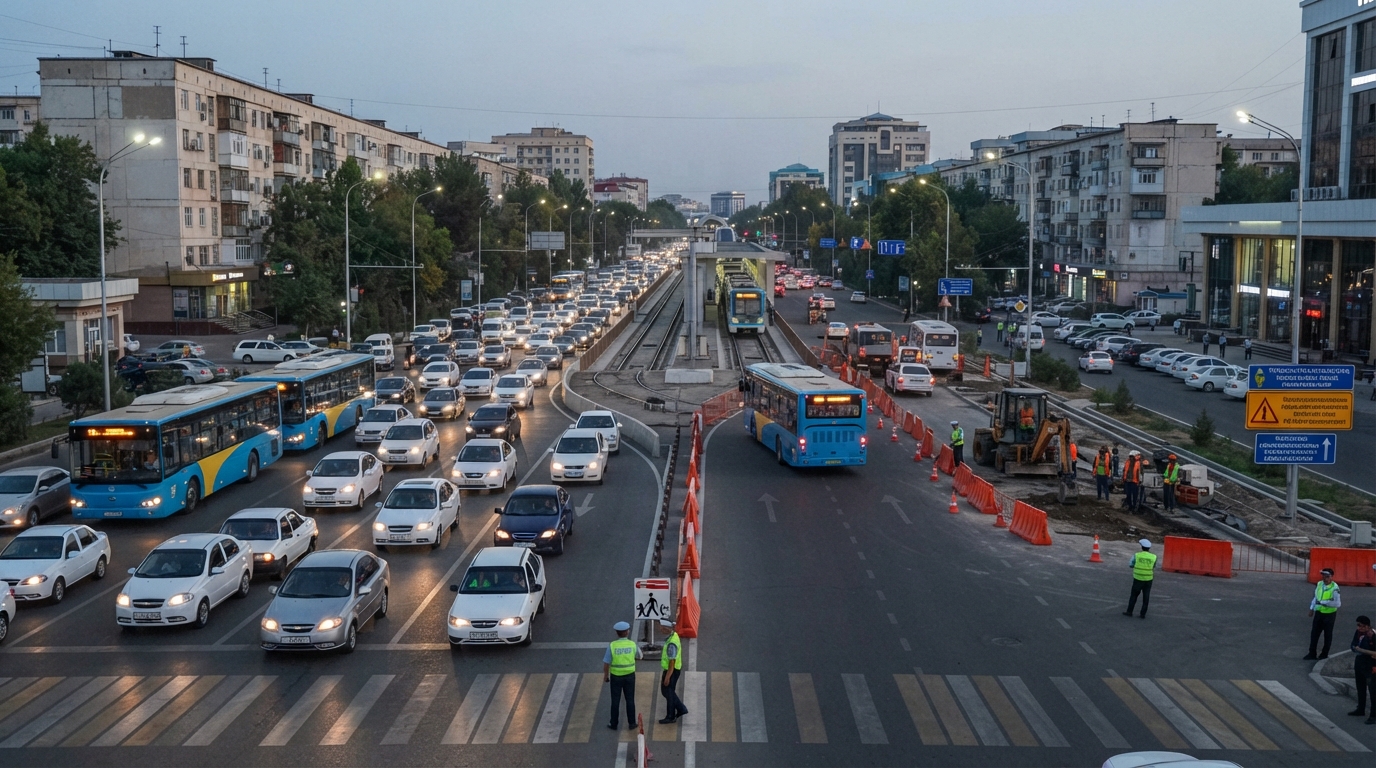
**Tashkent Roads Saw 1.47 Million Vehicles on September 5**
A total of 1,469,948 vehicles used Tashkent’s roads on 5 September, which was 32,109 fewer than the day before, when 1,502,057 vehicles were recorded, according to the Tashkent City Center for Road Traffic Management.
On the same day, the capital’s buses made 19,778 trips on 170 routes and transported 1,098,438 passengers.
The Tashkent Metro carried an additional 745,951 passengers during the 24-hour period.
Traffic congestion on the capital’s roads on 5 September was assessed at between 4 and 5 points. The traffic situation was partly influenced by utility works underway at seven locations across the city.
The works were carried out on Bogishamol, Al-Khwarizmi, Shokiraryk, P. Makhmud and Samarkand Darvoza streets, in Westminster Lane, and at the intersection of Farkhod and Lutfi streets. Because of the works, the use of certain parts of the roadway and the movement of traffic were partially restricted.
Drivers were urged to factor the roadworks into their travel plans and, if needed, use alternative routes.
Meanwhile, the Road Traffic Safety Service continued to monitor compliance with traffic regulations. Violations recorded on 5 September included eight cases of vehicles driving on pedestrian paths, 18 parking violations and 17 stopping-rule violations.
In addition, four violations were recorded involving the rules for using the “A” lane reserved for public transport.
The monitoring efforts are also intended to ensure priority for public transport, improve pedestrian safety and make sure road users follow the established rules.
Drivers were reminded not to leave vehicles on pedestrian crossings or immediately before them, to yield to pedestrians at designated crossings and not to occupy bus stop areas. Motorists should also follow the requirements when using designated “A” lanes and avoid blocking buses as they approach or leave stops.
The traffic situation in the capital is monitored in real time at the Situation Center. The monitoring system makes it possible to track changes in traffic volumes and promptly observe traffic conditions on the city’s streets.