

Tashkent plans to reduce public transport intervals during peak hours: buses down to 3–5 minutes, metro down to 2–3 minutes
People's deputies of Tashkent have instructed that measures be taken to reduce waiting times for buses and the metro during peak hours. Additional buses are planned to be dispatched to main routes, with articulated buses assigned to 25 congested ones. They will also consider the possibility of extending service on 20 bus routes until 23:00.
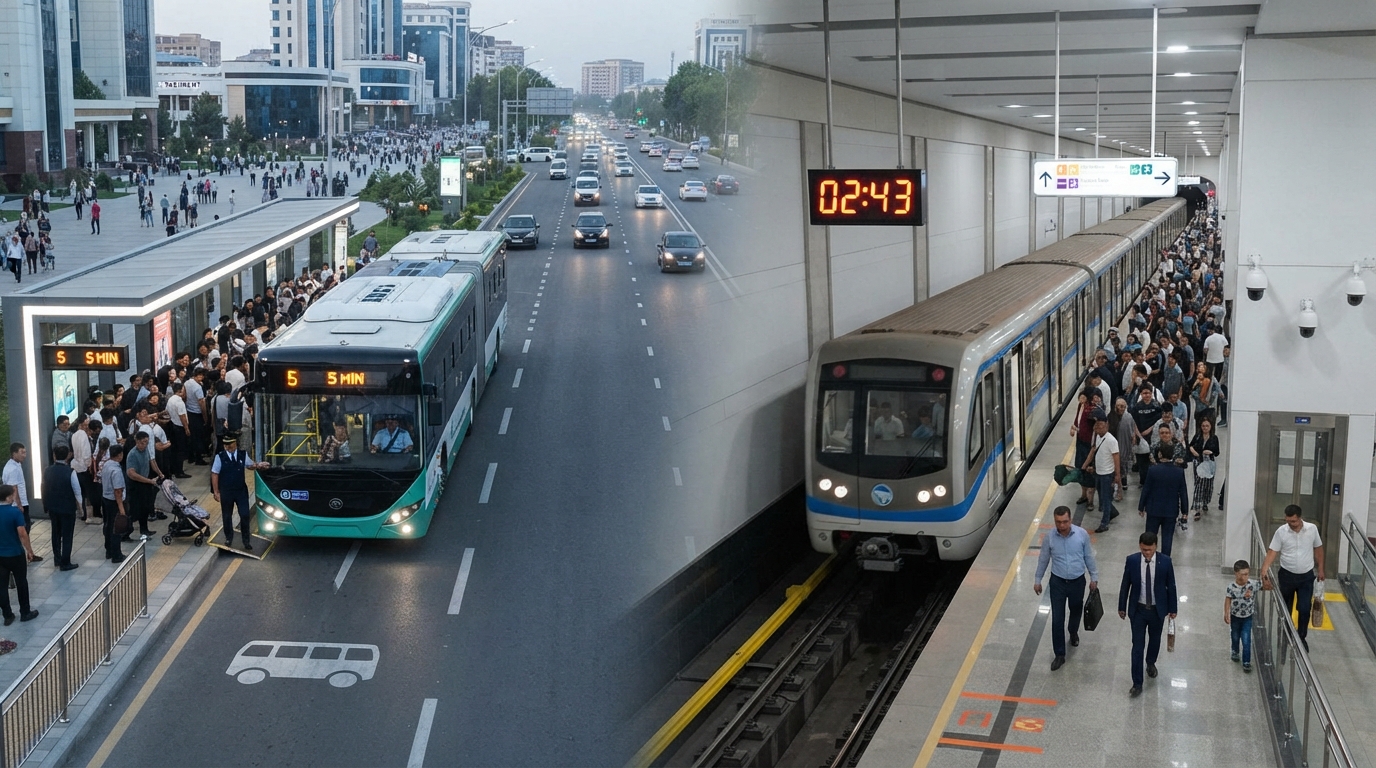
Tashkent aims to reduce public transport intervals during peak hours: buses down to 3–5 minutes, metro down to 2–3 minutes
By a decision dated October 30, the Tashkent Kengash of People's Deputies instructed that starting November 15, bus headways on all main routes be reduced to 3–5 minutes during peak hours.
To achieve this, additional buses are planned to be deployed during peak hours — in the morning from 7:00 to 9:30 and in the evening from 17:00 to 19:30.
Compliance with the schedules is to be monitored daily via a centralized dispatch service and online GPS tracking.
By December 20, it is recommended to deploy high-capacity articulated buses on 25 central and trunk routes with high passenger traffic, especially in the Uchtepa, Mirabad, Sergeli, and Yangihayot districts. In particular, these include route Nos. 8, 9T, 14, 18, 24, 28, 38, 44, 46, 51, 57, 58, 67, 72, 85, 91, 93, 98, 110, 115, 118, 122, 131, 147, and 155. Note that articulated buses are already operating on some of these routes.
By November 20, the Metro must determine measures to form five-car trainsets and reduce train headways to 2–3 minutes during peak hours — from 7:30 to 9:30, from 12:00 to 14:00, and from 17:00 to 19:30 — on the Chilonzor, Uzbekistan, and Yunusabad lines, as well as the elevated ring line.
In addition, by December 1, the Metro needs to take measures to manage passenger flows and ensure safety at high-traffic stations — at interchange hubs between lines and in front of escalators.
Starting November 1, continuous enforcement against illegal parking and driving of cars and private vehicles in dedicated "A" bus lanes will be stepped up.
By December 15, mobile video cameras that automatically record violations while in motion must be installed on the front of buses and integrated with the unified database of the Road Traffic Safety Department.
By December 1, authorities are instructed to consider organizing bus services from 21:00 to 23:00 on 20 routes connecting railway stations and bus terminals, the airport, metro stations, and densely populated residential areas "within available capabilities."
Bus headways in the evening and nighttime should not exceed 15–20 minutes. It is also instructed to publish the schedules for such trips at all stops and in digital applications, and to establish dispatch control over their adherence.
Bus drivers must pull up flush to the curb of the bus stop platform. Instances of stopping far from the curb are to be tracked via video surveillance, with disciplinary and financial measures applied to violators.
By December 1, a re-inspection of the serviceability of ramps and facilities for people with disabilities and passengers with strollers in all buses and at metro stations is to be carried out, alongside taking measures to rectify any deficiencies.
Opening the ramp for passengers with reduced mobility must be established as a mandatory duty for drivers. Disciplinary sanctions may be applied for refusal.
Starting November 10, full functionality of automatic voice announcements of stops and electronic displays in buses must be ensured, and drivers must be strictly prohibited from unjustifiably turning off the announcements.
From the same date, uninterrupted operation of cooling and heating systems, taking the season into account, must be ensured in all buses and metro trains, along with constant climate monitoring.
In October, it was reported that Tashkent Metro plans to purchase 14 five-car trains (70 cars in total) by 2027.