

Tashkent discussed the climate resilience of Uzbekistan's economy and the prospects for green development
On October 27, 2026, an international scientific and practical seminar titled "The Impact of Water and Climate Risks on the Economy of Uzbekistan and Opportunities for Green Development" was held in Tashkent. The event was organized by the Institute for Macroeconomic and Regional Studies under the Cabinet of Ministers of the Republic of Uzbekistan (IMRS) and the National Research University Higher School of Economics (HSE University, Russia) with the support of GPB Bank (JSC). The Institute for Strategic and Regional Studies acted as a co-organizer [...]
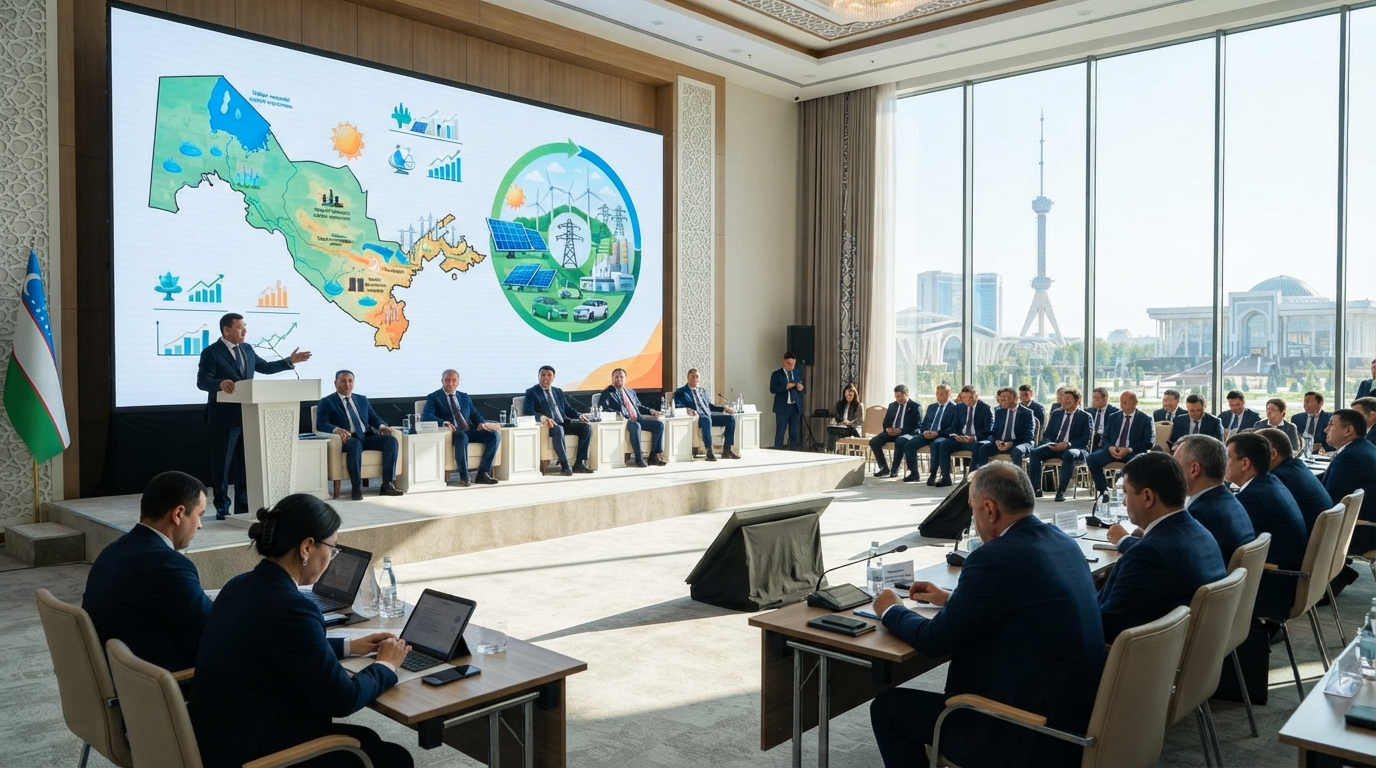
Tashkent Discussed Climate Resilience of Uzbekistan's Economy and Green Development Prospects
On October 27, 2026, an international scientific and practical seminar titled "Impact of Water and Climate Risks on the Economy of Uzbekistan and Green Development Opportunities" took place in Tashkent.
The event was organized by the Institute for Macroeconomic and Regional Studies under the Cabinet of Ministers of the Republic of Uzbekistan (IMRS) and the National Research University Higher School of Economics (HSE University, Russia), with the support of Bank GPB (JSC). The Institute for Strategic and Regional Studies under the President of the Republic of Uzbekistan (ISRS) acted as a co-organizer.
The seminar gathered representatives of government agencies, leading research centers, higher education institutions, and financial institutions from Uzbekistan and Russia.
In particular, participants included representatives from the ministries of economy and finance, energy, water resources, and transport, the National Committee for Ecology and Climate Change, the National Committee for Statistics, specialized scientific and educational institutions of Uzbekistan, as well as the Scientific Information Center of the Interstate Commission for Water Coordination of Central Asia. The Russian scientific and expert side was represented by HSE University, the Institute of Natural Resource Economics and Climate Change, the A.M. Obukhov Institute of Atmospheric Physics of the Russian Academy of Sciences, and other organizations.
Climate Risks and New Opportunities for the Economy
The discussion focused on enhancing the resilience of Uzbekistan's economy to climate change, the rational use of water resources, ensuring energy security, and leveraging the opportunities of the global transition to a low-carbon development model.
Participants exchanged views on how climate change affects long-term economic development, industry, agriculture, foreign trade, and public welfare. Special emphasis was placed on the prospects of renewable energy, electric vehicles, low-carbon industrial modernization, and carbon regulation, as well as measures to strengthen the competitiveness of domestic products in international markets.
Experts noted that climate change is a long-term trend increasingly impacting the socio-economic development of states. Under these conditions, adapting the economy, infrastructure, and population to changing natural and climatic conditions becomes an important part of strategic planning. At the same time, the global green transformation opens additional opportunities for technological upgrading, attracting investment, creating new industries, and expanding the country's export potential.
Research Study: Economic Effects of the Global Energy Transition
The main event of the seminar was the presentation of the report "Green Transformation of the Global Economy: Opportunities and Risks for Uzbekistan," prepared by the Institute of Natural Resource Economics and Climate Change at HSE University jointly with IMRS as part of the project "Adapting Uzbekistan's Economy to the Water-Climate Crisis and the Green Transformation of the Global Economy."
The study relies on scenario analysis and economic modeling, which allow assessing the impact of the global energy transition on Uzbekistan's economy up to 2035 and 2050. The authors compared four scenarios for the decarbonization of the global economy and different national economic policy options, identifying potential benefits, costs, and risks for key sectors.
This approach makes it possible to evaluate the consequences of changes in global demand, prices for low-carbon technologies, the availability of climate finance, and the spread of carbon regulation. This creates a foundation for formulating strategic decisions while taking into account various trajectories of global economic development, without tying long-term policy to a single forecast.
One of the key findings of the study was the economic rationale for Uzbekistan's policy toward developing renewable energy. According to the presented calculations, achieving the existing targets to increase the share of renewable energy sources, including hydropower, in electricity generation to 54% by 2030 provides the greatest economic return among the analyzed scenarios.
An additional benefit can be achieved through localizing the production of energy equipment and components directly in Uzbekistan. The development of a national manufacturing base will allow for job creation, the expansion of industrial cooperation, and an increase in the share of value added generated domestically.
According to researchers' estimates, solar generation possesses significant cost potential. However, the further expansion of renewable energy capacity must be accompanied by the modernization of power grids, the development of energy storage systems, and the creation of conditions for domestic equipment manufacturing.
A separate section of the report is devoted to the electrification of road transport. The authors consider it advisable to consistently meet current targets, which will help curb emissions growth while avoiding excessive increases in peak loads on the power grid. To achieve this, it is necessary to coordinate the development of electric vehicles, charging infrastructure, and power networks, as well as to improve urban public transport.
Global Energy Transition: Export Prospects and Industrial Modernization Tasks
The study also examined opportunities to expand Uzbekistan's export potential against the backdrop of shifting global demand for energy resources and materials required for low-carbon transformation.
Researchers emphasize that the global green transformation imposes higher requirements on the environmental characteristics of industrial products. In these circumstances, the modernization of energy-intensive industries—primarily chemical manufacturing, metallurgy, and the mineral fertilizer sector—becomes particularly important.
Reducing the carbon footprint of products, improving energy efficiency, and deepening the processing of raw materials are necessary to maintain the competitiveness of domestic goods in foreign markets amidst tightening environmental requirements. Therefore, the green transition is viewed not only as a task of emission reduction, but also as an opportunity to raise the technological level of industry, expand the production of high value-added goods, and strengthen Uzbekistan's position in international production chains.
Water-Climate Risk Atlas: A Basis for Targeted Solutions
As part of the seminar, the atlas "Impact of Changes in Water and Climate Conditions on the Economic Development of Uzbekistan" was also presented, designed to assess regional and sectoral climate risks.
The atlas allows for the identification of the most vulnerable regions and sectors, pinpoints areas where water scarcity, droughts, and extreme heat may limit economic activity, and establishes priority directions for adaptation.
The practical value of the tool lies in the ability to use climate assessments when modernizing irrigation systems, planning the location of production facilities, protecting critical infrastructure, and preparing regional investment programs. This will enable a shift from general assessments of climate threats to targeted solutions tailored to the specifics of local areas and water resource availability.
Uzbekistan Expands Climate Adaptation Measures
During the seminar, it was noted that under the leadership of the President of the Republic of Uzbekistan, Shavkat Mirziyoyev, large-scale transformations are underway in the country aimed at the rational use of natural resources, infrastructure modernization, and the transition to a green model of economic growth.
Significant results have been achieved in introducing water-saving technologies in agriculture. While in 2017 they covered 19,000 hectares, by 2026 this area grew to 2.6 million hectares, representing about 60% of the country's irrigated land. According to the presented data, this saves around 2.5 billion cubic meters of water annually. A task has been set to expand the area using water-saving technologies to 3.5 million hectares and increase annual water savings to 5 billion cubic meters.
Drinking water supply and sanitation infrastructure is also developing. In recent years, investments in this sector have increased tenfold, reaching 2.7 billion US dollars. The proportion of the population provided with centralized drinking water supply increased from 63% in 2017 to nearly 83%. During this period, 7.7 million people gained access to clean water for the first time, and 39,000 km of water supply networks and 3.4 thousand water supply facilities were constructed and reconstructed. In the medium term, the plan provides for increasing the coverage of the population with centralized drinking water supply to 90%.
In parallel, green energy is developing at an accelerated pace. With the participation of the private sector and international investors, projects are being implemented to build solar and wind power plants, modernize electrical grids, and deploy energy storage systems. According to data presented at the seminar, by October 2026, the share of renewable sources in electricity generation reached 31%. The current target envisions increasing the share of RES, including hydropower, to 54% by 2030.
These transformations form the foundation for further climate adaptation. As the study showed, to maximize the economic returns from the green transition, it is important to combine the development of clean energy with infrastructure modernization, improvements in industrial energy efficiency, and equipment localization.
Strengthening national scientific capacity plays an important role in this effort. In 2023, on the initiative of the President of Uzbekistan, the Central Asian University of Environmental and Climate Change Studies (Green University) was established. A Climate Science Residency was created at the university to conduct fundamental and applied research with the participation of foreign specialists. The approved scientific research program of Green University and its affiliated organizations for 2026–2029 provides for the further development of applied research and the training of specialists in environmental and climate fields.
Scientific Results as a Foundation for Practical Solutions
Following the seminar, participants stressed the need to continue joint research, expand the exchange of scientific data and practical experience, improve climate forecasting, and prepare targeted recommendations for regions and economic sectors.
The application of research results is of particular importance when developing long-term measures to adapt Uzbekistan's economy and population to changes in water and climate conditions, defining green development priorities, improving sectoral and regional programs, and attracting climate finance.
The presented report and atlas can serve as practical tools for evidence-based public administration. Their use will allow for a more precise definition of investment directions, reduction of water losses, modernization of production, enhancement of energy efficiency, and provision of reliable energy supplies for the growing economy.
Participants emphasized that combining the efforts of government bodies, research centers, international financial institutions, and technology partners will make it possible to direct resources more effectively toward reducing climate risks, strengthening water and energy security, and boosting the country's export competitiveness.
The hosting of the seminar confirmed the importance of international scientific cooperation for developing practical solutions in climate adaptation and shaping a sustainable model for Uzbekistan's green development.