

Swiss glaciers suffer 'disastrous' year of ice loss, threatening water supplies
Scientists say such rapid melting is no longer surprising given the pace of climate change.
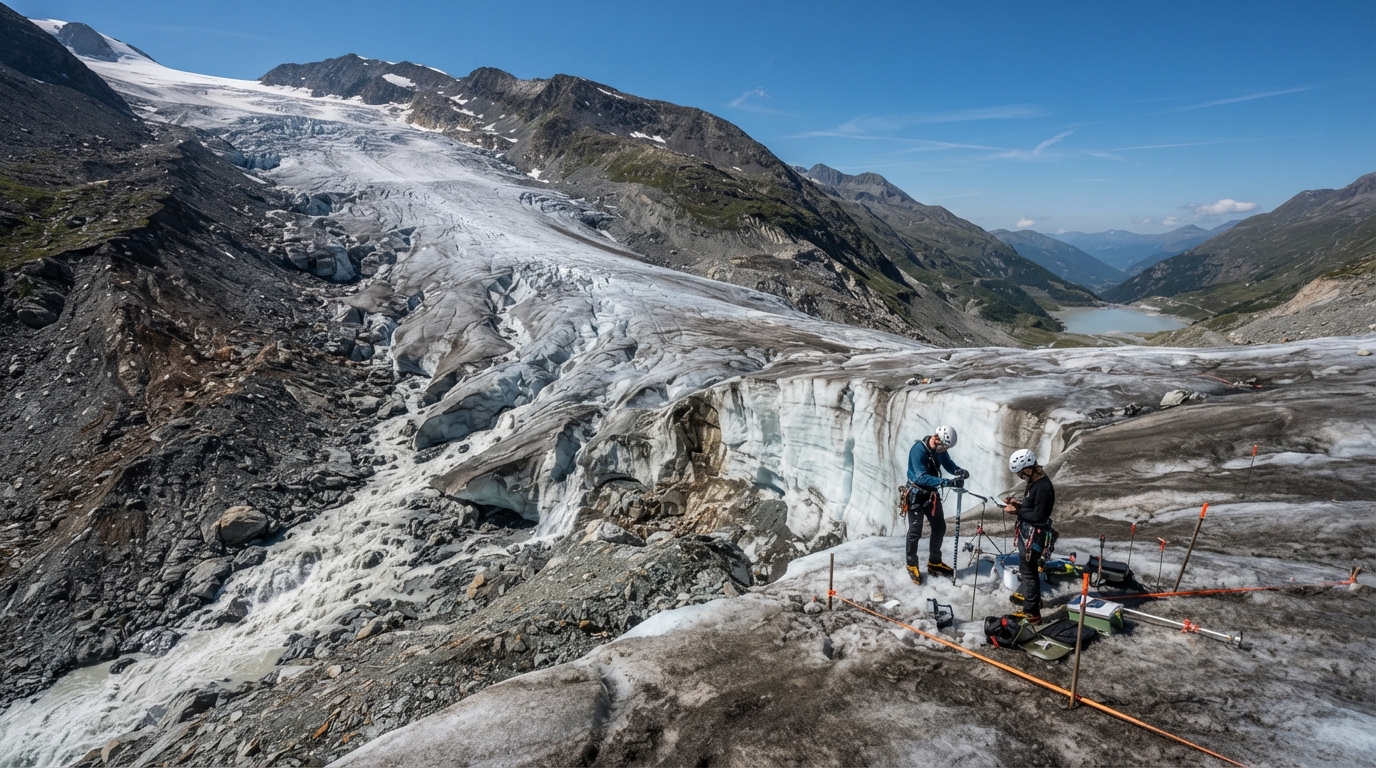
Swiss glaciers endure a “disastrous” year of ice loss, putting water supplies at risk
Swiss glaciers have experienced a near-record decline in ice in 2026, according to new data, as severe summer heatwaves hit Alpine peaks hard.
More than 5% of the nation’s remaining glacier ice has vanished over the past 12 months, a loss scientists describe as “extraordinary”.
They caution that such swift melting is no longer unexpected given the speed of climate change, but it may endanger water supplies for farming, hydropower and transport in the decades to come.
The disappearance of glacier ice can also weaken mountain slopes and raise the danger of landslides in some areas — which in extreme situations can trigger flash flooding, as happened in Nepal in August.
That incident involved several contributing factors, and was set off when a large section of bedrock and glacier ice gave way.
But scientists say long-term glacier thinning and the thawing of frozen ground probably increased the risk.
The key point from this latest report is not simply that Swiss glaciers are retreating — something expected in a warming climate driven mainly by fossil fuel emissions — but how fast the melting is happening.
Until recently, glaciologists in the Alps regarded a 2% annual ice loss as “extreme”. This year, an estimated 5.5% has disappeared.
“It’s really just disastrous,” said Dr Matthias Huss, director of Glacier Monitoring Switzerland, which compiled the report.
Swiss glaciers entered the summer already in a poor state, with less snow than normal after a mild winter.
Much of that snow then melted rapidly during the early and intense heatwaves of May and June, exposing the ice beneath.
Bare ice is darker and less reflective than fresh snow, so it absorbs more of the Sun’s energy.
That made glaciers even more vulnerable to melting during later heatwaves.
“Ten years ago, I wouldn’t have thought that it’s possible to lose glaciers so quickly,” said Dr Fabien Maussion, a glaciologist at the University of Bristol who was not involved in the Swiss report.
“What’s happened over the summer now is extremely distressing… but at the same time it was to be expected from a climate scientist’s perspective,” he added.
Meltwater from glaciers can be a crucial source of water for irrigation, hydropower and even shipping traffic during hot, dry periods.
Scientists estimate that Swiss glaciers released 2.2 trillion litres of meltwater between July and September.
While that eased water shortages this summer, it has quickly reduced the frozen reserve.
Huss warned that the ice loss could create long-term problems, with smaller glaciers unable to replenish water levels to the same degree.
“Every drop of water that runs off during these heatwaves is kind of old water that’s been stocked in the glacier ice centuries or decades ago,” said Huss.
“It’s helping us [now] but it’s unsustainable, so we won’t have it at [our] disposal in the next heatwave.”
The River Rhine hit record lows in some places this summer, disrupting shipping routes and pushing up transport costs.
One of the most alarming findings came from measurement sites at the highest elevations, where temperatures are lowest and glaciers are usually snow-covered.
Even at 3,500 metres above sea level, scientists found no snow left by the end of summer.
“At some glaciers we’ve seen four metres of ice loss at the highest point, where they should be covered by several metres of winter snow at this time of the year,” said Huss, from Glacier Monitoring Switzerland.
Snow is like glacier food — and under stable conditions, some of it would eventually compress into ice.
But if no snow survives the summer, it cannot replace the ice lost to melting at lower, warmer elevations. The glacier will starve, shrink and eventually disappear.
“Glaciers are complex because they gain mass at the top and they flow downstream, so there is a lot of physics,” explained Maussion.
“But in its simplest form, what we see right now is that we took an ice cube out of the fridge and it’s just melting in front of our eyes.”
Scientists say the climate is now too warm for many Alpine glaciers to survive.
Some, including Plattalva in eastern Switzerland, have already vanished.
But researchers emphasise that steep cuts to carbon emissions could still preserve much of the world’s glacier ice.
This is especially true in the Himalayas and the polar regions, where most of the planet’s ice is located.
“There we still can make a big difference with protecting the climate,” said Huss.
“If these ice masses can be saved or stabilised, we can limit the rise of global sea levels… which could affect billions of people living along the coast.”