

Collapsed glacier likely caused devastating Nepal-Tibet floods, scientists say
Preliminary investigations by scientists have pointed to a collapsed glacier as the cause, highlighting the issue of rapidly melting Himalayan ice.
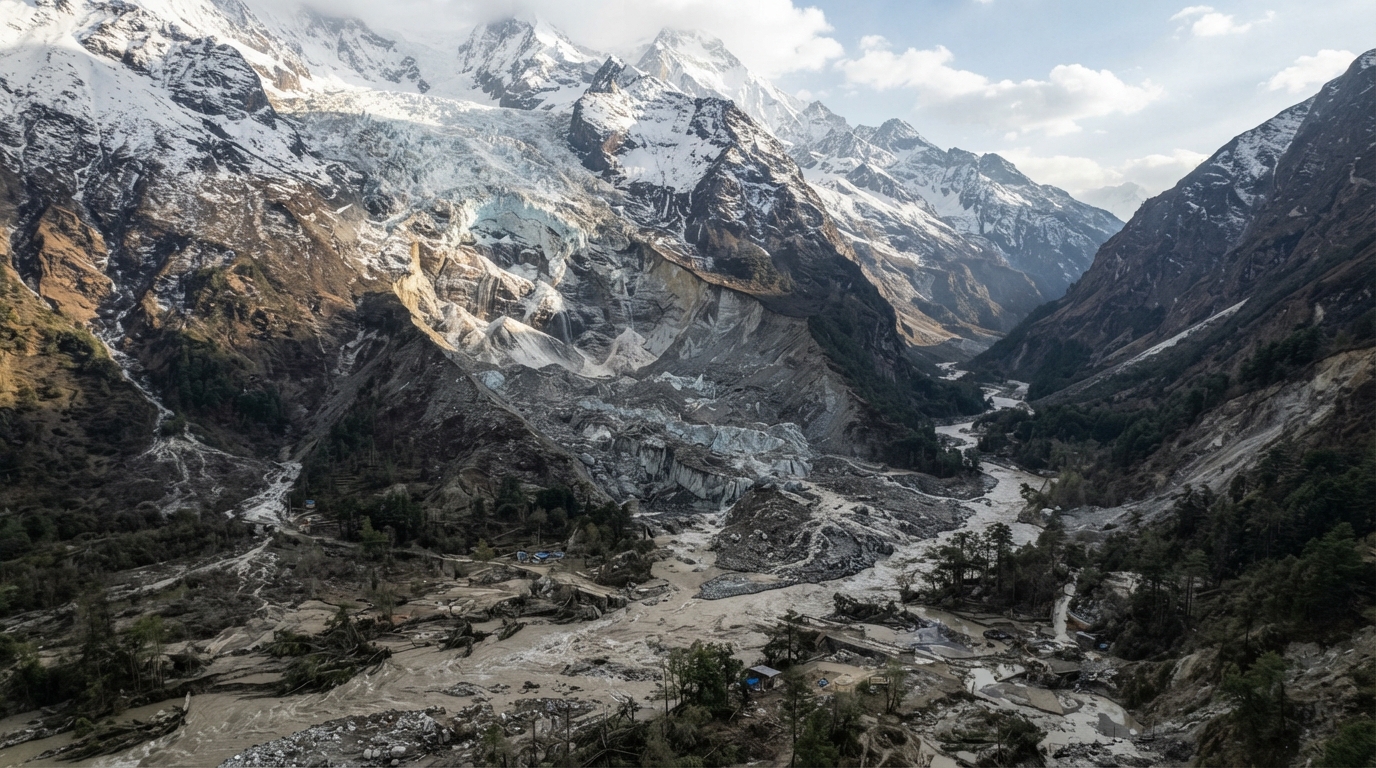
Scientists have indicated that a glacier collapse near the Langtang Lirung peak was the probable cause of the recent devastating floods in the Nepal-Tibet region. This preliminary finding, shared with the BBC, underscores the ongoing issue of rapidly melting ice in the Himalayas.
Initially, reports of an earthquake led to speculation that a tremor had triggered a landslide, which then caused the flood that has claimed at least 177 lives. However, the US Geological Survey later clarified that the disaster resulted from a "glacial collapse," a phenomenon where a glacier or a portion of it disintegrates.
The force of the collapsed glacier striking the valley floor was so immense that it registered a magnitude of 5.2, according to USGS data and scientific analysis of the event. Dr. Simon Cook, a glacier expert from the University of Dundee, informed the BBC that his team detected the collapse of the lower section of a glacier in Nepal, near the Langtang Lirung peak, situated approximately 15km (9 miles) west of the flood sites. He estimated the glacier collapsed in a northwesterly direction before moving westward downstream.
A separate, external assessment by the International Centre for Integrated Mountain Development (ICIMOD), an intergovernmental scientific body, suggested the event could have been an "ice-rock avalanche originating from a high-altitude area." This event caused a "large volume of ice and rock debris" to enter the Lende Khola, a tributary of the Bhote Koshi river. This influx, in turn, generated a sudden surge in the river, carrying water, sediment, and large boulders downstream.
ICIMOD's findings revealed that river levels downstream rose by seven to nine meters within a mere 30 minutes, leading to the destruction or damage of several water monitoring stations. Videos of the flood illustrate debris and water being funneled rapidly down the river, which is bordered by steep mountains.
The precise cause of the glacier's collapse on Wednesday remains unknown. Nevertheless, scientists have consistently warned for years about the melting ice and permafrost in the Himalayas, attributing it to rising temperatures and climate change. This phenomenon, in turn, heightens risks such as flooding.
Dr. Cook highlighted similar incidents of floods and landslides caused by glacier collapses in India, Switzerland, and Italy in recent years. In 2021, a significant portion of a Himalayan glacier collapsed in India's Chamoli valley, unleashing a torrent of debris and water that killed 200 people. Scientists later estimated the impact of that collapse to be equivalent to 15 atomic bombs. Even in Nepal, the same region experienced flooding last year due to a glacial lake bursting in Tibet.
Mohd Farooq Azam, an ICIMOD specialist, noted that the increasing frequency of hazards in the cryosphere—the Earth's frozen regions—"is becoming more visible than ever before. The pace of change is so rapid that current efforts are struggling to keep up."
While it is challenging to definitively link any single event to climate change, Dr. Cook stated, "when you look at the pattern of these events, you do think climate change could have an impact." He elaborated, "The logic is that with a warming planet, you will see shrinking glaciers, lots of snow melt. The permafrost [centuries-old frozen soil] that is partially holding some mountainsides together is warming and thawing and degrading." He concluded, "So you are going to get more landslides, debris flows, glacial meltwater, lake outbursts, glacier collapses, because climate warming ultimately destabilises these high mountain environments."